
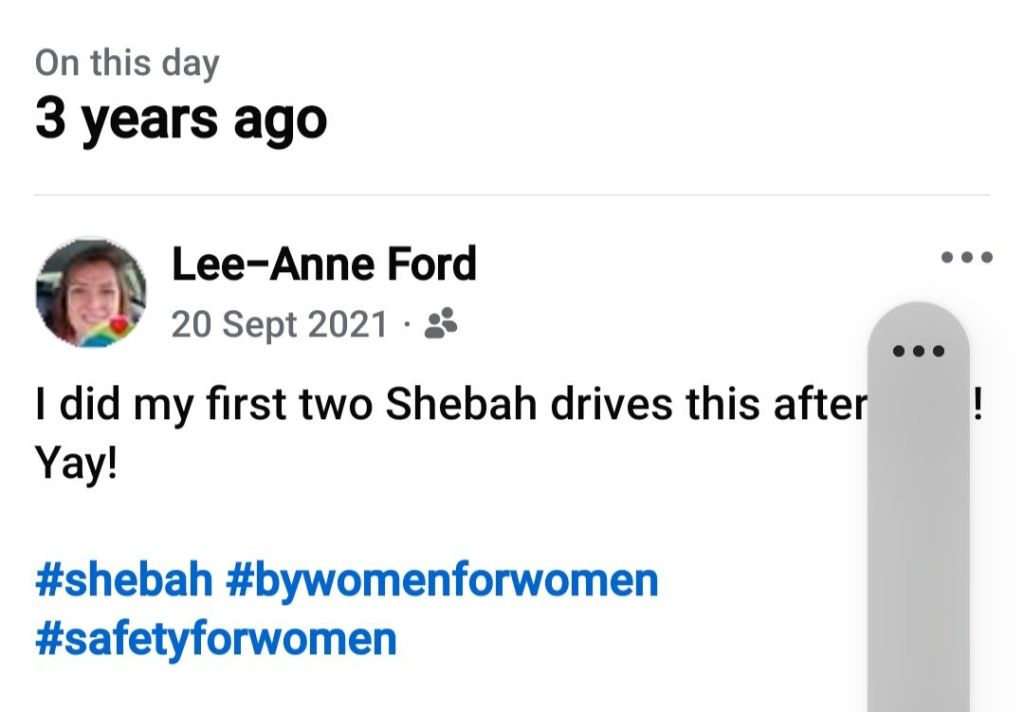
Three years ago today, I decided to make the roads safer for women and children by becoming a Shebah driver. In a world where women still face harassment and violence, my decision to drive for Shebah wasn’t just about earning an income—it was about changing lives, one ride at a time.
Shebah, you say? As in the Queen of Sheba? No. Although, our drivers are queens of the road, their microbusiness, and their future.
Shebah.
The Australian rideshare service, by women, for women.
The Australian rideshare service where you are guaranteed to get a lady driver.
The Australian rideshare service that cares for your children as you do, with rear facing, front facing and booster seats available.
The Australian rideshare service that cares for your children as you do, when they ride with us as unaccompanied minors.
The Australian rideshare service that will happily have your pets as passengers.
The Australian rideshare service that will happily accept male passengers if they are travelling with a child who needs a car seat.
Why Shebah?
I first heard of Shebah in an email newsletter from Women’s Agenda.
After an unpleasant experience with a taxi driver in 2018, I signed up as a passenger the next day.
In 2021, after considering driving for Shebah for a while, I signed up, did the training, and did my first bookings on 20 September 2021.
My personal mission statement is that every passenger’s trip with me is one of safety without fear of harm or harassment, changing the world, one trip and one conversation at a time.
Why Shebah is so good for me
As a Shebah driver, I am in control of my day, my workload, which bookings I accept and which bookings I decline.
I can rely on scripts – the text message to confirm an advance booking, the opening conversation with passengers whom I haven’t met before, the ongoing conversations with passengers I have met before.
Advance bookings and pre-bookings by text or phone call soothe my autistic soul because I know where and when I need to be. I can set up an itinerary with Google Maps for every booking for the day. Planning, knowing my routine and schedule for the day. My autistic heaven.
But more importantly, driving for Shebah gives me more fulfilment than any role I’ve ever held. Driving for Shebah fills my cup.
I treasure my regular passengers and families. I miss them when they don’t need the service anymore. The boys who “age out” when they turn 18. The girls who finish high school. The children who get withdrawn from school to be home schooled. The elderly clients who pass away.
My clients
The vast majority of Shebah passengers are children, for school runs; and boarding school children – they don’t have their parents here for trips to doctor, dentist, orthodontist, podiatrist, physiotherapist, hairdresser, sports and recreational activities.
Some passengers I see every day, some a few times a week, some once or twice a year, for trips and from to the airport wth children who need car seats.
One passenger has been a regular since I started driving for Shebah. We will have our third anniversary together next week.
I have watched the regular teenage passengers grow. And how some of those teenagers have taught me. For instance, did you know that there are three swords in fencing?
Do I have favourites? Yes, but I won’t say who.
Do I have passengers for whom I will never accept another booking? Yes, two.
Stories shared
Being a Shebah driver means you sometimes become part of your passengers’ lives, for a moment, a day, or months.
For instance:
- The lady with Ehlers Danlos syndrome, through her second pregnancy – driving her to work and hospital appointments, sharing hopes, fears, and providing soothing music and distractions when needed. Her courage – indomitable.
- The lady with a baby who fled an abusive partner.
- The legally blind lady and her young bub, isolated at home, being her driver for outings.
- The lady going through radiation for breast cancer – daily visits for four weeks, and the frightful day when she was so weakened by pericarditis that I had to walk her in to the clinic.
- Two times a wedding car, transporting bride, groom and children to the wedding.
- The lady who needed a new support dog, and the trip to first choose a puppy, then another trip to bring the puppy home.
- Two other ladies going through the initial stages of cancer – the reliable friendly face and the peace of mind knowing that you don’t have to worry about how you’re getting home.
- All the neurodivergent ladies and children – sisters and brothers of the brain.
- The autistic teenager, voluntary non-verbal, whose smile would light up the car and make my Friday complete.
These are just a few of the clients who invite me into their lives for a moment, a day, or months.
I plan on driving for Shebah for many more years; 6000 trips done, many more to go. Here’s to the next 12 months.
Women’s safety – why we need Shebah
In a perfect world, services like Shebah wouldn’t be necessary. Yet, here we are, in the 21st century, still needing a safe space for women on the road. Sadly, stories of harassment and violence in traditional rideshare services remind us that Shebah is more than just a business—it’s a sanctuary.
There are stories of female passengers in taxis and other rideshare services being assaulted.
There are stories of drivers of other rideshare services being assaulted.
As a lady driver, I truly appreciate the safety of a women’s network of passengers.
Our passengers appreciate the safety of a lady driver for themselves, and their children.
When you ride with Shebah, you have your driver’s phone number, to contact them directly.
And you can still share your journey with others, so they know where you are.
The experience of female passengers
My unpleasant experience in a taxi? I was at the airport, having flown back hime after a work trip. It was early evening. After a week away, I just wanted to get home.
At the taxi rank, where it is first in, first served. I was allocated a bay with a Maxi Taxi. The first red flag should have been the driver preventing entry to the back of the van by locking the van door, forcing me to sit in the passenger seat.
During that 20 minute journey from the airport, the taxi driver pestered me non-stop to agree to have a drink with him. The fact that I was married didn’t stop him. And he ended up so incensed by my continual refusals that he ran a red light on a major road, to scare me into acquiescing.
He refused all my requests to pull over and let me out.
I made it home, in one piece, but scared and rattled. The next day, I created my Shebah account.
This pales, though, compared to the stories I have heard from passengers.
Male rideshare and taxi drivers behaving badly
Male drivers pestering 15 year old girls to go out with them.
Male drivers who get handsy when passengers with disabilities need help getting their seatbelt done up… and then threatening the passenger not to tell anyone because “I know where you live”.
Male drivers locking the doors and refusing to let a female passenger out until they have agreed to the driver’s request.
Male drivers who get charged for sexual assault.
https://www.9news.com.au/videos/uber-driver-charged-with-sexual-assault/cjldfz16t00370is5u9j3ebww

 The Auld Skald's Fudgel