I can’t read some fantasy books. Why? Because they are single books, or only a trilogy. I need complexity and sweeping narratives, over, say, 12 books. Like Katherine Kerr’s Deverry novels.
As a pagan, her books get me right in the heart. As an autistic person, the complexity of the SOULS of people, interacting across reincarnations, multiple lives… that complexity is just magnificent. I have discovered that appreciation for rich, detailed, complex immersive narratives is an autistic thing.
I dived deep into her books, jumping backwards and forwards in time, the origin story of the books; the story of Jill, Rhodri and Nevyn, souls entwined in soul contracts that must be resolved, and the extra soul contracts, the “Wyrd” of each soul that each reincarnation comes into contact with.
It’s just superb. It appeals to what I now know to be aspects and traits of my autism – the sense of justice, hyperempathy, a love of words with hyperlexia, and intense focus.
Discovering my autism at the age 51, and discovering that being autistic is why I like some things… I love my autistic brain that gave me so much when I didn’t even know its true identity; my true identity.
It’s from Katherine Kerr’s books that I learned, in the pan-Celtic language she created for the series, of “hiraedd”, of Rhodri’s desperate longing for his home, the dun of his family, and that hiraedd, embedded in his soul across lifetimes. “Hiraedd” in fictional Deverry, “hiraeth” in Welsh; the word that has no translation in English, according to the BBC. According to this BBC article, hiraeth is:
A blend of homesickness, nostalgia and longing, “hiraeth” is a pull on the heart that conveys a distinct feeling of missing something irretrievably lost.
All through my spiritual life, in good and bad, through my late husband’s decline with Huntington’s Disease, there has been this hiraeth, a homesickness. Hiraeth, a word then a definition that made so much sense to me. Hiraeth, missing that place where I felt like I belonged.
Yet I always felt guilty of language appropriation because I’m not Welsh. Little did I know.
Hiraeth, autism and a search
I’ve written elsewhere about being autistic and where it came from, genetically. And I’ve written elsewhere about being adopted.
So, not belonging anywhere, really. Hiraeth, missing that place where I felt like I belonged.
My autistic literal thinking interpreted being adopted and not belonging anywhere as onlyness. Yes, I have adoptive aunts and uncles and cousins, and I have biological aunts and uncles and cousins, but I don’t belong in either camp. There’s that acceptance that, yes, there are those people who have those labels, but I don’t associate those labels with me. That’s the best way I can explain it. Onlyness. My autistic brain’s desire for order led me to investigate, to find a place where I belonged.
Genetic heritage and DNA
Building my family tree in Ancestry.com was always more about where I came from, not the people along the way. So when I did the Ancestry DNA, I was super-chuffed with the results.
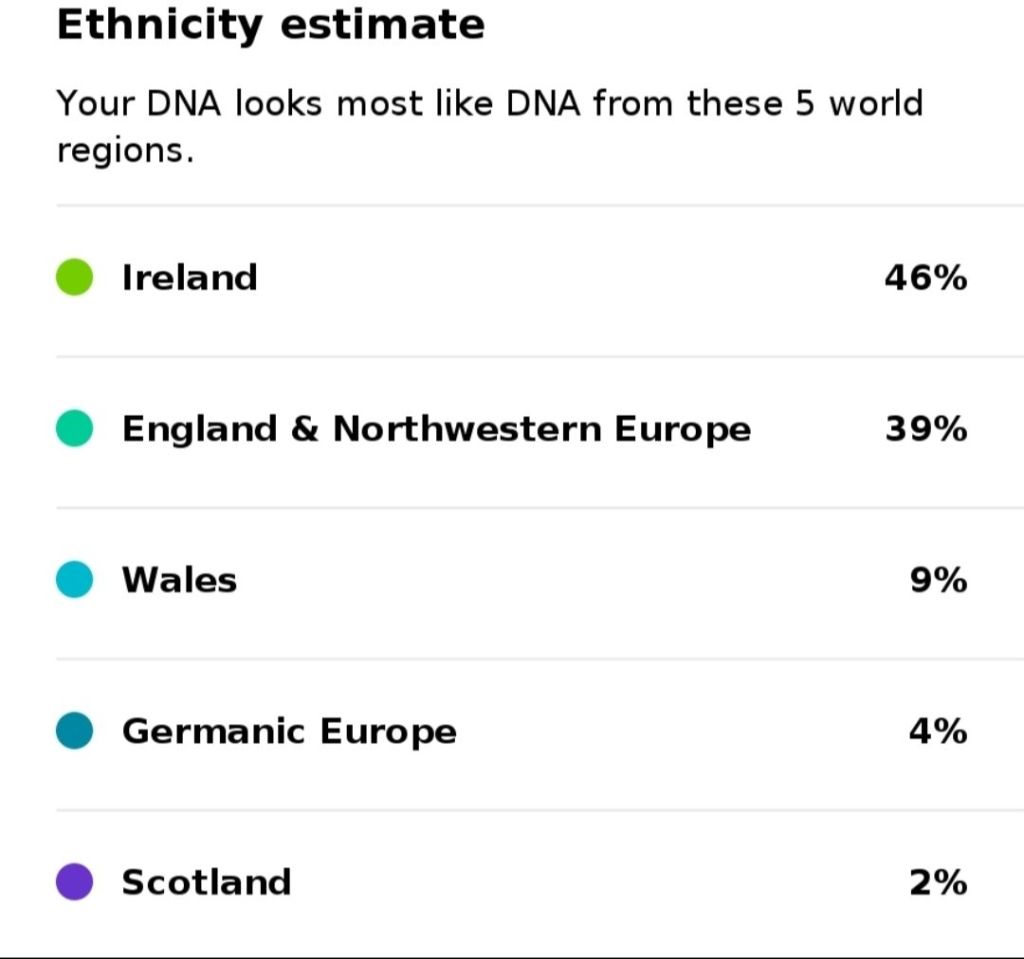
My DNA is similar to DNA that’s Irish, English, French, (by way of Brittany and the Channel Isles), Welsh, and a little Scottish! (The German 4% in my DNA is, as that family will tell you, Prussian, not German – I have mixed emotions about that… but no mixed emotions about Black Forest Gateau.)
But to know that my DNA is firmly rooted in that part of the world… my Welsh DNA says that I am not culturally or linguistically appropriating the word “hiraeth”, nor in the tenets of my eclectic spirituality and faith. Yeehah!
All of that is a really roundabout way of saying that Katherine Kerr’s Deverry books are great, and gave me insights that I then explored, and found ideas and concepts that resonated with me, and, despite feeling like I didn’t belong anywhere, my autism and my DNA tells me where I come from.
And the hiraeth that has haunted me, has abated.
Isn’t self awareness a grand thing?
 The Auld Skald's Fudgel