Osteopaths, hypermobility and autism

Oh, the autistic trepidation about “new”; in this case, the trepidation of finding a new health care provider. Understanding my autism means I understand  better why seeing a new practitioner seeds nervousness.

Osteopath,  physiotherapist or chiropractor?

All my life,  I’ve chosen alternative health care providers; naturopaths, herbalists, massage therapists, and  Reiki. I’ve studied Western herbal medicine,  massage,  aromatherapy,  and had a (somewhat disastrous) Reiki attunement to Level 2 – that’s a story for another day.

Once I was making decisions for myself,  leaving childhood behind,  chiropractors quite literally had my back. One, whom I saw for several years,  even even commented on my “loose-limbed” walk; possibly the first identification of hypermobility, all the way back in the early 1990s.

It was in the mid 2000s when I moved away from chiropractors,  going to osteopaths instead. 

What’s the difference? And why not physiotherapists?

Physiotherapists generally treat and rehabilitate injuries.

Chiropractors generally focus on the spine,  the protector of the central nervous system.

Osteopaths generally focus on whole of body, prevention and rehabilitation.

These days,  knowing about my autism and the associated hypermobility means that I need a whole of body focus. Hence,  finding a new osteopath.

But why did I need to find a new osteopath? That’s also a story for another day.

Empathy in practitioners

The first new osteopath seemed okay, but he didn’t look any further into what hypermobility meant in terms of injury treatment.  He also said,  “Freak”. He didn’t say it in an unkind way or context.  He was asking how my hypermobility manifested.  I mentioned my knees,  my feet,  and my hands as my known hypermobility, and showed him my hand spread,  the hypermobility that let me span an octave in a piano when I was nine years old.  His smiling response – “Freak”. Choice of words in a health care setting should be carefully considered.

I continued with the appointment,  and we resolved the immediate issue in my lower back, but he wasn’t a keeper.

I got to thinking. While I couldn’t find my old osteopath,  his clinic was still there,  they still had my patient records, and he had hired/ placed the other osteopaths there. So,  I made an appointment at the old osteopath’s clinic.

This new-to-me osteopath, Alison, is a keeper.  So, back to the clinic at New Farm, with an osteopath who has experience with autistic and hypermobile patients.

Why did I need to see an osteopath?

Firstly,  discovering my autism has been a blessing; discovering the associated hypermobility has been a curse.

It is thought that 60-70% of autistic people also have hypermobility, and like autism, hypermobility is different in every person. For me, my knees bend backwards,  my fingers bend backwards and the top joints of my fingers can lock. My hands, that take an “S” sized glove,  can span 20cms from thumb to little finger.  That’s my known hypermobility.

Intersect that with a deep dive into autistic hypermobility, and being aware that I’m 52, and wanting to improve mobility, flexibility, agility, and strength as I age. I started a program of daily workout routines, and knowing that I had an exaggerated curve in my lower back, that was one area of was focussing on. I was also focussing on reducing the chronic tension in my body. 

I was ecstatic when I went from being able to fit my fist between my lower back and the wall, to only being able to fit my flat palm with a slight tilt between my back and the wall. My everyday motion was freeing up, and walking felt good. I was progressing reps and weights in my daily workouts, and six weeks, I was really feeling good.

One night,  I went to sleep, in my typical autistic side sleeper posture. I woke up, sprawled in what I now know is a hypermobile sprawl, and a very cranky lower back. Old friends L4 and L5 were very unhappy. My entire lower back from ribs to tailbone had locked up and I was in pain.

I did some stretching and movements, and that got the pain manageable. Heat, magnesium cream, and specific rest postures helped. But I needed more help than that.

Hence, the search for a new osteopath.

The inception of a new autistic special interest

Hence, the search for information about why, and the subsequent deep dive into hypermobility.

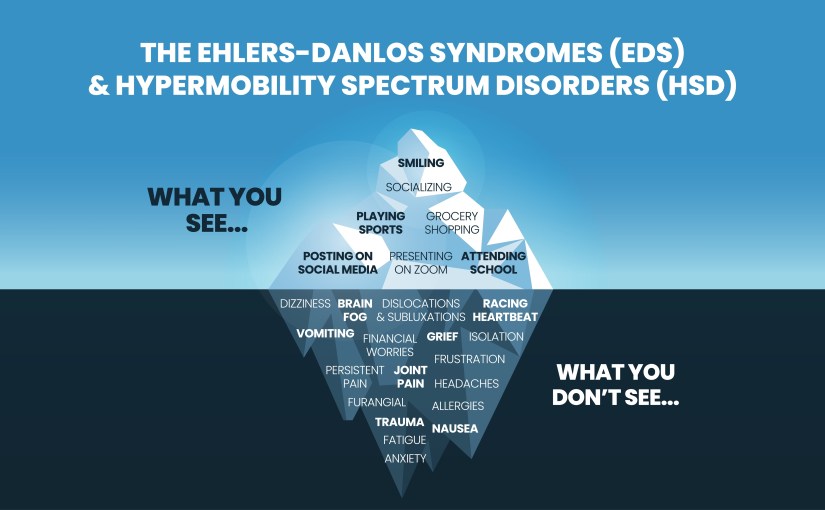
Hypermobility is a disorder of connective tissues. Some would consider connective tissues to be ligaments and tendons; they are that, and so much more.

Connective tissue is cartilage, bones,  fibres such as collagen and elastin, adipose tissue (yes, fat), blood and fibroblasts, the cells that activate for tissue healing and wound repair.

So hypermobility is not just a disorder of ligaments and tendons. It has the potential to affect the whole body.

I know a lady with Ehlers-Danlos Syndrome (hEDS). For her, it caused devastation, with nine miscarriages for two live births.

People with hEDS generally  have the super flexy, bendy bodies. An ignorant massage therapist can inadvertantly dislocate a shoulder during a massage. For my friend,  it meant the disorder of the connective tissues presented in her uterus, with devastating consequences.

So it makes me wonder, just how much the undisguised hypermobility has impacted my life. It makes me wonder what the links are between hypermobility and hormones, postural orthostatic tachycardia syndrome (POTS), adrenal fatigue, and mast cell activation syndrome (MCAS)? Is there a link to estrogen dominance and fibroids? And is there really a difference between Hypermobility Spectrum Disorder  and Ehlers Danos Syndrome?

There is so much more to be discovered. Stay tuned.
Fitness bands and feminist outrage

I started this blog from a simple Facebook post, expressing my frustration.

“Knowing I’m autistic and hypermobile, I started a program of daily exercises designed for an autistic, hypermobile body. I recently bought some resistance bands to add, to strengthen muscles around my hypermobile joints to help stabilise the joints. I bought a product marketed at women. Smaller diameter and thickness on the bands, girly pinks and purples as opposed to the men’s bigger, thicker and generally black bands. That’s ok. I’m starting out. I’m happy with a lighter, graduated set. So imagine my feminist outrage when I open the box of this product, marketed at females, to find a male model in the photos on the instruction sheet. WTF?”

Femvertising

Femvertising is the use of feminism in advertising. Slogans like “You go, girl” and “Girl, you’ve got this” are rampant, yet the companies behind these campaigns often fail to live up to their marketing. Recent lawsuits and scandals involving companies such as Dove, KPMG, and the Australian High Court illustrate this hypocrisy.

Interestingly, the company behind my resistance bands isn’t guilty of femvertising. There’s nothing on their website claiming feminist values or corporate social governance (CSG) statements to suggest they uphold such values. They do sponsor women’s sports teams like the Matildas (soccer) and the Opals (basketball), but there’s no explicit feminist branding. CSG is generally required for companies listed on the Australian Stock Exchange, as part of their Annual Reports.

For a deeper dive into the concept of femvertising and its impact on consumer perceptions, you can refer to Negm’s (2023) study on femvertising social marketing and Sterbenk et al.’s (2022) exploration of corporate commitment to gender equality and Katie Martell’s post on Chief Marketer (2019).

The Issue, Unboxed

Despite this, a novice like me might assume that a product with a woman on the box is specifically for women. This was my perception.

Discovering my autistic identity and acknowledging my hypermobility has been a game-changer. At 52, I realized it’s never too late to start focusing on mobility, agility, strength, and fitness. My autistic need for routines led me to design a daily exercise routine tailored to my body, focusing on strengthening muscles around my hypermobile joints to enhance stability and reduce injury risk. Recently, I decided to up my game by incorporating resistance bands into my workouts. Little did I know, this simple addition would spark a wave of feminist outrage.

These resistance bands, in lighter, graduated weights, and adorned in rainbows, seemed like the perfect fit for someone like me who is just starting out. The smaller diameter and thickness of the bands were exactly what I needed to ease into this new aspect of my fitness journey. As an autistic, hypermobile woman, the gentler progression promised by these bands was what I wanted.

Imagine my surprise and disappointment when I opened the box to find a male model featured in the photos on the instruction sheet. Here I was, having purchased a product clearly targeted at women, yet the first visual guidance I received was of a man demonstrating the exercises.

It felt like a slap in the face. In a market where women’s specific needs are frequently overlooked or downplayed, the decision to use a male model in a product designed for women seemed not just careless but insulting.

This incident might seem minor to some, but it underscores a broader issue. Why, in 2024, are women still being subjected to such thoughtless marketing strategies? The fitness industry is rife with gender-specific products, yet it continues to perpetuate outdated and exclusionary practices.

Women, especially those like me who are navigating unique physical challenges, deserve products that not only cater to their needs but also respect and acknowledge their identity. Seeing a male model in the instructional material for a women-targeted product reinforces the notion that women are an afterthought in the fitness industry.

Curwen and Park’s (2014) research on female consumers’ negative emotions can provide further insights into how such marketing missteps affect women’s experiences and perceptions .

We Deserve Better

My feminist outrage isn’t just about a model on an instruction sheet; it’s about the pervasive issue of women’s representation and respect in all areas of life, including fitness. It’s about demanding better, not just for myself but for all women.

This experience serves as a reminder that as consumers, we have the power to demand change and to support brands that genuinely understand and cater to our needs.

The journey of understanding and embracing my autistic, hypermobile body has been empowering and enlightening. Integrating resistance bands into my routine was a step towards greater strength and stability. Yet, this small act of purchasing a fitness product unveiled a glaring issue in the way women’s products are marketed.

As I continue my fitness journey, I am reminded of the importance of not only physical strength but also the strength to stand up against gender biases and demand better representation. Here’s to all the women who refuse to be sidelined and continue to push for a world that sees and respects us.

References and Bibliography

Cunningham, J., & Roberts, P. (2006). Inside her pretty little head a new theory of female motivation and what it means for marketing / Jane Cunningham and Philippa Roberts. Cyan.

G. Curwen, L., & Park, J. (2014). When the shoe doesn’t fit: female consumers’ negative emotions. Journal of Fashion Marketing and Management, 18(3), 338–356. https://doi.org/10.1108/JFMM-12-2012-0078

Martell, K. (2019) The new rules of using feminism in marketing, Chief Marketer. Available at: https://www.chiefmarketer.com/new-rules-using-feminism-marketing/ (Accessed: 25 July 2024).

Negm, E. M. (2023). Femvertising social marketing: a focus on perceived authenticity and perceived congruence of the advertising and consumers’ attitudes toward female portrayal. Journal of Humanities and Applied Social Science5(5), 435–449. https://doi.org/10.1108/JHASS-05-2023-0053

Sterbenk, Y., Champlin, S., Windels, K., & Shelton, S. (2022). Is Femvertising the New Greenwashing? Examining Corporate Commitment to Gender Equality. Journal of Business Ethics, 177(3), 491–505. https://doi.org/10.1007/s10551-021-04755-x

Bibliophile to the rescue!

Eric Van Lustbader, aikido, and self.

In a previous post, I wrote about the clean start, the reset, for my workroom and bedroom.  Now the challenge is to keep that momentum going.

In my 20s, all the way back in the 1990s, I discovered Eric van Lustbader’s Nicholas Linnear novels. I was hooked. The beguiling mix of Eastern mysticism, Western pragmatism, martial arts, the corporate shenanigans, the violence; I was besotted.

Addictive personality or autistic special interest – the heartbreak of self-deprivation
One of the things that breaks my heart, that makes me grieve for my younger self, is how I denied myself things. Things, like van Lustbader’s books, because they were enthralling. I used them as a launching board to find out about so many things, including aikido. But even though they were books that I wanted to read again and again, I denied myself, because I was afraid I had an addictive personality. In reality, all I had was undiagnosed autism, and a new-found special interest.

You see, while addictive personality is not a disorder under the DSM-5-TR, it is generally used to describe a compulsive need to engage in certain behaviours or with certain substances. On the surface, that can look a lot like an autistic special interest, and an autistic special interest can look a lot like an addiction to a thing, or a compulsion.

So, imagine my confusion and dilemma, when I didn’t know I was autistic, and found things that were special interests. Imagine the autistic need, the desire, to go down that rabbit hole, and misdiagnosing yourself, from your teenage years as potentially having an addictive personality. Imagine containing yourself, depriving yourself of that joy, because you thought you may have had a mental health disorder.

One of my autistic traits is hyperlexia, a deep fascination with words and language, that often presents as early acquisition of reading and written words. I’m also a bibliophile to go with that. Books have always been my best friends. Rediscovering an old friend, hidden on a bookshelf, is a rare delight. But the books I have denied myself, because I thought I had an addictive personality… such as Dungeons and Dragons and the spinoff Dragon Lance, and Margeret Weis’s “Star of the Guardian” series. These are just the ones that have come up in conversation recently. There would be tens, hundreds of books that I read once, found utterly delightful and enthralling, that I put aside because I thought I had an addictive personality.

Part of me rages, now, and grieves, for those books that could have been lifelong special interests, maybe a missed genesis for writing fan fiction, maybe a missed opportunity to research the issues present in the books, acquiring more knowledge… so much missed that could have been so rich and satisfying.

Fast forward to today, restarts and maintenance
In thinking, though, about my issues with executive allofunction (my positive language, instead of using “dys”), and the fresh clean start of my revived workroom and bedroom, I remembered some of the principles of aikido. Dusty memories of those books by Eric van Lustbader and his character Nicholas Linnear, and the things I learned from the books about martial arts, and then went on to research.

One of those things from those books was aikido – avoid and deflect. In a lightbulb moment, I realised that that is how I could manage my executive allofunction; by avoiding and deflecting. Now, it may sound crazy to talk about managing my mind as if it’s a third party. I know it isn’t; it’s just me. It is, though, almost doing an end run around myself, or rather, knowing where the blocks are, and doing an end run around them. Avoid, and deflect.

How?
How does this work for me? Follow my mental path. This is going to be like a braid, several strands woven together and coming together at the end.

Thread 1. My good-as-brand-new workroom, I need to keep it that way. So if I also use it as my workout area, as well as my study and writing area, my collectables in display cabinets, and my sewing equipment temporarily put aside… then if I move those desks from being back to back, to being against the wall, then I have room for my exercise bike and Nordic walker. And the newly cleared drawers in the display cabinets can hold my yoga gear. Then there’s a space there for a yoga mat, and a space there for dumbbells… well, if I’m going to use that part of the room as a workout area, then I need to keep the chaise clear for a post workout transition. And given that one of my workout routines includes prone shoulder abductions, I want a clean carpet.

So cleaning isn’t a function in and of itself. It is an adjunct to my workout routines.

Thread 2. Why are workout routines so important? They’re important because I discovered I am autistic, and autism isn’t just the mind, it is the body as well. Now, I’m 52, and don’t have the “chunky” movements that some autistic people have, likely because of the “inadvertent supports” I received as a child, in ballet, speech and drama, piano and singing, and cycling, and walking and showing dogs.

However, some 60% or more of autistic people are also hypermobile. (Waving hello.) Yes, that’s me. I have hypermobile knees and hands. I’m researching the concept of “masked” hypermobility at the moment, as it may be possible that the chronic muscle tension I have is not necessarily all from the stresses of my life, but is masked hypermobility. Have my muscles tensed to stabilise hypermobile joints? That theory makes sense when I recall the time I dislocated T3 (the third vertebrae in the thoracic section of the spine) inwards. My osteopath was really scratching his head over how I did it, and how to get it back into its proper place so I could breathe properly again. My workout routines are to stabilise joints through the muscles around them. Hence, workout routines.

Thread 3. My financial situation already tells me that I’ll be renting for the rest of my life. (Because I spent nearly $300,0-00 on my late husband’s care, over and above his pension and the NDIS – Huntington’s Disease is expensive.) So, I have a plan that my retirement life will be peripatetic, calling to my ancient Romany DNA; van life, roaming around Australia. That will need strength, fitness, mobility and agility. I figure I’ve got 18 years to get ready for that. Hence, workout routines.

Thread 4. Sewing. Another special interest. But I don’t have any of my homemade garments in my wardrobe right now, because they don’t fit me at the moment. Weight loss isn’t the goal. Getting back into those dresses and skirts and blouses – that’s the goal. Hence, workout routines.

Bring all those threads together into my daily workout routines that I need to keep my workroom clean and tidy for. Avoid and deflect. I’m not cleaning. I’m making my workouts possible. Avoid the PDA, the RSD, the overwhelmed autistic freeze, the need for a body double. Avoid and deflect.

My daily workout routines – now on my fourth week.
Monday – knees and shoulders – toe raises, walking backwards, dynamic lunges, toe raises to heel lifts, static lunges, shoulder stretches, and twists

Tuesday – shoulders and arms – bent arm lateral raises, bicep curls, reverse bicep curls, hammer bicep curls, triceps curls, external and internal shoulder rotations, prone horizonal abductions, and prone lower arm raises. These have progressed from 500g weights to 2.5kg dumbbells, with sets increasing from 5 to 2 x 10.

Wednesday – hips – hip abductions, prone side leg lefts, cat/cow, hip adductions, high-kneed marching on the spot, and butterfly pose.

Thursday – core, all yoga poses – cat/cow, upward/downward dog, dead bugs, boat pose, half table pose, twisting boat, side bends, child pose.

Friday – yin yoga hip openers – sleep swan, butterfly, cat/cow, half butterfly, and a repeating flow from cat/cow to child to frog, back to child, then cat/cow

Saturday – whole of body strength – push-ups, split level lunges, squats, overhead presses, walking lunges, bent over dumbbell rows.

Sunday – gentle whole of body stretches. – marching in place, side steps, toe tape, and seated hamstring and quad stretches, seated calf and shin stretches, seated upper back and chest stretches, seated ankle rotations, wide legged forward bend, standing to raise to heel raise flow, shoulder rolls, and the weighted hula for some fun.


This is why I have been saying lately that my autism diagnosis has given me a new lease on life.