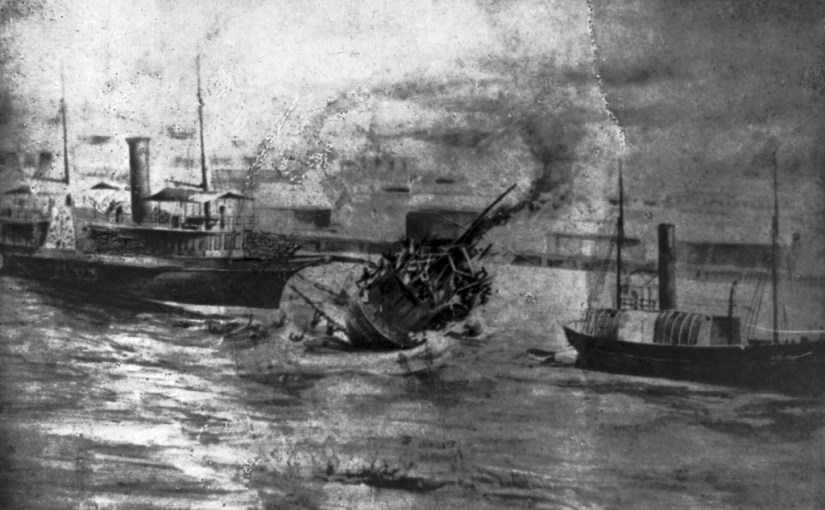
Once again, this is authored by ChatGPT in response to my prompts and instructions. When I asked it to write about the ferry tragedy in with the Lucinda was involved, it got it quite wrong. But even with prompts, it wasn’t 100% correct. The ferry tragedy was in 1896, not 1893 and there are a few other errors and aggrandisements; ongoing flaw of AI chat bots, giving what it thinks you want, not what is actually correct.
For the correct story of the ferry tragedy – https://blogs.archives.qld.gov.au/2023/02/07/australias-worst-river-disaster-the-pearl-ferry-incident/
The Context of Federation: Tensions and Negotiations
Before the dissolution of Queensland’s Legislative Council in the 1920s, the state had already been through the monumental process of Federation in 1901. As Australia moved toward becoming a unified nation, Queensland’s political leaders played a significant, though sometimes reluctant, role in shaping the new Commonwealth.
The road to Federation was fraught with debate over the distribution of power between the state governments and the new federal government. Queensland, along with other states, was deeply concerned about preserving state rights and autonomy. While the movement for Federation had been gaining momentum across Australia, Queensland’s politicians were particularly cautious, fearing that joining the Commonwealth might diminish their state’s political power.
At the heart of these discussions were not just legislative concerns but also strategic negotiations among political leaders. One such venue for these discussions was Queensland’s government yacht, the Lucinda, which became a symbol of the behind-the-scenes meetings and informal talks between Queensland’s Premier, Sir Hugh Nelson, and other key figures during the crucial months leading up to Federation.
The Lucinda Meetings: An Unlikely Venue for Federation Negotiations
The Lucinda was used by Queensland’s government to facilitate conversations about the state’s participation in Federation. In the late 1890s and early 1900s, these informal meetings were held on the yacht, sailing off the coast of Queensland, to avoid the more formal, contentious settings of parliament. The location of these discussions may have seemed unconventional, but they provided a space where political leaders could meet privately to discuss the delicate issues of state sovereignty, the proposed Constitution, and the balance of power in a new federal system.
The Lucinda meetings were pivotal for fostering a more cooperative relationship between Queensland and the other colonies, despite initial reservations. Premier Sir Hugh Nelson, a key figure in these meetings, worked to secure Queensland’s place in the Commonwealth while ensuring that the state maintained its legislative authority and autonomy. The Lucinda became a venue where strategic alliances were formed and compromises were made, though the overarching tension over the loss of power to a centralised government remained.
The historical irony is that, while Queensland’s leaders engaged in complex negotiations for Federation aboard the Lucinda, the state’s upper house, the Legislative Council, was by no means immune to similar political tension in the years that followed. The same concerns about balancing power and safeguarding state rights that had shaped the Federation process would later play a role in the fight over the Legislative Council’s future. The Labour government’s decision to dissolve the upper house in 1922, just over two decades after Federation, can be viewed as a direct consequence of those very debates about power, democracy, and the role of unelected bodies in the governance of Queensland.
Post-Federation Struggles: A Continuing Tension
In the aftermath of Federation, Queensland faced the challenge of reconciling its participation in a national government with its state-based interests. The fear of being subsumed by a centralised Commonwealth government remained strong in many quarters, and this tension between state and federal power would continue to influence Queensland’s politics throughout the 20th century.
Just as Federation had been a defining moment of political compromise, the dissolution of the Legislative Council represented another moment of political reckoning, but this time at the state level. Queensland’s decision to abolish its upper house was partly a reflection of the changing political landscape after Federation, where the dynamics between central and state governments were continuously evolving. Many saw the Legislative Council’s opposition to Labour’s progressive legislation as a direct challenge to the democratic will of the people, an affront that harkened back to earlier fears about non-elected bodies overreaching their authority.
Thus, the tension over Queensland’s Legislative Council was not just a local issue; it was part of a broader narrative of governance, power, and democracy in the post-Federation era. The Lucinda meetings, with their behind-the-scenes discussions of state rights and national unity, were a microcosm of the larger political struggles that would unfold both in Queensland and across Australia in the decades to follow.
The Lucinda and Brisbane’s Only Ferry Disaster: The 1893 Flood Tragedy
While the Lucinda is most famously remembered for its involvement in the informal Federation negotiations, it is also linked to a tragic event in Brisbane’s maritime history—the 1893 ferry disaster, which remains Brisbane’s only recorded ferry disaster.
The 1893 Flood Disaster: The Role of the Lucinda
On January 26, 1893, Brisbane experienced one of its most devastating floods. The heavy rainfall had caused the Brisbane River to rise rapidly, and the city was inundated by the floodwaters. Amidst the chaos, a significant tragedy occurred involving a cross-river ferry, The Pearl, which was caught in the surging floodwaters.
At the time, the Lucinda was anchored in the Brisbane River, as was customary for many vessels during the flood. However, the rising floodwaters caused debris, including logs and other detritus, to be swept along by the torrent. One such piece of debris struck The Pearl, pushing it toward the Lucinda. The force of the floodwaters was so powerful that it pushed the ferry up the Lucinda’s anchor chain, dragging it until it fell back into the river and capsized.
The Aftermath: The Loss of Life
In the wake of the disaster, it was revealed that The Pearl had been overloaded with passengers who were trying to escape the floodwaters. Tragically, the disaster resulted in the deaths of several individuals, although the exact number remains unclear. As the ferry was capsized and submerged, the lives of the passengers on board were lost, adding a deep layer of sorrow to the already overwhelming flood.
This incident shocked the people of Brisbane, not just because of the loss of life but also because it highlighted the unpredictability and ferocity of the floodwaters. The Lucinda’s involvement was more passive—serving as the anchor point from which the debris had pushed the ferry. Nonetheless, the tragedy underscored the vulnerability of river transport during such extreme weather events.
A Turning Point for River Transport Safety
Following the disaster, the Lucinda ferry tragedy became a pivotal moment for Brisbane’s river transport system. It drew attention to the dangers posed by the unpredictable floodwaters, particularly for ferries that were integral to the city’s transport network. Public authorities were forced to reconsider the safety standards and operational procedures for river transport to better prepare for similar disasters in the future.
The event also underscored the pressing need for more robust infrastructure and regulatory oversight to protect the public during extreme weather events, which Brisbane was not unfamiliar with. The Lucinda disaster became a symbol of the untamed power of the Brisbane River and the vulnerability of human settlements situated near it.
The Dual Legacy of the Lucinda
The Lucinda’s legacy in Queensland is marked by both its role in political history and the 1893 ferry disaster. While the yacht’s role in Federation talks helped shape the course of Queensland’s political future, the tragic events of the flood that same year offer a sobering reminder of nature’s power and the vulnerabilities of the city’s transport systems.
The disaster also reflects the broader historical context of the time, as Queensland grappled with the challenges posed by rapid development and the necessity for modern infrastructure to keep pace with the city’s growth.
 The Auld Skald's Fudgel