The Forde Inquiry and the forgotten, adoption and genetic inheritance

(or, how I got to be me)

This is the story of my biological parents and my genetic inheritance. First, though, some background on “the forgotten” – those who were thrown into orphanages and detention centres and… forgotten – including my biological parents.

In June 1999, the report of the Commission of Inquiry into Abuse of Children in Queensland Institutions was tabled in the Queensland Parliament.

It covered the period from 1911 to 1999, examining records from more than 150 orphanages and detention centres, and evidence given by more than 300 people. The Commission of Inquiry found significant evidence of abuse and neglect of children in the past. (https://fordefoundation.org.au/resources/the-forde-inquiry/)

What was not investigated, because it was not in the terms of reference of the Forde Inquiry, was the forgotten who were put into psychiatric wards because of their behaviour.

Imagine this. In 1971, in a psychiatric hospital in southern Queensland, two patients in their 20s met, fell in love, pledged themselves to each other, and conceived a child. Once her pregnancy was discovered by hospital staff, he was transferred to another facility, the Challinor Centre, in south-east Queensland, while she remained in the same psychiatric hospital, Bailey Henderson, alone, having had her love ripped away from her. Her pregnancy developed, and on 5 April, 1972, she gave birth to baby girl.

Within two weeks, that infant had been removed from her mother, transferred to
the Warialda home in Brisbane, and prepared for fostering and adoption. Her mother remained at the hospital, now having had two loves ripped away from her.
Two lovers, forcibly separated, and an infant in an unknown location, being given to someone else.

All hope was lost.

That is the story of my biological parents, and me. It continues.


In 2003, I searched for,  and found, both my biological mother and father.

In 2004, my biological mother and father saw each other for the first time in 33 years.

In 2005, they married.

In 2024, the lovers are separated once more, with him in a secure nursing home with dementia of the Alzheimers type, and her,  with emotional and physical frailty, in a different nursing home.

Underlying this, like a discordant threnody, lies the falsehoods that saw the mother and father
institutionalised while very young.

She went in before the age of 10, with borderline schizophrenia.

He went in at 11, with schizophrenia and borderline mental retardation. They both got out of the system, and to this day, are not on medication for schizophrenia, indicating they never had the condition in the first place.

In the mid-20th century, especially during the 1940s and 1950s, there was a significant lack of understanding and knowledge about autism. Many children who today would be recognized as autistic were often misdiagnosed or misunderstood. Terms like “borderline mental retardation” and “childhood schizophrenia” were commonly used to describe behaviors and conditions that we now recognize as part of the autism spectrum.

So it’s entirely possible that both of my biological parents are neurodivergent, with either ADHD, autism, or both. My biological father was surrendered as a ward of the state by his parents, and what is described of his behaviour matches a PDA response. My biological mother was a quiet, reserved child, often “away with the fairies”, detested by her adopted mother, and was committed to the psychiatric hospital by her adoptive parents. That sounds an awful lot like the inattentive ADHD type.

In the “pick up sticks” process of meiosis, when DNA from both parents is jumbled and shuffled to create the zygote that then becomes an embryo, which then becomes  a foetus, and then becomes a baby, it was almost a dead certainty that their child, me, would be neurodivergent; autistic, in fact.

Experts posit that autism is a combination of genetic and environmental factors. Environmental factors would include whatever drugs she was taking in that hospital, both before and after they knew she was pregnant. There wouldn’t have been a folate supplement, or any of the things that are recommended for intending and expectant mothers today.

Research into and knowledge about autism has come a long way since then, but mostly relevant only for five year old white boys. The gaps in knowledge about autism and girls, autism and ethnicity,  and autism and aging are still wide, and the DSM-5-TR diagnosis criteria are still looking at the male  presentation of autism.

All we can do is keep speaking up, advocating, participating in research and making the most of every single day. Autism is more than Autism Awareness Day, Week or Month. Autism is for life.
RSD, PDA and sensory seeking

In this post,  I’d like you to take a walk with me.  Engage your imagination, then engage your empathy and open your mind to possibility and potential.

Imagine this scenario.  Two pre-teen girls, the best of friends, having a sleepover. Or, close to midnight, not sleeping but having a snack and ceaseless chatter behind a closed bedroom door.

They hear bumps and thumps, and one girl yells out to her younger brother to stop being creepy and to stop eavesdropping.

On hearing this,  the younger brother bursts into the room, limping with a moonboot on his right foot. He trips on a bag left by the door, and falls on to the floor, arms reaching out to break his fall.

One girl screams, thinking he was reaching for her. This brings Mum to the bedroom door, where she sees her son on the floor, raging, and her daughter and her daughter’s best friend, huddled on the bed, as far away from the boy as they can get.

Mum tells the girls to go into the lounge room, and they dart around the boy to get out of the bedroom.

Mum leaves the boy where he is, to wear himself out, and brings the girls’ bags out to them, suggesting that the friend’s dad could come and get them, to continue the sleepover at her home. The friend is nearly hysterical, thinking she had nearly been attacked.

Her dad arrives and both girls race out to his car.

The boy has gotten himself up and appears in the lounge room just as the front door closes behind the door. He is shouting and swearing, words unintelligible as they run together in his agitation, and he is hitting his head with his hands and stamping on the floor with his moonboot.


It’s a stark scenario, isn’t it? So let’s add that the mum and the daughter have ADHD, and the boy has autism. How does your perspective of this scenario change?

Could the timbre, pitch, tone and volume of the girls’ chatter have triggered sensory issues for the boy?

Could the closed door have triggered rejection sensitivity dysphoria (RSD) for the boy?

Could the closed door have triggered pathological demand avoidance (PDA) for the boy?

What sensory seeking issues are present in behaviour involving the moonboot, such as stamping the foot and the possible aggravation of  injury that required the moonboot for the boy?

What do his mum and his sister understand about their autistic son and brother?

What do his mum and sister understand about their own ADHD?

At the age of 11, what does the girl experience if she has RSD and is experiencing the desire to fit in with her friends and deal with peer pressure?

What does the girls’ departure do for the boy’s RSD?

What if we have a family that is a single, widowed mum with ADHD, diagnosed when her daughter was diagnosed,  with two neurodivergent children, working full-time, managing her grief,  a full time job to support her family, and self-managing three NDIS accounts?

It’s a stark scenario, whichever way you look at it.

Autism doesn’t end on 30 April, the end of Autism Awareness Month. Autism awareness, just like autism, is a 24/7 issue for families and friends or autistic people, just like it is for autistic people themselves, adults and children

How do you, or how can you, support the autistic people in your life?


Footnote, courtesy of ChatGPT:

RSD is primarily associated with intense emotional reactions to perceived rejection or criticism. People with RSD might be hypersensitive to social cues and might overreact to situations where they feel criticized or judged, even if the criticism is not intended or is minor.

PDA is characterized by an extreme aversion to demands and expectations. Individuals with PDA often resist and avoid tasks or requests, sometimes to an extent that significantly impacts their daily functioning. This behavior is typically not driven by fear of rejection but rather a need to maintain control and autonomy.

Sensory seeking traits in autism refer to behaviors and preferences where individuals actively seek out or crave sensory input in various ways. These sensory seeking behaviors are part of the broader sensory processing differences commonly observed in individuals with autism spectrum disorder (ASD).

Here are some common sensory seeking traits in autism:

Tactile Sensory Seeking: This involves seeking out tactile sensations such as touching, rubbing, or feeling different textures. Individuals may enjoy touching specific objects or surfaces, or they may seek deep pressure sensations by hugging or pressing against objects.

Visual Sensory Seeking: Some individuals with autism may be drawn to visual stimuli and seek out bright lights, spinning objects, or visually stimulating patterns. They may engage in repetitive visual behaviors like staring at moving objects or watching spinning objects.

Auditory Sensory Seeking: This involves seeking out auditory stimuli such as loud noises, music, or specific sounds. Some individuals may enjoy listening to music at a high volume or repeatedly making loud vocalizations.

Vestibular Sensory Seeking: This relates to seeking movement and vestibular input. Individuals may enjoy activities like swinging, spinning, jumping, or rocking back and forth to experience movement-related sensory input.

Proprioceptive Sensory Seeking: Proprioception refers to the sense of body position and movement. Some individuals with autism may seek proprioceptive input by engaging in activities that provide deep pressure or joint compression, such as squeezing into tight spaces or carrying heavy objects.

Olfactory and Gustatory Sensory Seeking: This involves seeking out specific smells or tastes. Individuals may have strong preferences for certain foods based on their sensory characteristics or may enjoy smelling or tasting non-food items.These sensory seeking traits can vary widely among individuals with autism and may change over time or in different environments.

Understanding and addressing these sensory needs and preferences are essential in creating supportive environments and developing effective interventions to help individuals with autism thrive and engage more comfortably in daily activities.

Autism and synaesthesia- is there a link?

Imagine, that for you, Tuesday always tastes salty and is white, or that the number eight is always sad. That’s a brief introduction to synaesthesia. The etymology of the word is Greek in origin meaning “perceiving together”. Senses blurring to give taste, colour or emotion to words.

Jazz musician Peter Cincotti wrote a song, “The Country Life”, and I can hear the presence of synaesthesia in the lyrics.

The Country Life, by Peter Cincotti

Time can fly, and days go by
It speeds, we can’t control
It’s been thirty years of city life
And now we’re growing old
There’s nothing more we needed for
And there’s nothing left to do
So let’s spend the autumn years ahead of us
Like the summers of our youth
I never knew how much we had back then
But it’s not too late to have it all again
I wanna wake up to the music
Of hummingbirds and harmony
I wanna feel the morning sunlight
Filling up the room
I wanna listen to the silence
That’s singing through the scenery
I wanna smell the roses of our love
The day they bloomed
Let’s go back and find
The simple world we knew
Cause I still wanna live again
The country life with you
Country life with you
Taxi cabs and traffic jams
Subways on the ground
Don’t you miss the days when all we hear
The nature’s quiet sounds
I’m tired of just remembering
When their memories left to make
Just you and me in a hundred miles
Of greenery and lake
Oh, take me to that peaceful place I miss
‘Cause I can’t spend another day like this
I wanna wake up to the music
Of hummingbirds and harmony
I wanna feel the morning sunlight
Filling up the room
I wanna listen to the silence
Singing through the scenery
I wanna smell the roses of our love
The day they bloomed
Let’s go back and find
The simple world we knew
‘Cause I still wanna live again
The country life with you
Don’t it let be another thing
You always meant to do
Just let me live again
The country life with you
Country life with you

When you read the lyrics, it reads normally, but when I hear the song, to me, the metaphors describe a synaesthetic experience. Maybe that’s because the only time my synaesthesia comes out is when I’m writing in a stream of consciousness, and my inner voice narrates it. I’ve written a passage about daffodils marching to a syncopated beat that is purple, from nodding flower heads in a breeze. Why is the beat purple? I don’t know; it just is. And some guitar riffs are red, some are black and some are blue. My synaesthesia seems to completely related to music. It’s just another aspect of my autism.

That’s in a positive sense. In a clinical sense, some clinicians would see that as a hallucination. But blending of the senses is just another sensory processing difference.

Synaesthesia is not exclusive to autism, but autistic people are more likely to experience synaesthesia.

When I asked ChatGPT about links between synaesthesia and autism, this is how it closed the five hundred words I requested.  “… the realms of synaesthesia and autism offer a glimpse into the vast spectrum of human perception and cognition. Rather than viewing these differences as deficits, we should celebrate neurodiversity and embrace the unique ways in which individuals experience the world.

“By fostering understanding, conducting research, and tailoring interventions to individual strengths and preferences, we can create a more inclusive and enriching environment for everyone.”

And for someone else’s experience of synaesthesia, there’s this from the Canadian Western University’s  “Thrive Online” blog – https://uwo.ca/se/thrive/blog/2021/the_interesting_connection_between_autism_and_synesthesia.html

So if we’re talking and it seems like my focus is suddenly elsewhere, ask me what song I’m hearing and what colour it is.

Executive dysfunction – my way

For 45+ years, I have been castigated, and self-castigated, for my inability to keep my room/ rooms/ desk/ home clean and tidy. That’s how my executive dysfunction manifests. I may have periods of a special interest where I can do a cleaning spree, but then it will fall back to executive dysfunction.

What does a sporadic special interest in cleaning look like? It’s when I know the chemistry and delight in making my own products,  using my knowledge of kitchen chemistry and aromatherapy.  It’s when I take base produce,  unscented,  and use aromatherapy to give them my signature scent,  or maybe a specific essential blend for a specific situation, such as mould.

Otherwise,  however,  my personal brand of executive dysfunction combined with object permanence means untidiness and clutter. Internalised ableism from a lifetime of masking and pretending to be what I was not creates a cruel inner voice.

This is the damage of undiagnosed autism. Parents remonstrate, real estate property managers write bad reports and managers down grade your annual performance appraisal.

So how am I going to deal with it? Like this.  I have four polypropylene shopping bags,  2 black,  2 white.  Each one has been labelled – upstairs,  downstairs,  rubbish,  recyclables. And with a timer set for 20 minutes,  pick a pile of shame and go for 20 minutes, filling those bags up.  After 20 minutes,  stop.  Go and deal with the contents of the bags. Throw stuff into the correct bin,  take stuff upstairs or downstairs, where it needs to go. Wash hands,  have a glass of water,  and that’s one little bit done.

I’ve beaten back executive dysfunction in my cooking.  Now it’s time to triumph with my executive dysfunction and set routines to help me be a better,  autistic,  me.

Gender bias in autism research

I intended this blog post to be about the parasympathetic and sympathetic nervous system, getting locked in fight/flight/freeze/fawn mode,  and the mind body connection.

In doing my research for this,  I came across a piece that  yelled, “Stop the press!”

Many in the autism community say that there is likely a high rate of under- or mis-diagnosis for autistic women. Why? Because autistic girls present differently to autistic boys, and the diagnostic criteria in the DSM-5-TR is based on typically male presentation of autism.

This article,  reporting research that was presented to a symposium is entirely representative of that.

“The pupils of preschool-age children with autism are slow to constrict in response to light, according to results from two unpublished studies presented … at the 2016 International Meeting for Autism Research in Baltimore. The findings suggest that the pupillary reflex could serve as an early indicator of autism risk.” https://www.spectrumnews.org/news/delayed-pupil-response-to-light-may-be-early-sign-of-autism/

This study was based on pupil response to watching cartoons. Of the 104 children observed in this study, aged between 2 and 6, half were autistic and half were “developing typically”.

But all 104 were boys.

Now, this was in 2016. Three years later, in a study looking at pupillometry, visual perception, and ASD features in a task switching paradigm, this was included in the recommendations:

“While sex-differences was not the central focus of the current research, future studies across the BAP should continue to explore differences in neurobiological correlates such as pupil response and phenotypic variability between males and females.”

(DiCriscio, A.S., Hu, Y. & Troiani, V. Brief Report: Pupillometry, Visual Perception, and ASD Features in a Task-Switching Paradigm. J Autism Dev Disord 49, 5086–5099 (2019). https://doi.org/10.1007/s10803-019-04213-8)

Gender bias is prevalent.  https://www.edgehill.ac.uk/news/2023/08/fewer-females-may-be-diagnosed-with-autism-due-to-gender-bias-new-research-suggests/#:~:text=News%20story-,Fewer%20females%20may%20be%20diagnosed%20with%20autism,gender%20bias%2C%20new%20research%20suggests&text=Fewer%20females%20may%20be%20diagnosed%20with%20autism%20due%20to%20misconceptions,condition%2C%20new%20research%20has%20found.

FEMALE AUTISM IS REAL. It’s time,  past time,  to reflect this in diagnostic criteria and research.

So, well, I don’t know

This is a personal reflection on my experience of,  and learning about autism.  I have committed to a blog post,  every day,  for the month of April,  as my commitment to Autism Awareness Month. In this post, we will look at denial, interoception, and  alexithymia.

Most people would know what denial is – from the childhood state of being tired but claiming that you are not tired, to the adult state of saying you’re fine,  but you’re not.

Interoception is the body’s alarm system, the helper in your head that tells you how you are feeling; hot, cold, hungry, thirsty, need to go to the loo. It’s our internal awareness and alarm of bodily sensations, functions and emotions.

Alexithymia is when you have trouble identifying, understanding, and expressing your feelings. For me, before I was diagnosed, this made itself apparent in my grief before (anticipatory grief) and after becoming a widow. Sadness, yes, but any other emotion was bewildering. 

Masking, camouflaging, is an incredibly damaging state that autistic, and other neurodivergent, people engage in order to fit in with “normal” society. It requires mental energy, physical energy and social energy. 

What can it be like? There are a number of challenges in social media, where the challenge is to not react in any way when a hit song is played. Think about how hard it is to not twitch your shoulders,  shimmy your hips,  tap your feet, thrash your head when a favourite song comes on.  Stopping  a stim (self-stimulatory behaviour) is significantly more challenging, and more energy-depleting, than not reacting to a favourite song.

But that can be what masking is, stopping or transferring a stim. For me,  it’s running a rhythm with my fingers in a repetitive pattern, or tapping my teeth in a rhythm. It can also be about the language we use.

My big inner revelation about my autism, just this morning, was just how much I mask. So much of my communication, written and verbal, is prefaced with softening words, such as “so” and “well”. I was typing something in a chat this morning, and started to type in “so”. My inner voice spoke up, loud and clear. “Don’t do that. Doing that hides your intelligence, your literacy, your autism.”

Mic drop for the inner voice, and instant tears and grief for the 4-year-old girl I was in 1976, and all the masking, the camouflaging of her true nature that she had to do to become 51-year-old me, discovering my autism just months ago.

It’s as if my “heart knowledge” and “head knowledge” have finally aligned about my autism.

So today, (see, there it is again!), my interoception is working for me, alexithymia is absent, denial is in abatement and, I’m okay. I’m shaky, after such a big revelation, my heartbeat is a little elevated, but I’m okay. And that’s good enough for today.

Happy Autism Awareness Month

Did you know that our autistic brains are actually built and wired differently? And every autistic brain is different. From cortex, neocortex, amygdala, hippocampus, even the corpus callosum.

But, feminism again – female autistic brains appear to have more/better structure and integrity of the corpus callosum than male autistic brains. What does the corpus callosum do? It’s the white matter that connects the two hemispheres of the brain. So female autism appears different to male autism.

https://www.spectrumnews.org/news/brain-structure-changes-in-autism-explained/#:~:text=Compared%20with%20their%20non%2Dautistic,in%20their%20non%2Dautistic%20peers.

Meal plans,  budget eats and executive function

Last week was week 10 of meal planning and prepping. This is achieving my goals of reigniting my love of cooking,  overcoming autistic executive function issues and eating better.

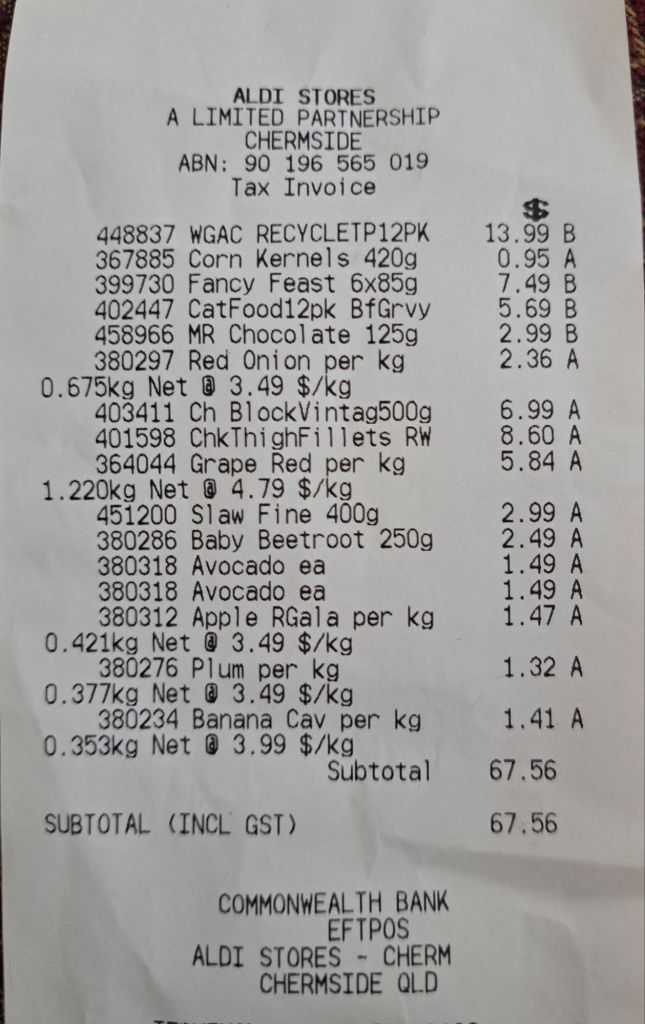
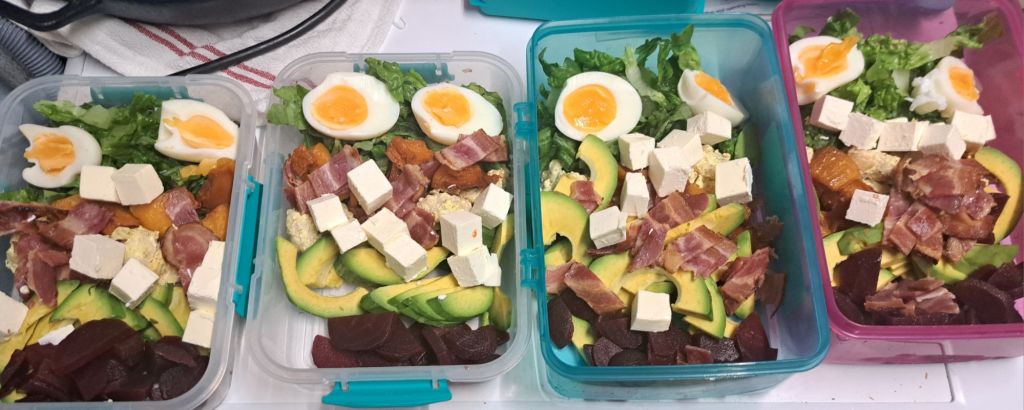
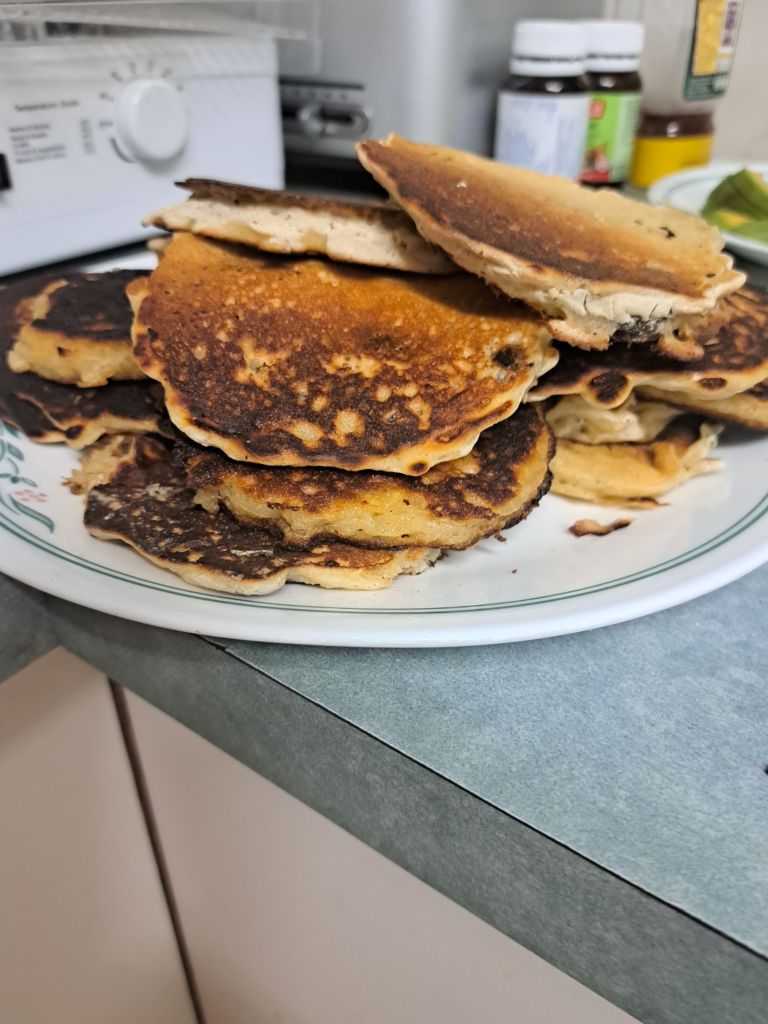
On the menu last week was apple fritters with coconut yoghurt for breakfast,  and a version of a Cobb salad for lunch.   The bill from Aldi was $31.70, and those purchases, along with what I had in the pantry and freezer,  yielded six lunches and 6 breakfasts.

This version of a Cobb had cos (romaine) lettuce, boiled eggs,  roasted pumpkin, avocado, feta, bacon, and marinated crocodile meat. Why modify the classic Cobb salad? Because of food sensitivities – the roasted pumpkin replaced the tomato. Because of economies – the crocodile meat was in the freezer. Because of preference – I don’t like blue cheese as the  texture is a sensory issue, so feta was a good,  sharp,  substitute.

Apple fritters, or apple pancakes, if you like, weree made using a bought pancake mix,  gluten free, 4 Granny Smith apples, grated, 280ml water,  1/2 cup of rice flour,  an egg and vanilla paste.  It made 18 pancakes – three got eaten as quality control… they weren’t perfect, but they were good enough for me. Two pancakes plus two spoons of coconut yoghurt made a perfect breakfast.

So what do I have planned for week 11?

A breakfast oat bake with berries, and a “super” coconut yoghurt.  “Super” coconut yoghurt is a vanilla  yoghurt with enough vegan chocolate protein powder in it to make it thick like a  chocolate mousse.

Lunches this week will be premade coleslaw, from a bag that says 5 serves.  To that,  I’ll add chicken,  apples, onions, avocado and sultanas. Diced chicken thigh fillets marinated in a honey soy sauce should provide a pop of flavour,  and extend the coleslaw beyond 5 serves. 

And all for $40.39, plus what’s in the pantry and freezer.

For the coleslaw dressing… from the freezer,  a cauliflower “mayonnaise” I made,  mixed with some left over blue cheese dressing from last week.

What’s cauliflower “mayonnaise”? A cauliflower head,  chopped and cooked in the pressure cooker,  then blitzed in the food processor with a little bit of coconut yoghurt,  honey, and mustard powder, and a little water to get to the right consistency. It made very big batch,  so I froze what I didn’t need.

For snacks,  I’ll pack cheese and rice crackers,  and grapes or  a plum. It’s late in the season for plums,  but they are still so good to eat.

So here’s to being autistic, using your autistic strengths to overcome autistic deficits and cheap, nutritious meals.

Getting supports

Almost three months after getting the diagnosis that, yes, I am autistic, I will confidently say that that diagnosis, at the age of 51, is both a blessing and a curse.

Redefining what I thought were anxiety attacks as autistic meltdowns would be a win, you would think. But until you can get your head around to the recognition that (1) When you thought these were anxiety attacks, you managed them (2) So simply reframing them as autistic meltdowns shouldn’t change the fact that you have managed them in the past (3) Except you are terrified that this is burnout and skill regression which would mean an end to your life as you know it.

Communities and networks

There are damned few support groups for adult autistic women.

I don’t feel like I can participate in my old communities and networks, after having been an (unknowing) fraud all my life.

I can’t bear to look at LinkedIn with its allistic cheer parties for allistic professionals.

So – Instagram, and all the autistic content creators who so bravely share their hearts, souls, minds, thoughts, autistic traits and autistic lives. I found great neighbours there, but can I share my heart, soul, mind, thoughts, traits and life there? Not yet.

Head to Health

I turned to “Head To Health”, a federal government program offering eight free psychologist appointments. This was in a time of crisis before I knew I was autistic. I know now that that crisis was a meltdown from sensory overload.

Universities

I might have a fighting chance at university now, as a mature age student. With supports and accommodations in place, and gaining a better idea of my strengths, which have always been autistic; it’s about getting to the sympathetic resonance of them as autistic strengths.

My assignments so far at university have focused on mature-age students, and grief. Maybe, as I discover more and more of my authentic self, I can focus on the female autism phenotype and adult diagnosis. Maybe I can write about grief through the lens of autism. Maybe I can write about forgiving myself for not grieving like others do, because my grief is autistic. Maybe I can write about the validation, and then fresh grief, that I always felt that my late husband loved me more than I loved him, because I was an undiagnosed autistic woman, and our mirror neurons work differently, and there’s a thing called hyperempathy.

Yet, I still curse every physiotherapist, massage therapist, chiropractor and osteopath that didn’t twig that the hyperextension of my knees was hypermobility, and a flag for autism.

So, those eccentric cams with the unshed tears, maybe they need a deep clean.

Maybe the NDIS can help, if they could see the not-done housework that has been a point of self- castigation for my whole life; it’s not laziness, it’s an executive function issue.

May this prose illustrate just how shattered yet whole I feel – the 51-year-old widow with a fresh diagnosis of autism, in the melange of grief and hope and fear and bravery.

Footnote – au is gold, in the periodic table. Gold is ductile, malleable and versatile, with a melting point of over 1000°C.

Doesn’t that sound like every “high functioning” autistic person you know?

Doesn’t that sounds like me?

How do I cook, again?

Oh, my. Here I had been thinking that an extra layer of nuttiness had been added to my life, and fretting about early onset dementia. Then I found this.

“Autistic regression is both a reaction to, and the cause of, burnout. Imagine being faced with the daily demand to be someone you are not. At some point, things just don’t work anymore. Executive functioning deteriorates, memory is compromised, the ability to tolerate sensory or social overload is reduced, social skills fade, and one’s general ability to cope is greatly reduced or lost. One regresses, and for those adults whose coping skills were minimal to begin with, the process can kindle severe reactions.” (https://kennethrobersonphd.com/autistic-regression-and-burnout-descriptions-of-life-on-the-spectrum/)

Regression and burnout, almost as if I’m taking off a cloak that is made from a lifetime of masking because it’s just too heavy to wear.

So I asked my AI guy about this, in a conversation about skill regression. His response:

“Autistic regression in adult-diagnosed women refers to a phenomenon where individuals who were previously able to function relatively well start experiencing a decline or loss of previously acquired skills and abilities. It can manifest as changes in communication, social interaction, sensory processing, or repetitive behaviors. While the exact causes of regression are not fully understood, it is believed to be influenced by various factors such as stress, hormonal changes, or co-occurring conditions.”

Autistic women in social media also offer their anecdotal reports of autistic regression soon after an adult diagnosis of autism. (Yes, that’s me. I identify with that.)

So what led to my dive into the issues of skill regression? For me, the moment of despair, the extra layer of nuttiness that had me worrying about early onset dementia? Cooking.

I had planned a Sunday a few weeks ago to do meal prep, something I haven’t been able to do for weeks, months, because of depression. I planned what I was going to make, what ingredients I needed to buy, ordered them, and picked them up.

Back at home, with everything for the chick pea and roasted vegetable salad, the fruit salad, and the egg, rice and seaweed balls, all on the kitchen couter, chopping board, knife and peeler all set out, I looked at, and froze.

I could not think how to start.

This was devastating. Me, who has cooked and cooked and cooked. Lunches for 15, dinners for 10, end of year dinner parties for my housemate’s employees. “Daft days” breakfasts for the skeleton office staff where I used to work. All showing brilliant executive function for planning menus, preparing ingredients lists, matching flavours, and allergies. Planning to start three days beforehand, for sauces, frozen desserts; the things that could be prepared ahead of time. D-3, D-2, D-1, D. Four days worth of prepping, cooking, execution.

Yet standing there, that Sunday, I didn’t have a clue what to do. My anxiety and that inner monologue ramped up.

Then came the next realisation. What I’ve been thinking of as anxiety attacks were, more than likely, my version of a masked autistic meltdown. So, I had a meltdown, then got a pen and paper and wrote out a plan for the meal prep day. Mission accomplished. But what will I discover next?

I know that every autistic person has individual characteristics and traits, and that it’s different for everyone.

But, seriously, with all of our our psychological and psychiatric professionals, around the globe – why can no-one produce a list of every “side effect” of being autistic. Finding things out piecemeal, lurching from crisis to crisis by turning to social media for answers, is frustrating, demeaning and utterly ridiculous.

Autistic people deserve better.