My thoughts on it? ChatGPT did a pretty good job creating a 1000 word blog post on the possible intersection between “lagniappe” and “twice exceptional. It expressed what I am just too stymied and overwhelmed (hello, autism), to put those words together.
What do you think we would use instead of “twice exceptional”?
Me: Hello, friend. Could you write a 1000 word blog post about the meaning and usage of “lagniappe”, and how it could be used to replace the pejorative “twice exceptional” term?
ChatGPT:
Exploring Lagniappe: A Gift to Replace “Twice Exceptional”
In the rich tapestry of language, some words stand out not only for their unique meanings but for the cultural nuance they carry. One such word is “lagniappe,” a term that, at first glance, may seem simple, but when unpacked, reveals layers of generosity, surprise, and an unspoken social contract of goodwill. In this blog post, we’ll delve into the meaning and origins of lagniappe, explore its usage, and propose how this delightful concept could be an empowering alternative to the term “twice exceptional.”
What is Lagniappe?
Lagniappe (pronounced LAN-yap) is a term rooted in the Creole culture of Louisiana, with influences from French, Spanish, and Native American languages. The word itself comes from the Quechua word “yapa,” meaning “a little something extra,” which made its way into the Spanish language as “la ñapa.” Eventually, it evolved into the French Creole “lagniappe,” and today it is most commonly associated with New Orleans and the surrounding regions.
In essence, lagniappe refers to a small, unexpected gift or bonus that a merchant might give to a customer—a little something extra, thrown in to sweeten the deal. It could be an extra beignet tossed into a bag of pastries, a complimentary sample at a farmer’s market, or even an unexpected dessert sent to your table by a generous chef. The idea is that lagniappe is a token of goodwill, a gesture that goes beyond the transaction, enriching the experience with an element of surprise and joy.
The Cultural Significance of Lagniappe
Lagniappe is more than just a word; it’s a cultural practice that embodies the spirit of hospitality and generosity. In the bustling markets of New Orleans, where diverse cultures have blended over centuries, lagniappe became a way to build relationships, encourage loyalty, and foster a sense of community. It’s a small act that says, “I appreciate your business, and I want to give you a little something extra to show it.”
This practice has broader implications as well. In a world where interactions can often feel transactional, lagniappe introduces a human element that reminds us of the importance of kindness, thoughtfulness, and connection. It’s a reminder that we can all benefit from giving a little more than what is expected, whether in business, in personal relationships, or in life.
The Term “Twice Exceptional”
Now, let’s turn our attention to the term “twice exceptional,” often abbreviated as 2e. This term is used to describe individuals, particularly students, who are identified as gifted in one or more areas but also face challenges or disabilities that make their educational journey more complex. For example, a child might have a high IQ and excel in creative writing but also struggle with ADHD or dyslexia.
While the term “twice exceptional” aims to capture the dual nature of these individuals’ abilities and challenges, it can carry a negative connotation. The word “exceptional” is often used in a way that emphasizes deviation from the norm, and when coupled with “twice,” it can create an impression of being doubly outside the ordinary, which some might perceive as pejorative. For those who identify as twice exceptional, the term can sometimes feel like a label that highlights their struggles more than their strengths.
Why Lagniappe as a Replacement?
This is where the concept of lagniappe can offer a refreshing alternative. Imagine if, instead of being labeled as “twice exceptional,” individuals were described as possessing “lagniappe”—a little something extra that enhances their unique makeup. This reframing shifts the focus from a clinical description of abilities and challenges to a celebration of the unexpected gifts that these individuals bring to the table.
Lagniappe, as a concept, is inherently positive. It suggests that what might be seen as a challenge or a difference is actually a bonus, a delightful surprise that adds value to the whole. By adopting lagniappe as a term to describe those who are currently labeled as twice exceptional, we can shift the narrative from one of deficiency or deviation to one of abundance and appreciation.
Practical Applications of Lagniappe in Education and Beyond
In the context of education, adopting the term lagniappe could transform how we approach teaching and supporting students who are gifted and have disabilities. Rather than focusing on the challenges they face, educators could embrace the idea that these students have a little something extra—a combination of talents and perspectives that enrich the learning environment for everyone.
For example, a student with ADHD might struggle with traditional classroom structures but excel in creative problem-solving and thinking outside the box. Rather than seeing this as a challenge to be managed, what if we viewed it as a form of lagniappe—a bonus talent that can inspire new teaching methods and innovative approaches to learning?
Beyond education, the concept of lagniappe can be applied in various areas of life, particularly in how we view and interact with others who might be different from us. By embracing the idea that everyone has a little something extra to offer, we can create more inclusive and supportive communities where diversity is celebrated, and each person’s unique contributions are valued.
Conclusion: Embracing Lagniappe
Language shapes how we see the world and how we see ourselves. By choosing to replace the term “twice exceptional” with “lagniappe,” we open up new possibilities for how we understand and appreciate those who have both gifts and challenges. Lagniappe invites us to see the world with a sense of wonder, to appreciate the little extras that life offers, and to recognize that everyone has something special to contribute.
In a society that often emphasizes conformity and standardization, the concept of lagniappe reminds us that it’s the unexpected, the extra, and the unique that truly enrich our lives. So, let’s celebrate the lagniappe in ourselves and others, and in doing so, create a world where everyone’s gifts are recognized and cherished.
By adopting lagniappe as a term, we not only honor the cultural heritage of a word steeped in generosity and goodwill but also offer a more empowering and positive way to describe those who are currently labeled as twice exceptional. In this way, lagniappe becomes not just a word, but a philosophy—a way of seeing and celebrating the richness of human diversity.
Undiagnosed autism means you might act, speak or be in a way that others don’t like. I see so many stories on social media about this.
This is another area where I struggle to identify with the experience of other autistic people. In my diagnostic assessment, I scored in the 96.4th percentile for masking and in the 94.2nd percentile for assimilation.
What do those numbers actually mean? It means I masked at a very high level, frequently and with more intensity than 96.4% of other diagnosed autistic people. It means that I adopted behaviours, language and cultural norms to fit in, at a higher level and intensity than 94.2% of other diagnosed autistic people.
But those high scores belie the untold toll of exhaustion and turmoil, the contributing factors for C-PTSD that I would likely be diagnosed with, should I be interested in such a diagnosis.
(I’ll post about late diagnosis,C-PTSD, masking and assimilation on another day.)
“Why can’t you be more spontaneous?” That’s the way my autism runs.
Masking and unmasking
My difficulty in being spontaneous is related to my autistic need for routine and structure. Changes in plans or routines can be disabling; masking and assimilation means covering that up so my distress is not seen.
Since my autism diagnosis, I’ve been working on unmasking, unwinding all those things that cause internal stress simply by virtue of being aware of my differences.
The challenge is engaging with society, unmasked.
“Why can’t you be more spontaneous?” That’s the way my autism runs.
A Francophile and Brisbane’s annual French Festival
I’ve been aware that I need to start getting out and about again. Since my diagnosis, I’ve been a bit reclusive, not going out much, just going out for my Shebah work and groceries, and the occasional movie.
I heard promotions for the 2024 French Festival, and decided I would go. I bought a three-day pass, thinking that it would Gove me some flexibility around Shebah bookings.
I went along, catching the bus down to South Bank. Getting to the festival was easy. My autism made the rest of it tricky.
My planning was simply to go to the French Festival. I didn’t plan for what to do at the festival. And that was my unmasked downfall.Wandering aimlessly might sound wonderful to some people. For autistic me, it was distinctly uncomfortable.
“Why can’t you be more spontaneous?” That’s the way my autism runs.
Regathering and planning another outing
After thinking deeply, on the bus after leaving the festival, on the drive from the bus station to home, and at home, I realised that the discomfort I was in was from the aimless wandering.
Hence, I then planned outings that I could set up a program for; no aimless wandering.
… drumroll … The Ekka.
The Ekka, or more correctly, the Royal Queensland Show, is a celebration of agriculture and a joyful meeting of country and city in the Brisbane CBD. It started in 1876, and has run every year since except for:
1919 – because of the influenza epidemic;
1942 – during World War Two, the showgrounds were used by the military, including what we now know as The Old Museum;
2020 and 2021 – during the Covid-19 pandemic.
Yes, the Ekka is an institution.
My Ekka memories
I went to the Ekka many times as a child. My parents bred and showed dogs, so we were at the dog show that is part of the Ekka. We had backyard chooks, so I would go to the poultry pavilion.
I remember sitting in the stands at the main arena, watching the cattle and horses being paraded, the horses being put through their paces in dressage and show jumping.
I remember the Ekka “must dos”; the showbags which, back then, were sample bags; the dogwood dogs, the fairy floss and the now famous strawberry sundaes.
The Ekka 2024
I bought a ticket for Tuesday, because at the dog show, Tuesday was the day for Terriers (Group 2). I grew up with Australian Terriers and Scottish Terriers that were showed. Of our dogs, in the 1970s, we had three champions (Australian Terriers) and one triple champion (Scottish Terrier). So, yes, there is a connection to Group 2.
But then, I heard a callout for volunteers for The Common Good, the charity that put on the strawberry sundae stands, raising funds for The Common Good, the Prince Charles Hospital Foundation. I decided to register as a volunteer.
Ekka Strawberry Sundaes
My autistic heart was singing. Registration was easy, on-boarding was slick and well done. I signed on for four shifts as a Cashier.
The Ekka runs for nine days, from Saturday to Sunday on the following week. My four shifts were from 5pm to 9.30pm, Sunday, Wednesday, Thursday and Sunday.
First shift, at the Gregory Terrace stand. They had four cashiers for two registers, so I volunteered to stay out the back, cutting and slicing strawberries. For the first shift, I was very nervous, and anxious. So when they needed strawberries cut, I jumped in. Having a knife in my hand, a cutting board in front of me and food to be prepared; that’s my happy place.
Second shift, at the Plaza stand. They only had one register, and was on that register for my full shift. Busy, busy, busy. And I had a golden moment.
Third shift, back at the Gregory Terrace Stand, on the registers. A negative experience.
Fourth shift, at the Gregory Terrace stand, in the registers. Good as gold.
“Why can’t you be more spontaneous?” That’s the way my autism runs.
The golden moment
At the Plaza stand, we had two cashiers for one register, so one of us ran the register and the other handed across the card that was to be presented at the next window to receive your sundae/s.
I was on cards when I noticed a young man come up, wearing a sunflower lanyard. I noticed his speech pattern, eye contact, and the way he moved, and knew he was autistic. As I handed him his card, I told him that he was “doing great, autistic brother, from an autistic sister”.
His smile, and the slight change in his posture, made my day.
So imagine my delight when he came back, later in the evening. He looked at my name badge, and in a measured way, called me by my name, and said I was also doing great, “autistic sister, from an autistic brother”.
I nearly cried.
If you have any hidden disability, you know how moving it is to be seen. My words obviously affected that young man, the same way his reciprocation moved me.
When I think about that young autistic man, going to the Ekka on People’s Day, usually the busiest day of the Ekka, my heart swells. (Autistic hyperempathy.) Deploying his coping strategies, not masking, wearing the sunflower lanyard, moving about the Ekka.
So yes, I’m counting those combined experiences as a golden, precious moment.
The negative moment
At the start of each shift, I disclosed my autism. On the third shift, another cashier was a retired teacher. My experience with her was less than stellar. She questioned my diagnosis and didn’t believe it was possible to be diagnosed so late in life. I had to explain Level 1, 2 and 3 support needs for autistic people.
Later in the evening, this person socially excluded me from the social chat among the cashiers at the end of the shift.
I had a little RSD (Rejection Sensitivity Dysphoria flare, but then reminded myself – it was her loss, not mine.
In conclusion
So, no, I didn’t get to see the dog show. I did have a fantastic experience volunteering for The Common Good. And I had that golden moment.
I’ve bought myself a sunflower wristband and pin, so maybe there might be more autistic recognition, and potential for more golden moments.
Going to big event, with a definite plan of what to do, made a big difference in my autistic experience at The Ekka, in contrast to the aimlessness French Festival.
My next test of my coping strategies at an event will be a trip to the Eat Street Markets at Hamilton. A plan – to explore it as it is now, and have something to eat.
Here’s to the next steps in my journey as a late diagnosed autistic women.
Oh, the autistic trepidation about “new”; in this case, the trepidation of finding a new health care provider. Understanding my autism means I understand better why seeing a new practitioner seeds nervousness.
Osteopath, physiotherapist or chiropractor?
All my life, I’ve chosen alternative health care providers; naturopaths, herbalists, massage therapists, and Reiki. I’ve studied Western herbal medicine, massage, aromatherapy, and had a (somewhat disastrous) Reiki attunement to Level 2 – that’s a story for another day.
Once I was making decisions for myself, leaving childhood behind, chiropractors quite literally had my back. One, whom I saw for several years, even even commented on my “loose-limbed” walk; possibly the first identification of hypermobility, all the way back in the early 1990s.
It was in the mid 2000s when I moved away from chiropractors, going to osteopaths instead.
What’s the difference? And why not physiotherapists?
Physiotherapists generally treat and rehabilitate injuries.
Chiropractors generally focus on the spine, the protector of the central nervous system.
Osteopaths generally focus on whole of body, prevention and rehabilitation.
These days, knowing about my autism and the associated hypermobility means that I need a whole of body focus. Hence, finding a new osteopath.
But why did I need to find a new osteopath? That’s also a story for another day.
Empathy in practitioners
The first new osteopath seemed okay, but he didn’t look any further into what hypermobility meant in terms of injury treatment. He also said, “Freak”. He didn’t say it in an unkind way or context. He was asking how my hypermobility manifested. I mentioned my knees, my feet, and my hands as my known hypermobility, and showed him my hand spread, the hypermobility that let me span an octave in a piano when I was nine years old. His smiling response – “Freak”. Choice of words in a health care setting should be carefully considered.
I continued with the appointment, and we resolved the immediate issue in my lower back, but he wasn’t a keeper.
I got to thinking. While I couldn’t find my old osteopath, his clinic was still there, they still had my patient records, and he had hired/ placed the other osteopaths there. So, I made an appointment at the old osteopath’s clinic.
This new-to-me osteopath, Alison, is a keeper. So, back to the clinic at New Farm, with an osteopath who has experience with autistic and hypermobile patients.
Why did I need to see an osteopath?
Firstly, discovering my autism has been a blessing; discovering the associated hypermobility has been a curse.
It is thought that 60-70% of autistic people also have hypermobility, and like autism, hypermobility is different in every person. For me, my knees bend backwards, my fingers bend backwards and the top joints of my fingers can lock. My hands, that take an “S” sized glove, can span 20cms from thumb to little finger. That’s my known hypermobility.
Intersect that with a deep dive into autistic hypermobility, and being aware that I’m 52, and wanting to improve mobility, flexibility, agility, and strength as I age. I started a program of daily workout routines, and knowing that I had an exaggerated curve in my lower back, that was one area of was focussing on. I was also focussing on reducing the chronic tension in my body.
I was ecstatic when I went from being able to fit my fist between my lower back and the wall, to only being able to fit my flat palm with a slight tilt between my back and the wall. My everyday motion was freeing up, and walking felt good. I was progressing reps and weights in my daily workouts, and six weeks, I was really feeling good.
One night, I went to sleep, in my typical autistic side sleeper posture. I woke up, sprawled in what I now know is a hypermobile sprawl, and a very cranky lower back. Old friends L4 and L5 were very unhappy. My entire lower back from ribs to tailbone had locked up and I was in pain.
I did some stretching and movements, and that got the pain manageable. Heat, magnesium cream, and specific rest postures helped. But I needed more help than that.
Hence, the search for a new osteopath.
The inception of a new autistic special interest
Hence, the search for information about why, and the subsequent deep dive into hypermobility.
Hypermobility is a disorder of connective tissues. Some would consider connective tissues to be ligaments and tendons; they are that, and so much more.
Connective tissue is cartilage, bones, fibres such as collagen and elastin, adipose tissue (yes, fat), blood and fibroblasts, the cells that activate for tissue healing and wound repair.
So hypermobility is not just a disorder of ligaments and tendons. It has the potential to affect the whole body.
I know a lady with Ehlers-Danlos Syndrome (hEDS). For her, it caused devastation, with nine miscarriages for two live births.
People with hEDS generally have the super flexy, bendy bodies. An ignorant massage therapist can inadvertantly dislocate a shoulder during a massage. For my friend, it meant the disorder of the connective tissues presented in her uterus, with devastating consequences.
So it makes me wonder, just how much the undisguised hypermobility has impacted my life. It makes me wonder what the links are between hypermobility and hormones, postural orthostatic tachycardia syndrome (POTS), adrenal fatigue, and mast cell activation syndrome (MCAS)? Is there a link to estrogen dominance and fibroids? And is there really a difference between Hypermobility Spectrum Disorder and Ehlers Danos Syndrome?
There is so much more to be discovered. Stay tuned.
I started this blog from a simple Facebook post, expressing my frustration.
“Knowing I’m autistic and hypermobile, I started a program of daily exercises designed for an autistic, hypermobile body. I recently bought some resistance bands to add, to strengthen muscles around my hypermobile joints to help stabilise the joints. I bought a product marketed at women. Smaller diameter and thickness on the bands, girly pinks and purples as opposed to the men’s bigger, thicker and generally black bands. That’s ok. I’m starting out. I’m happy with a lighter, graduated set. So imagine my feminist outrage when I open the box of this product, marketed at females, to find a male model in the photos on the instruction sheet. WTF?”
Femvertising
Femvertising is the use of feminism in advertising. Slogans like “You go, girl” and “Girl, you’ve got this” are rampant, yet the companies behind these campaigns often fail to live up to their marketing. Recent lawsuits and scandals involving companies such as Dove, KPMG, and the Australian High Court illustrate this hypocrisy.
Interestingly, the company behind my resistance bands isn’t guilty of femvertising. There’s nothing on their website claiming feminist values or corporate social governance (CSG) statements to suggest they uphold such values. They do sponsor women’s sports teams like the Matildas (soccer) and the Opals (basketball), but there’s no explicit feminist branding. CSG is generally required for companies listed on the Australian Stock Exchange, as part of their Annual Reports.
For a deeper dive into the concept of femvertising and its impact on consumer perceptions, you can refer to Negm’s (2023) study on femvertising social marketing and Sterbenk et al.’s (2022) exploration of corporate commitment to gender equality and Katie Martell’s post on Chief Marketer (2019).
The Issue, Unboxed
Despite this, a novice like me might assume that a product with a woman on the box is specifically for women. This was my perception.
Discovering my autistic identity and acknowledging my hypermobility has been a game-changer. At 52, I realized it’s never too late to start focusing on mobility, agility, strength, and fitness. My autistic need for routines led me to design a daily exercise routine tailored to my body, focusing on strengthening muscles around my hypermobile joints to enhance stability and reduce injury risk. Recently, I decided to up my game by incorporating resistance bands into my workouts. Little did I know, this simple addition would spark a wave of feminist outrage.
These resistance bands, in lighter, graduated weights, and adorned in rainbows, seemed like the perfect fit for someone like me who is just starting out. The smaller diameter and thickness of the bands were exactly what I needed to ease into this new aspect of my fitness journey. As an autistic, hypermobile woman, the gentler progression promised by these bands was what I wanted.
Imagine my surprise and disappointment when I opened the box to find a male model featured in the photos on the instruction sheet. Here I was, having purchased a product clearly targeted at women, yet the first visual guidance I received was of a man demonstrating the exercises.
It felt like a slap in the face. In a market where women’s specific needs are frequently overlooked or downplayed, the decision to use a male model in a product designed for women seemed not just careless but insulting.
This incident might seem minor to some, but it underscores a broader issue. Why, in 2024, are women still being subjected to such thoughtless marketing strategies? The fitness industry is rife with gender-specific products, yet it continues to perpetuate outdated and exclusionary practices.
Women, especially those like me who are navigating unique physical challenges, deserve products that not only cater to their needs but also respect and acknowledge their identity. Seeing a male model in the instructional material for a women-targeted product reinforces the notion that women are an afterthought in the fitness industry.
Curwen and Park’s (2014) research on female consumers’ negative emotions can provide further insights into how such marketing missteps affect women’s experiences and perceptions .
We Deserve Better
My feminist outrage isn’t just about a model on an instruction sheet; it’s about the pervasive issue of women’s representation and respect in all areas of life, including fitness. It’s about demanding better, not just for myself but for all women.
This experience serves as a reminder that as consumers, we have the power to demand change and to support brands that genuinely understand and cater to our needs.
The journey of understanding and embracing my autistic, hypermobile body has been empowering and enlightening. Integrating resistance bands into my routine was a step towards greater strength and stability. Yet, this small act of purchasing a fitness product unveiled a glaring issue in the way women’s products are marketed.
As I continue my fitness journey, I am reminded of the importance of not only physical strength but also the strength to stand up against gender biases and demand better representation. Here’s to all the women who refuse to be sidelined and continue to push for a world that sees and respects us.
References and Bibliography
Cunningham, J., & Roberts, P. (2006). Inside her pretty little head a new theory of female motivation and what it means for marketing / Jane Cunningham and Philippa Roberts. Cyan.
G. Curwen, L., & Park, J. (2014). When the shoe doesn’t fit: female consumers’ negative emotions. Journal of Fashion Marketing and Management, 18(3), 338–356. https://doi.org/10.1108/JFMM-12-2012-0078
Negm, E. M. (2023). Femvertising social marketing: a focus on perceived authenticity and perceived congruence of the advertising and consumers’ attitudes toward female portrayal. Journal of Humanities and Applied Social Science, 5(5), 435–449. https://doi.org/10.1108/JHASS-05-2023-0053
Sterbenk, Y., Champlin, S., Windels, K., & Shelton, S. (2022). Is Femvertising the New Greenwashing? Examining Corporate Commitment to Gender Equality. Journal of Business Ethics, 177(3), 491–505. https://doi.org/10.1007/s10551-021-04755-x
I kid you not. Potatoes, pasta, corn, legumes, oats, rice and bread can all be good for you.
How? Leftovers.
Yes, leftovers often taste better the next day. They can also be better for you the next day.
Let’s take potatoes, for example. Whether boiled or baked, potatoes go through a chemical process during cooking that, when cooled overnight in the refrigerator, transforms them into medicine for your gut and blood sugar.
The commonality between potatoes, corn, bread, rice, legumes, and pasta is that they all contain starches. The science? Starch cokes in two forms – amylase and amylopectin. They are polysaccharides made up of glucose units.
Cooking those foods starts a process of gelatinising the starch. This loosens the bonds in crystalline granular form of the starches. The starches become amorphous, disordered, dispersed in water.
Cooling the cooked potatoes, corn, etc, rapidly on the bench and then in the refrigerator initiates the process of retrogradation, where the starches reform in a more structured state. This is the magic. The more structured state transforms that same chemical compound, C6H10O5, in a different form, and makes it a resistant starches.
What’s so good about resistant starches? It’s good for your gut, and good for your blood sugar.
How?
Resistant starch is prebiotic. Prebiotics feed the beneficial bacteria in your gut.
Resistant starches have a lower glycaemic index. This helps to stabilise blood sugar levels.
The fascinating thing, to me, is that these starches don’t change their chemical notation. It remains the same from before cooking, through cooking and gelatinisation, through cooling and retrogradation, and through reheating. It’s the way that two or more of these starch molecules are bonded that make the difference.
Granules, gelatinised, then reformed into granules again but in a different structure than they were before cooking.
Food chemistry is kitchen magic.
My favourite recipes for the next day, and those resistant starches?
Creating a new identity, a sense of self, happens at times in our lives, usually after a significant life event. For me, becoming a widow was one such event.
No longer was I a wife or carer. I was a widow, determined to forge a new sense of self as a “merry widow”.
I settled on the “merry travelling widow”. Let me tell you, I got moving on that. What I had planned:
May 2020, multi-modal trip to Melbourne and back on trains, plains, and ships.
November 2020, camp and cruise from Cairns to Bamaga and back.
April 2021, New Zealand by rail and ferry, flying in, cruising back.
September 2021, a Queensland cruise.
May 2022, a half world cruise, Brisbane to Southhampton, train to France, 8 weeks there, then the Orient Express from Paris to Venice, overland to Rome, then flying home. It was to be a glorious three month indulgence.
But, we all know what happened in February, 2020. Covid-19. All those travel plans got cancelled.
Who was I?
If I couldn’t be the “merry travelling widow”, then who was I? That’s when I settled on the “merry student widow”, as going to university had been a lifelong dream.
Prerequisites. I met the prerequisites from life experience, but I was apprehensive about writing, and, let’s face it, I left school in 1988.
I found UQ College and their Tertiary Preparation Program. Back then, in 2020, it was free. It was a crazy but wonderful program that crammed Year 11 into 13 weeks, and then crammed Year 12 into another 13 weeks.
It was wonderful. All mature age students, small class sizes, because of Covid-19, on campus at the University of Queensland’s magnificent St Lucia campus. I did Academic English, Maths, Chemistry, Biology, and Business Management.
I loved it. I thrived. It was amazing. It was life-changing. I was happy.
Regrettably, university turned out to be a major disappointment. Yes, my undiagnosed autism, and the trials and tribulations of being a grey-haired mature-age student played into it, as well. Imposter syndrome occupied every thought.
Back to UQ College
This is an essay I wrote for Chemistry. From the list of topics, I chose:
Topic Number and Name: 6. The quality of air in towns and cities is greatly affected by automobile emissions. What causes this pollution and what can be done to control it? How does the “catalytic converter” help to cut down on the pollutants released from car exhausts? Discuss the chemistry of automobile emissions and why they are pollutants and the chemistry behind the catalytic converter.
This was a no-brainer for me. With my background in occupational health and safety and environmental management, 11 years of that in downstream petroleum, along with a lifetime of “leaning left and bleeding green”, I knew this like the back of my hand.
So enjoy a technical look into vehicle emissions public health and air quality. Or, as I put it:
A story about cars, lunatics, acid rain, white bread, suicide prevention, and it’s as serious as a heart attack
(Apologies about the academic language. These assignments were supposed to get us ready for university. Oh, and I got 100% for this. )
The quality of air in towns and cities is greatly affected by automobile emissions. Vehicle emissions, and industrial emissions, have been linked to acid rain and other pollution events, and the presence of lead in petroleum (gasoline) has been linked to neuropsychiatric illnesses and lead toxicity in the general population (World Health Organisation 2002). Concerns over the air quality around the world saw international efforts to reduce exhaust emissions. In 1975, the USA implemented legislation requiring a 75% reduction in exhaust emissions, which saw the removal of lead from gasoline and gave impetus to the introduction of catalytic converters. In Australia, unleaded gasoline was introduced nationally in 1985, although it had a slow take-up (Kristensen 2015).
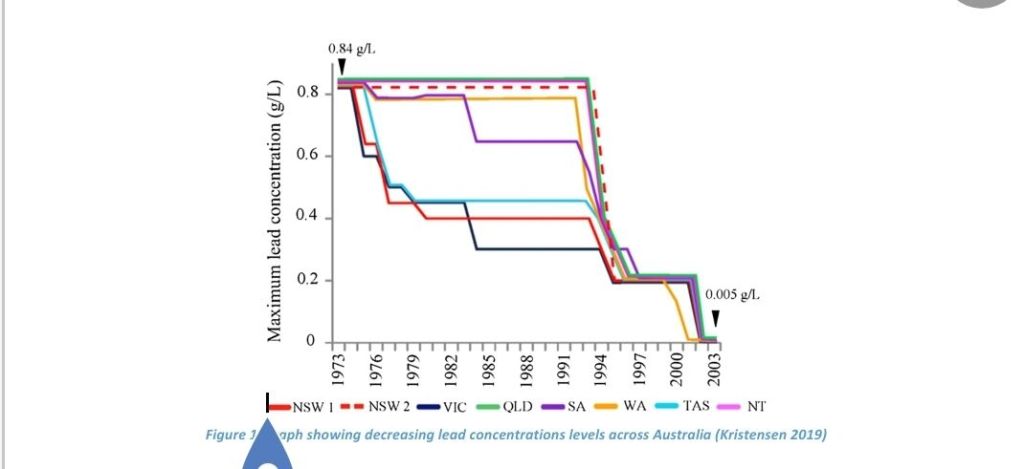
Removing lead from gasoline was a major advance in improving air quality in towns and cities (see figure 1 below), and the introduction of catalytic converters for gasoline vehicles also saw significant reduction in air pollution. In more recent times, the introduction of selective catalytic reduction (SCR) for diesel vehicles aimed to reduce greenhouse gas emissions. Internationally, vehicle emissions standards have grown increasingly stringent, such as the current Euro 6 standards and proposed Euro 7 standards. This paper will investigate, firstly, the removal of lead from gasoline; secondly, chemical reactions in a catalytic converter; thirdly, it will investigate the potential loss of functionality in catalytic converters, and lastly, it will explore selective catalytic reduction in diesel vehicles. This investigation of changes resulting in improved air quality begins with the removal of lead from gasoline.
Figure 1, graph showing decreasing lead concentrations levels across Australia (Kristensen 2019)
Leaded petrol
Lead was added to gasoline in the 1920s as an anti-knock agent and octane booster, reducing pre-ignition in engines (Compound Interest 2016). Following on from the UN’s 1972 Conference on Human Health and the Environment and the introduction of US EPA standards, lead was removed from gasoline around the world from the mid-1970s (Encyclopaedia Britannica 2019). The release of harmful lead oxides into the atmosphere was as a result of this reaction, in the combustion of leaded gasoline in internal combustion engines.
(CH3CH2)4Pb + 13O2+ heat → 8CO2 + 10H2O + Pb
Lead could then oxidise further to yield as lead(II) oxide:
2Pb + 2O2 → 2PbO2
Removing lead removed lead oxide from vehicle exhaust gases; with the move to unleaded gasoline, the combustion reaction changed to:
C8H18 + 25/2 O2 → 8CO2 + 9H20
Unleadedpetroland catalytic converters
The removal of lead also allowed for the introduction of catalytic converters, to further modify the profile of vehicle exhaust gases (Chemistry LibreTexts 2021). While the reactions above state oxygen as a reactant, the actual fuel/air mixture for the internal combustion engine cycle is drawn from air; air generally consists of 21% oxygen, 78% nitrogen, and the remaining 1% is a mixture of carbon dioxide and other gases. As a result, the reaction that produces nitrogen oxides in vehicle exhaust gases is incidental to the internal combustion engine process. These harmful nitrogen oxides, along with carbon monoxide, are dealt with by the catalytic converter. The catalysts, platinum, palladium and rhodium, trigger a two-stage reaction. The first stage in a catalytic converter deals with the nitrogen oxides, in a reduction reaction, using rhodium as the catalyst.
2NOx → xN2 + xO2
The second stage in a catalytic converter is an oxidation reaction, with platinum and palladium as the catalysts, combining carbon monoxide and oxygen to create carbon dioxide, and combustion of gasoline to produce carbon dioxide and water in vehicle exhaust gases.
2CO + O2 → 2CO2
2C8H18 + 25O2 → 16CO2 + 18H2O
The question remains, though, for how long does a catalytic converter remain effective?
Precious metals found where?
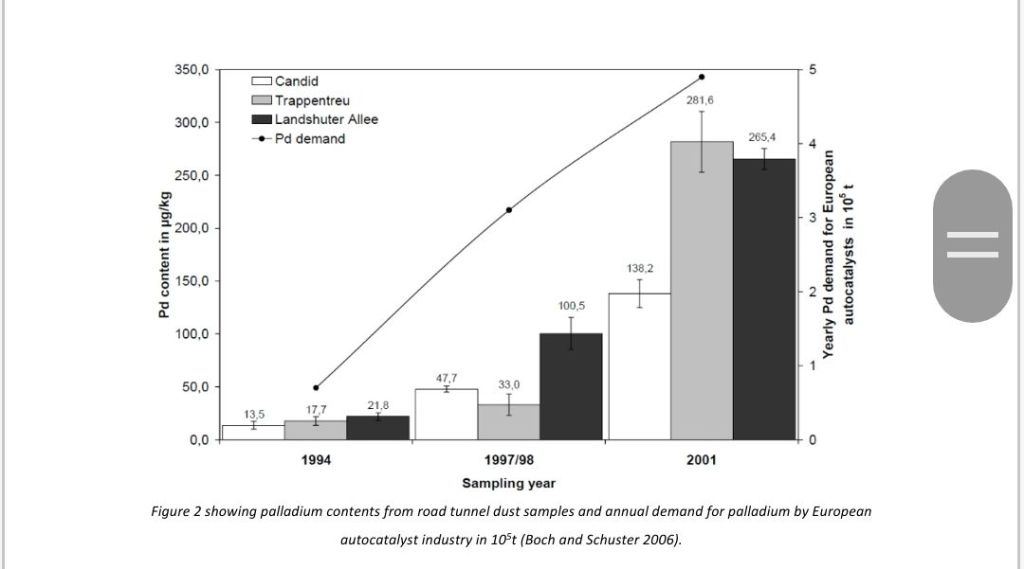
Since the introduction of catalytic converters, researchers have explored the presence of platinum, palladium and rhodium in the environment. Researchers have discovered these precious metals in road sludge and sewage systems. In Germany, a longitudinal study of samples of road tunnel dust, over seven years from 1994 to 2001, showed the presence of palladium in dust samples increasing over time; in 2001, samples yielded a combined total palladium content from the three tunnels involved in the study, of 685.2 palladium μg/kg (Boch and Schuster 2006). See figure 2 below.
Figure 2 showing palladium contents from road tunnel dust samples and annual demand for palladium by European autocatalyst industry in 105t (Boch and Schuster 2006).
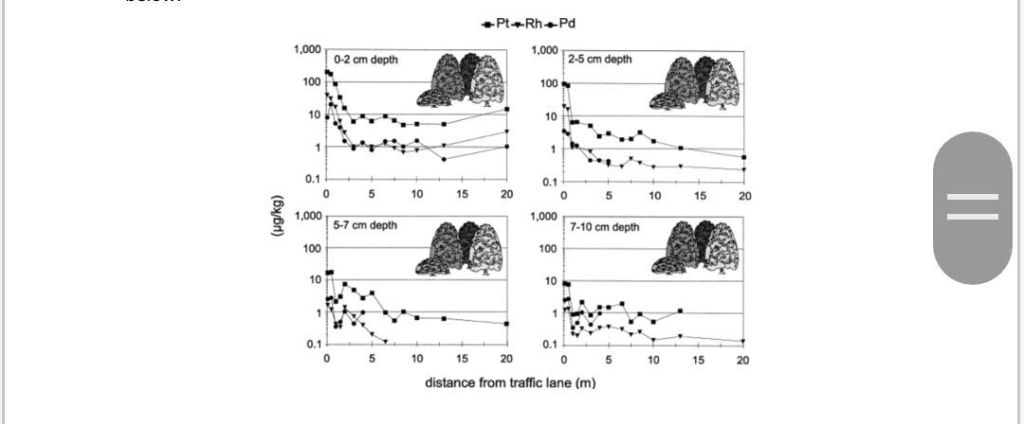
In 1998, further research found platinum, palladium and rhodium at locations along German roads, yielding concentrations above background levels at varying depths, with the highest concentrations found within 10 metres of the road (Schäfer and Puchelt). See figure 3 below.
Figure 3 showing concentrations of platinum, palladium and rhodium found along German highways (Schäfer and Puchelt 1998).
In 2016, Chinese researchers found platinum, palladium and rhodium above background levels, with a median measurement of 68.25ng/kg, 93.15ng/kg and 23.85ng/kg, respectively (Zhong et al).
The conclusion is that these metals are on the road after having become detached from the catalytic converter (Boch and Schuster 2020; Schäfer et al 1996). In 2019, Goodman et al reported that while car manufacturers, in the expectation that metal atoms would move to form larger particles, usually apply more platinum, palladium and rhodium to catalytic converters than would normally be considered necessary. It was expected that this sintering, forming larger particles would decrease the effectiveness of catalytic converters over time. Goodman et al discovered that the opposite also happens, with the elements becoming ineffective as catalysts, as they decompose into single atoms. This then calls into question the long-term effectiveness of catalytic converters, in the absence of mandatory exhaust emission testing. However, Brisbane City Council offers exhaust emission testing for diesel vehicles as part of the City’s environmental management program (Brisbane City Council 2020).
Diesel fuel
Diesel vehicles have a different profile for exhaust gases, including sulphur dioxide and nitrogen oxides. Sulphur dioxide emissions have been reduced through fuel quality standards in Australia, which restrict sulphur content in diesel to no more than 10mg/kg (Fuel Quality Standards (Automotive Diesel) Determination 2019 (Cwth)). Nitrogen oxides in diesel exhaust gases have been reduced through the introduction of SCR. SCR, aqueous urea, is marketed in Australia as AdBlue, and most modern diesel trucks, and some diesel passenger vehicles, will not operate without an adequate volume of AdBlue in the tank. The SCR is injected into the exhaust of diesel vehicles. See figure 4 below.
Figure 4, still from video illustrating the SCR reaction in diesel vehicle exhaust (AdBlue Dispensing n.d.)
The aqueous urea (32.5% in solution) decomposes in the hot exhaust gas to form ammonia and isocyanic acid.
(NH2)2CO → NH3+ HNCO
The isocyanic acid hydrolyses to produce carbon dioxide and ammonia.
SCR technology has progressively been rolled out to trucks and passenger vehicles, under the Euro Diesel 6 standard (Association for Emission Control by Catalyst 2021). The ongoing focus on particulate matter in diesel exhausts and the impact on human health, though, has seen a trend to ban diesel vehicles from roads entirely (European Federation for Transport and Environment 2018).
Vehicle exhaust gases, from both gasoline and diesel vehicles, have contributed to air pollution. The switch from leaded gasoline to unleaded gasoline was a major first step; the introduction of catalytic converters for gasoline-powered vehicles saw further improvement. The presence of the catalysts, platinum, palladium and rhodium, in roadside environs, raises questions about the ongoing effectiveness of catalytic converters, in the absence of mandatory testing of vehicle exhaust gases. Exhaust gases from diesel vehicles have also been cleaned up, with aqueous urea as the catalyst to remove greenhouse gases from diesel vehicle exhaust gases.
As the world considers the transition to electric vehicles, and hydrogen powered vehicles, gasoline and diesel-powered vehicles are likely to remain on our roads for several years to come. In the interim, mandatory testing of exhaust emissions in gasoline vehicles could quantify the issue of non-functional catalytic converters, complemented by further research to follow on from the work of Goodman et al.
Diesel vehicle exhaust emissions could also be tested regularly, for particulate matter. Shifting the transport of freight from road to rail, such as is proposed for the inland rail corridor, could see a reduction in the number of trucks on the roads, and there are already many electric buses on the roads. Lessons can be learned from the introduction of tetraethyllead into gasoline, given the public health epidemic that ensued. Such advancements in improving air quality may yield better health outcomes not just for humans, but also our planet.
Boch K, Schuster M, 2006, ‘Determination of palladium in road dust and sewage sludge ashes’, in F Zereini, F Alt (eds), Palladium Emissions in the Environment, Springer, Berlin, Heidelberg, pp. 191-201, https://doi-org.ezproxy.library.uq.edu.au/10.1007/3-540-29220-9_14.
Goodman, ED, Johnston-Peck, AC, Dietze, EM, Wrasman, CJ, Hoffman, AS, Abild-Pedersen, F, Bare, SR, Plessow, PN & Cargnello, M 2019, ‘Catalyst deactivation via decomposition into single atoms and the role of metal loading’, Nature Catalysis, vol. 2, no. 9, pp. 748-755, https://www-nature-com.ezproxy.library.uq.edu.au/articles/s41929-019-0328-1.
Schäfer, J & Puchelt, H, ‘Platinum-Group-Metals (PGM) Emitted from Automobile Catalytic Converters and Their Distribution in Roadside Soils’, Journal of Geochemical Exploration, vol. 4, no. 1, pp. 307–14, https://doi.org/10.1016/S0375-6742(98)00040-5.
Schäfer, J, Eckhardt, J, Detlef, B, Zsolt, A & Stüben, D 1999, ‘Time-dependent increase of traffic-emitted platinum-group elements (PGE) in different environmental compartments’, Environmental Science & Technology, vol. 33, no. 18, pp. 3166–3170, https://pubs-acs-org.ezproxy.library.uq.edu.au/doi/abs/10.1021/es990033i.
Zhong, L, Li, J, Yan, W, Tu, X, Huang, W & Zhang, X, ‘Platinum-group and other traffic-related heavy metal contamination in road sediment’, Journal of soils and sediments, vol. 12, no. 6, pp.942–951, https://doi-org.ezproxy.library.uq.edu.au/10.1007/s11368-012-0527-8.
Nutrition Information Panel Did you know that you can create your own nutrition information panel, like this one? Food Standards Australia has a free Nutrition Information Panel creator. https://npc.foodstandards.gov.au/ManageRecipes.aspx
So this nutrition information panel is as I made it, for my allergies and sensitivities. If you want pumpkin instead of sweet potato, go for it. If the sodium is too high, use reduced salt cheese and a reduced salt stock, or maybe steam the sweet potato instead of cooking it in stock.
If the thought of making bread makes you break out in hives, then use sliced white bread with the crusts cut off. Or a large Turkish bread, cut in half. If you want to use your own bread dough (or the SCA trail bread recipe), be my guest. Make this work for you, the way I made this recipe to work for me.
I also understand that not everyone has access to all the kitchen appliances I use, like a pressure cooker, food processor, and air fryer. If you don’t have these, a microwave, blender or knife, and oven grill are more than adequate to make this recipe. It’s important to me that cooking remains accessible to everyone. Cooking from scratch can be a step towards better health and affordability.
The way I made this, with these ingredients bought from a local independent market and some stuff from the pantry and freezer, it cost $35 and I got 18 pieces of it. That around $1.95 per piece. That’s a cheap and nourishing breakfast.
Recipe
For the loaf 1 packet Laucke Easy Bakers gluten free special white bread mix 1 sweet potato approximately 1kg, cooked, drained and mashed – I cooked it in the pressure cooker with 1 litre of vegetable stock 2 large field mushrooms, minced or finely chopped – I minced them in the food processor, 1 large onion, finely chopped 3 cloves garlic, finely chopped 250g block cheddar cheese, grated – I used a mature cheddar 4 thin sausages – I used honey beef sausages
For the topping Grana padano cheese, 250g, sliced chunky Spring onions, chopped, to taste A splash of aged balsamic vinegar ¼ teaspoon mustard powder 20ml rice bran oil Salt and pepper to taste
Method (Putting It All Together)
First, Prepare and Combine the Filling
Slice the sausages into discs, about as wide as they are thick.
Fry sausages and onions over medium heat until the onions are nearly translucent.
Add garlic to onions and continue frying.
When done, add to sweet potato mash along with minced mushrooms and grated cheddar cheese. Mix well.
Second, Make the Bread Batter
Make up the bread mix according to the instructions on the packet. Laucke’s is a pourable batter. Alternatively, you could use any bread dough, or you could use bread slices with the crusts removed.
Assemble the Loaf
Using a large baking dish lined with parchment (measurements), spread half the bread batter (or dough or bread slices) on the bottom.
Spread the sweet potato mix on top, like the filling in a sandwich.
Finish with the other half of the bread batter/dough/bread slices.
Third, Cook
Bake according to the instructions on the packet, or until the top is light brown. For me, that was 195°C in a fan-forced oven for 30 minutes.
The parchment paper makes it very easy to lift out. I turned it upside down and peeled off the parchment paper to check that the base layer of bread was cooked, and it was.
Cool overnight in the fridge. That will make it easier to slice into smaller portions.
The Next Day, Make the Topping
Blitz together the Grana Padano, spring onions, balsamic vinegar, mustard powder, oil, salt, and pepper.
Cut the stuffed bread loaf into portions. I got 18 rectangular portions by cutting it in half, and then into thirds across and down.
Spread the topping on each portion.
I used an air fryer, 10 minutes at 180°C. Alternatively, you could put them under the grill.
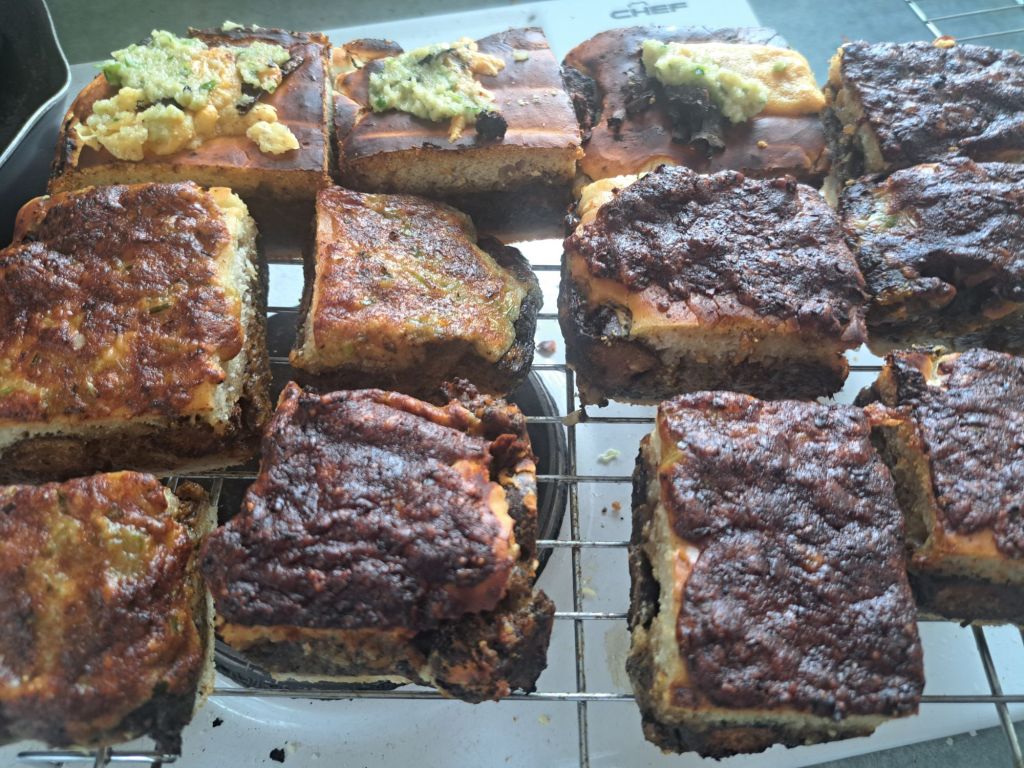
And there you have a loaded breakfast loaf, and an extra serve of vegetables in your day. For me, that’s two pieces for breakfast, either cold or heated. Either way, the satisfaction and full feeling is high. Because the bread has been refrigerated overnight, the simple starches have been transformed into resistant starches, which are great for your gut.
These finished pieces after the air fryer. The the pieces at the back were a “failure to launch”. It was after those pieces cane out that I shifted to blitzing the topping ingredients. And I prefer my topping dark, not pale.
Disclaimer: I am not a dietitian, nutritionist, endocrinologist or chef. I just love food and cooking, one of my autistic special interests.
A friend and I were discussing a current debate about a sugar tax. Addressing the diabetes epidemic is about more than sugar. Sugar is more than sucrose. It includes fructose (fruit), glucose (grains), lactose (milk), galactose (some vegetables), and maltose (grains).
There’s also the issue of simple carbohydrates versus complex carbohydrates. Complex carbohydrates take longer to break down, with a slow energy release, whereas simple carbohydrates are digested much more quickly, and can cause a spike in blood sugar.
Fibre, too, needs to be considered. Australian dietary guidelines recommend 25g to 30g of fibre daily. Fibre helps with a feeling of fullness, or satiety. Fibre is also food for your gut biome.
High fibre foods often cross over with complex carbohydrates; foods like oats, beans, lentils (insoluble fibre), fruit, vegetables, seeds and nuts (soluble fibre).
Additionally, there is a magical chemical process in cooked rice, pasta or potatoes that after 24 hours of refrigeration, the simple starches (a type of carbohydrate) become complex starches. This retrogradation forms resistant starches, a type of complex carbohydrate. This can have a positive effect on insulin sensitivity and blood sugar.
A discussion about socio-economic status also needs to feature here. Highly processed foods, which can have fewer complex carbohydrates, more simple carbohydrates, and can be higher in sugar and fat, are often some of the cheapest foods in the supermarket. Generational poverty may also mean that children don’t learn food preparation skills, and so cannot pass this to their own children.
I can’t wave a magic wand to fix this. But I can share my recipes; the recipes I’ve created for myself, and the recipes I’ve curated for myself.
In a previous post, I wrote about the clean start, the reset, for my workroom and bedroom. Now the challenge is to keep that momentum going.
In my 20s, all the way back in the 1990s, I discovered Eric van Lustbader’s Nicholas Linnear novels. I was hooked. The beguiling mix of Eastern mysticism, Western pragmatism, martial arts, the corporate shenanigans, the violence; I was besotted.
Addictive personality or autistic special interest – the heartbreak of self-deprivation One of the things that breaks my heart, that makes me grieve for my younger self, is how I denied myself things. Things, like van Lustbader’s books, because they were enthralling. I used them as a launching board to find out about so many things, including aikido. But even though they were books that I wanted to read again and again, I denied myself, because I was afraid I had an addictive personality. In reality, all I had was undiagnosed autism, and a new-found special interest.
You see, while addictive personality is not a disorder under the DSM-5-TR, it is generally used to describe a compulsive need to engage in certain behaviours or with certain substances. On the surface, that can look a lot like an autistic special interest, and an autistic special interest can look a lot like an addiction to a thing, or a compulsion.
So, imagine my confusion and dilemma, when I didn’t know I was autistic, and found things that were special interests. Imagine the autistic need, the desire, to go down that rabbit hole, and misdiagnosing yourself, from your teenage years as potentially having an addictive personality. Imagine containing yourself, depriving yourself of that joy, because you thought you may have had a mental health disorder.
One of my autistic traits is hyperlexia, a deep fascination with words and language, that often presents as early acquisition of reading and written words. I’m also a bibliophile to go with that. Books have always been my best friends. Rediscovering an old friend, hidden on a bookshelf, is a rare delight. But the books I have denied myself, because I thought I had an addictive personality… such as Dungeons and Dragons and the spinoff Dragon Lance, and Margeret Weis’s “Star of the Guardian” series. These are just the ones that have come up in conversation recently. There would be tens, hundreds of books that I read once, found utterly delightful and enthralling, that I put aside because I thought I had an addictive personality.
Part of me rages, now, and grieves, for those books that could have been lifelong special interests, maybe a missed genesis for writing fan fiction, maybe a missed opportunity to research the issues present in the books, acquiring more knowledge… so much missed that could have been so rich and satisfying.
Fast forward to today, restarts and maintenance In thinking, though, about my issues with executive allofunction (my positive language, instead of using “dys”), and the fresh clean start of my revived workroom and bedroom, I remembered some of the principles of aikido. Dusty memories of those books by Eric van Lustbader and his character Nicholas Linnear, and the things I learned from the books about martial arts, and then went on to research.
One of those things from those books was aikido – avoid and deflect. In a lightbulb moment, I realised that that is how I could manage my executive allofunction; by avoiding and deflecting. Now, it may sound crazy to talk about managing my mind as if it’s a third party. I know it isn’t; it’s just me. It is, though, almost doing an end run around myself, or rather, knowing where the blocks are, and doing an end run around them. Avoid, and deflect.
How? How does this work for me? Follow my mental path. This is going to be like a braid, several strands woven together and coming together at the end.
Thread 1. My good-as-brand-new workroom, I need to keep it that way. So if I also use it as my workout area, as well as my study and writing area, my collectables in display cabinets, and my sewing equipment temporarily put aside… then if I move those desks from being back to back, to being against the wall, then I have room for my exercise bike and Nordic walker. And the newly cleared drawers in the display cabinets can hold my yoga gear. Then there’s a space there for a yoga mat, and a space there for dumbbells… well, if I’m going to use that part of the room as a workout area, then I need to keep the chaise clear for a post workout transition. And given that one of my workout routines includes prone shoulder abductions, I want a clean carpet.
So cleaning isn’t a function in and of itself. It is an adjunct to my workout routines.
Thread 2. Why are workout routines so important? They’re important because I discovered I am autistic, and autism isn’t just the mind, it is the body as well. Now, I’m 52, and don’t have the “chunky” movements that some autistic people have, likely because of the “inadvertent supports” I received as a child, in ballet, speech and drama, piano and singing, and cycling, and walking and showing dogs.
However, some 60% or more of autistic people are also hypermobile. (Waving hello.) Yes, that’s me. I have hypermobile knees and hands. I’m researching the concept of “masked” hypermobility at the moment, as it may be possible that the chronic muscle tension I have is not necessarily all from the stresses of my life, but is masked hypermobility. Have my muscles tensed to stabilise hypermobile joints? That theory makes sense when I recall the time I dislocated T3 (the third vertebrae in the thoracic section of the spine) inwards. My osteopath was really scratching his head over how I did it, and how to get it back into its proper place so I could breathe properly again. My workout routines are to stabilise joints through the muscles around them. Hence, workout routines.
Thread 3. My financial situation already tells me that I’ll be renting for the rest of my life. (Because I spent nearly $300,0-00 on my late husband’s care, over and above his pension and the NDIS – Huntington’s Disease is expensive.) So, I have a plan that my retirement life will be peripatetic, calling to my ancient Romany DNA; van life, roaming around Australia. That will need strength, fitness, mobility and agility. I figure I’ve got 18 years to get ready for that. Hence, workout routines.
Thread 4. Sewing. Another special interest. But I don’t have any of my homemade garments in my wardrobe right now, because they don’t fit me at the moment. Weight loss isn’t the goal. Getting back into those dresses and skirts and blouses – that’s the goal. Hence, workout routines.
Bring all those threads together into my daily workout routines that I need to keep my workroom clean and tidy for. Avoid and deflect. I’m not cleaning. I’m making my workouts possible. Avoid the PDA, the RSD, the overwhelmed autistic freeze, the need for a body double. Avoid and deflect.
My daily workout routines – now on my fourth week. Monday – knees and shoulders – toe raises, walking backwards, dynamic lunges, toe raises to heel lifts, static lunges, shoulder stretches, and twists
Tuesday – shoulders and arms – bent arm lateral raises, bicep curls, reverse bicep curls, hammer bicep curls, triceps curls, external and internal shoulder rotations, prone horizonal abductions, and prone lower arm raises. These have progressed from 500g weights to 2.5kg dumbbells, with sets increasing from 5 to 2 x 10.
Wednesday – hips – hip abductions, prone side leg lefts, cat/cow, hip adductions, high-kneed marching on the spot, and butterfly pose.
Thursday – core, all yoga poses – cat/cow, upward/downward dog, dead bugs, boat pose, half table pose, twisting boat, side bends, child pose.
Friday – yin yoga hip openers – sleep swan, butterfly, cat/cow, half butterfly, and a repeating flow from cat/cow to child to frog, back to child, then cat/cow
Saturday – whole of body strength – push-ups, split level lunges, squats, overhead presses, walking lunges, bent over dumbbell rows.
Sunday – gentle whole of body stretches. – marching in place, side steps, toe tape, and seated hamstring and quad stretches, seated calf and shin stretches, seated upper back and chest stretches, seated ankle rotations, wide legged forward bend, standing to raise to heel raise flow, shoulder rolls, and the weighted hula for some fun.
This is why I have been saying lately that my autism diagnosis has given me a new lease on life.
In another engagement with generative AI, I asked ChatGPT about “need for cognition as a concept to intersect with intrinsically motivated learning and self-directed learning. Why? Because I’m dissatisfied with the university experience, both on campus and remotely. But I want to learn, I need to learn. That’s the “need for cognition”, which I will consider to be part of my flavour of autism.
This is what ChatGPT had to say.
“Need for cognition” refers to an individual’s tendency to engage in and enjoy activities that require thinking, problem-solving, and understanding complex ideas. It’s a personality trait characterized by a desire for effortful cognitive activities.
While “need for cognition” is not specifically an autistic trait, some people with autism may exhibit a high need for cognition due to their intense focus on particular interests or their enjoyment of intellectual challenges. Autistic individuals often have specific areas of interest that they delve into deeply, which can align with a high need for cognition in those areas. However, this is not universal for all autistic people, as each individual’s traits and interests vary widely.
For a mature autistic woman, the intersection of need for cognition, intrinsically motivated learning, and self-directed learning can be particularly enriching and empowering. Here’s how these concepts might manifest and be beneficial:
Need for Cognition Deep Engagement: A mature autistic woman may find deep satisfaction in activities that require intense focus and problem-solving. This can be intellectually stimulating hobbies, academic pursuits, or professional work. Special Interests: Autistic individuals often have special interests that they explore in great depth. A high need for cognition can enhance the engagement and enjoyment derived from these interests, leading to a fulfilling and intellectually rich life.
Intrinsically Motivated Learning Lifelong Learning: Intrinsic motivation can drive continuous learning and skill development throughout life. For a mature autistic woman, this might mean pursuing new hobbies, further education, or self-improvement activities purely for personal satisfaction. Personal Fulfillment: Learning driven by personal interest can provide a strong sense of accomplishment and joy. This intrinsic motivation can help in maintaining mental agility and emotional well-being.
Self-Directed Learning Autonomy: Self-directed learning aligns well with the preference for autonomy often found in autistic individuals. It allows for control over what, how, and when to learn, reducing the stress that can come from structured, externally-imposed learning environments. Customized Learning: This approach enables tailoring learning experiences to personal needs and preferences, which can be especially important for autistic individuals who might have unique ways of processing information and engaging with content.
Practical Strategies Identify Interests: Leveraging special interests to engage in deep, intrinsically motivated learning activities can be very rewarding. This might involve reading, research, or hands-on projects. Set Personal Goals: Establishing clear, personal learning goals can help in structuring self-directed learning. This can include both short-term and long-term objectives related to personal and professional growth. Seek Resources: Finding resources that cater to personal learning styles, such as online courses, books, podcasts, or workshops, can enhance the learning experience. Community groups or clubs related to specific interests can also provide social interaction and support. Reflect and Adapt: Regularly reflecting on learning progress and adapting strategies as needed can ensure that learning remains aligned with personal interests and needs.
Benefits Cognitive Stimulation: Engaging in intellectually challenging activities can keep the mind sharp and provide a sense of purpose and accomplishment. Emotional Well-Being: Pursuing interests and learning for personal satisfaction can enhance overall happiness and reduce stress. Resilience and Adaptability: Developing a habit of self-directed learning can build resilience and adaptability, important traits for navigating life’s challenges.
By understanding and harnessing these traits, a mature autistic woman can create a rich, fulfilling learning journey tailored to her unique strengths and interests.
All my life, the erroneously neurotypical life, I wanted to go to university. As a “2e” undiagnosed autistic girl, learning was incredibly fun. As a hyperlexic undiagnosed autistic girl, I read anything and everything. The 1932 edition of “Charles Mee’s Encyclopedia for Children” was rich pickings, as was the much more current World Book Encyclopedia set. If you remember that beauty, you’ll remember that the dictionary came in two volumes, A-L and M-Z. I read both volumes. University was a dream from my teenage years, and people in my life spoke of it as an unquestioned expectation. Yet, life happens, and I never made it to university. Only once I was widowed did I see the opportunity to finally go to university.
From 2022, as an undiagnosed autistic, mature age student, I struggled at university. I did well in some things, but my undiagnosed autism was a hindrance. My autism diagnosis in late 2023 was a revelatory experience. The last eight months of exploring autism, and my flavour of autism has been fascinating, and I understand myself so, so, much better. I understand the PDA (pathological demand avoidance aka perpetual drive for autonomy) and the issues it causes with assessments and due dates; the RSD (rejection sensitivity dysphoria) that is the inner child so easily hurt by a turn of the head, let alone group work issues; the gestalt learning and thinking that seems to be the antithesis of university course curricula.
My latest learning has been about “need for cognition”. I don’t care about external recognition. I just want information, not the certificate and the mortarboard. I want to learn, and engage, and synthesise. I want to come up with questions to lead me down another rabbithole. Which leads me to think that going to university is not what I actually wanted. Auditing university courses would be more my style.
Which leads me to self-directed learning, adult style.
The clever people at the Centre for Teaching Excellence at the University of Waterloo (Canada), came up with this Independent Studies: Unit Planning Decision Guide. They say that “the following questions are meant to guide you through the process of designing a “course” or unit of study. Take time to reflect on them to help create a cohesive, concrete plan.”
Now, way back in the early years of my working life, I was a workplace trainer and assessor, an old BSZ40198 Certificate IV. I wrote and delivered training courses, starting from corporate needs and working backwards to develop training material to get team members to that outcome. So, why can’t I do that for myself?
Thankfully, this unit planning decision guide is published under Creative Commons, allowing others to “remix, tweak and build upon our work non-commercially”, with the proviso of credit and an indication if changes were made. So here are my tweaks.
Where are you?
What is your background?
What prior knowledge do you have of this material?
Where does this unit fit with your degree requirements special interests, current affairs or anything else?
What are your beliefs, attitudes, skills, values, and support structure, both in life and as a student?
Where do you want to go?
What would you like to get out of this unit (knowledge and skills)?
What do you want to be able to do once the unit is over?
What will you have to know in order to do the items listed above?
How will you know you got there?
How can you assess your learning achievements?
What types of evaluation methods will suit the goals you outlined for question two (e.g., essay, presentation, annotated bibliography, webpage)?
How are you going to get there?What general structure of activities do you want to use? You can design your own, or use one of the following activity structures:
Read-write-AI chat: Sequence of reading, reflective writing, and discussion with advising faculty member AI.
Do/look-read-talk: Start with some field or lab work, followed by readings and discussion with advising faculty member – write-ups of experiential work can be included
Know-do-do: Work through a series of stages – build some background knowledge of skills, work on smaller application projects, conclude with larger, more complex project
Talk-read-write: Start with some intensive meetings with advising faculty member AI to discuss material, read recommended resources, prepare written work
What are you going to do?
What specific activities will you use to attain each of the goals for question two, in keeping with the general strategy chosen?
Critically evaluate these activities. Is reading/writing/reflecting, etc. enough to attain the desired amount of learning?
When are you going to do what?
Develop a week by week schedule for the whole term
What activities need to come first?
What activities do you want to conclude with?
What sequence makes sense for the middle?
Who/what can help?
What resources do you need to support each of the goals listed for question two?
Include people, places, community, articles, media, library, and advising faculty member resources
How will your work be assessed?
Who will do the assessing?
What activities will be assessed? (Not all activities may require assessment)
Communicate Develop your plansIt is now time to develop your learning contract plan. A sample learning contract and tips on developing the contract are available from Centre for Teaching Excellence. The contract plan should include:
Goals for the unit
Structure and sequence of activities
Timeline for completion of activities
Details about resource materials for each goal
Assessment procedures
A section for advising faculty member AI feedback and evaluation as each goal is completed
May include a plan for regular meetings with advising faculty member and other unit policies, such as work turned in late
Once created, contracts should be assessed by the advising faculty member. What could go wrong? Is there too much or too little work? Is the timeline and evaluation reasonable?
How will you know how the unit is going?
What kinds of feedback will you need?
How often should you meet with the advising faculty member?
What specific questions do you want answered as each goal is achieved?
Do some self-evaluation as you progress to help you stay focused
So there we are. Designing my own course and lesson plan, then embarking on that course, and getting ChatGPT to ‘mark’ my work. So just what might the autistic polymath with a magpie mind want to research? Oh, my, so much. In no particular order:
The Vienna Convention
Hildegarde of Bingen
The history of Druids
The history of the nations of my genetics
Studies on AI learning to read human minds
Consciousness of animals
Autism… of course
Masking hypermobility
Autistic bodies and exercise
Autistic bodies anhd nutrition
DNA analysis
Etymology
Aromatherapy (existing special interest)
The history of cooking (existing special interest)
3D printing and coding (existing special interest)
Best practice in palliative care, terminal care
Grief in different cultures
The history of woodworking in different cultures (existing special interest)
Western herbal medicine (existing special interest)
Quantum mechanics
Cognitive psychology
Writing
And so, so much more.
Dancing to the beat of different drum has never been more true. My drum, my drumbeat, my dance.









 The Auld Skald's Fudgel