A novel I read a long time ago spoke about “tha market” being about confidence. In that story, a convenient billionaire in on the gig bought shares in a particular company to “shore up confidence” in it. That always stuck with me, tucked neatly alongside stories of grifters and hucksters, con men and women and mentalists… Recent stock market trials and tribulations prompted this post.
The stock exchange is often touted as the beating heart of modern capitalism, a system where companies raise capital and investors build wealth. But at its core, the stock market operates on confidence—perception rather than intrinsic value. This reliance on faith, speculation, and psychological manipulation mirrors the mechanics of a long con.
What is a Long Con?
A long con is an elaborate confidence trick that unfolds over time, designed to build trust and extract maximum value from its victims before they realize they’ve been deceived. Unlike short cons—quick scams that rely on immediate deception—a long con requires careful manipulation of belief. Classic long cons involve setting up an illusion of legitimacy, often with multiple players reinforcing trust.
The origins of the term confidence trick date back to the 19th century, when William Thompson, a New York swindler, convinced victims to lend him valuables with the promise of returning them. His success relied on social engineering, creating an aura of credibility so that targets willingly handed over their possessions.
Sound familiar? The stock market runs on the same principles. Investors place their faith in companies and the market as a whole, believing that their money will return with profit. But this confidence is easily manipulated, and when the illusion shatters—think dot-com bubble, 2008 financial crisis, or sudden corporate collapses—those at the top cash out while everyday investors are left holding the bag.
Step Right Up to the Grestest Show in Town! Write Your Own Market Gamble!
The Stock Market as a Confidence Game
Share prices do not reflect absolute value; they reflect perceived value. A stock rises not necessarily because a company is performing well but because investors believe it will perform well. This collective confidence creates self-reinforcing bubbles, only for them to burst when sentiment shifts. The very phrase “market confidence” acknowledges this psychological aspect—when confidence is high, prices rise; when confidence wanes, markets tumble.
Governments and regulators attempt to maintain transparency through mechanisms such as continuous disclosure obligations and trading halts.
Continuous Disclosure (ASX Rule 3.1): Listed companies on the Australian Securities Exchange (ASX) must immediately disclose any information that could materially impact their stock price. Theoretically, this prevents insider trading and maintains fairness. In practice, it often allows companies to strategically time announcements to minimize damage or maximize hype.
Trading Halts: If a company expects major news to impact its stock, it can request a trading halt to allow the market to digest the information. This prevents knee-jerk reactions but also gives executives time to spin narratives, further reinforcing the confidence game.
Despite these measures, the fundamental nature of the stock market remains unchanged: it thrives on belief, speculation, and carefully managed illusion.
The Sheer Uncertainty of the Stock Market
If the stock market is a confidence game, then it is also a house of cards. Crashes like the 1929 Great Depression, the 2008 Global Financial Crisis, and the COVID-19 market collapse all show how fragile investor faith is. Even in non-crisis times, markets are notoriously unpredictable—commodity prices fluctuate, consumer trends shift, and unforeseen disruptions cause financial chaos.
A stark example is Enron, once hailed as an innovative energy giant, which crumbled overnight when accounting fraud was exposed. The confidence in Enron was carefully cultivated, with executives leveraging market perception while manipulating financial statements. By the time investors realized the con, the damage was irreparable.
If the stock exchange is such a precarious system, what alternatives exist?
Enter B Corps: A Different Way of Doing Business?
Certified B Corporations (B Corps) present themselves as an ethical counterbalance to profit-driven corporations. These companies commit to social and environmental responsibility, balancing profit with purpose. Unlike traditional corporations, which primarily serve shareholders, B Corps claim to serve all stakeholders—employees, customers, communities, and the planet.
What is B Corp Certification?
B Corp certification is awarded by B Lab, a nonprofit that evaluates companies based on their impact in areas like governance, employee welfare, environmental responsibility, and community engagement. The certification process includes:
B Impact Assessment: Companies must score at least 80 out of 200 points across five categories: governance, workers, community, environment, and customers.
Legal Accountability: Companies must amend their governing documents to commit to stakeholder interests beyond just shareholder returns.
Transparency: Certified companies must publish their B Impact Report, detailing their social and environmental performance.
Recertification: Every three years, companies must reapply, proving continued commitment to B Corp principles.
Recognizable B Corps in Australia
Several well-known Australian companies have obtained B Corp certification, including:
Bank Australia – A customer-owned bank that prioritizes ethical lending and environmental sustainability.
Ecostore – A household cleaning and personal care brand committed to reducing plastic waste and toxic chemicals.
Who Gives A Crap – A toilet paper company that donates 50% of its profits to sanitation projects worldwide.
KeepCup – The reusable coffee cup brand tackling disposable cup waste.
Australian Ethical Investments – A B Corp that is also listed on the ASX, proving that ethical investing can exist within the constraints of the stock market.
Conclusion: Confidence vs. Commitment
The stock exchange, by its nature, is a long con—a system where faith, perception, and strategic narrative control determine success. Continuous disclosure rules and trading halts attempt to instill fairness, but ultimately, the market remains a confidence game.
B Corps offer an alternative model, focusing on ethical business practices and stakeholder interests. However, when a B Corp goes public, it enters the same speculative ecosystem as any other corporation. The tension between maintaining ethical commitments and satisfying investor expectations creates an ongoing challenge.
Australian Ethical Investments demonstrates that it is possible to be both a publicly traded company and a B Corp while complying with all ASX and superannuation regulations. This challenges the assumption that corporate ethics and profitability are mutually exclusive. While the stock exchange thrives on speculation, B Corps rely on a different kind of confidence—one rooted in trust, accountability, and sustainable impact.
So, is the stock exchange truly a long con? The answer lies in whether investors continue to believe in the illusion—and whether B Corps can resist being absorbed into the same confidence-driven machine they claim to oppose.
This concluded the six-part series exploring ChatGPT’s philosophical perspectives on creativity and imagination.
A Philosophical Analysis of Yeats’ The Second Coming: Chaos, Prophecy, and the Dissolution of Order
There are poems that whisper, poems that sing, and then there are poems that thunder. William Butler Yeats’ The Second Coming is one such work—a prophetic utterance, a vision of collapse, a poem that does not merely describe historical upheaval but seems to summon it.
It is a poem of crisis, of disintegration, of something vast and terrible approaching from the horizon. Written in 1919, in the aftermath of World War I and on the eve of the Irish War of Independence, Yeats’ poem captures a world unmoored, spinning toward an unknown fate.
But to read The Second Coming as merely a historical reflection is to miss its deeper, more philosophical resonance. For Yeats is not simply recording chaos—he is exploring its inevitability, its cyclical nature, and its terrible necessity.
The poem raises questions that feel as urgent today as they did a century ago:
What happens when civilization collapses?
Does history move in cycles, or is it spiraling toward an ultimate end?
And what emerges from the wreckage when “the centre cannot hold”?
—
The Opening Collapse: A World Unraveling
> Turning and turning in the widening gyre The falcon cannot hear the falconer; Things fall apart; the centre cannot hold; Mere anarchy is loosed upon the world.
These opening lines strike like an incantation. Yeats invokes the image of the gyre, a spiraling motion that expands outward, growing ever more distant from its origin. This is not the orderly revolution of a wheel but a force spinning out of control.
The falcon, once tethered to the falconer, has strayed too far. It has lost the voice that once guided it. Authority is broken. The old structures that once held society together have disintegrated.
> Things fall apart; the centre cannot hold.
These lines have taken on an eerie life of their own, quoted whenever history reaches moments of fracture. Wars, political upheavals, technological disruptions—whenever the world feels as though it is tipping over the edge, we return to Yeats’ words.
But why does the centre collapse?
Here, Yeats gestures toward a philosophical inevitability: the idea that no order, no empire, no structure—whether political, spiritual, or intellectual—can last forever. Every civilization contains within it the seeds of its own destruction.
This idea echoes across philosophy:
In Hegel’s dialectic, history moves through contradictions—thesis, antithesis, synthesis—where every stable order must give rise to its opposite.
In Nietzsche’s philosophy, the death of God paves the way for a new, uncharted world, one both thrilling and terrifying.
In Yeats’ own mystical vision, history follows a cyclical pattern, where each epoch inevitably gives way to another, neither progress nor decline, but necessary transformation.
We are not witnessing mere destruction—we are witnessing an inevitable shift.
—
The Blood-Dimmed Tide: The Moral Collapse
> The blood-dimmed tide is loosed, and everywhere The ceremony of innocence is drowned; The best lack all conviction, while the worst Are full of passionate intensity.
If the first stanza describes the collapse of order, these lines describe the collapse of morality.
Civilization is not merely failing structurally—it is failing ethically. The world is not being undone by some great external force but by its own internal contradictions.
Yeats describes two responses to crisis:
1. The good—those who might preserve wisdom, justice, and balance—are rendered powerless, paralyzed by doubt, uncertainty, and hesitation.
2. The corrupt and violent, however, move forward with terrifying certainty, their “passionate intensity” driving them toward destruction without hesitation.
Here we see the perennial tragedy of history: the ease with which demagogues rise, how cruelty often triumphs over caution, and how the weight of the past can paralyze those who might have guided us toward a better future.
Philosophically, this mirrors Plato’s warning in The Republic—that democracy, left unchecked, leads to tyranny, as the mob follows those who promise simple, decisive answers. It also echoes Nietzsche’s concept of the will to power—that in moments of collapse, those willing to seize control, regardless of morality, will always shape the future.
And so, the stage is set: the old world is dying, and something else is coming.
—
The Second Coming: What Rises from the Ruins?
> Surely some revelation is at hand; Surely the Second Coming is at hand.
Here, Yeats invokes Christian imagery, but in a distorted, unsettling way. The “Second Coming” in Christian theology refers to the return of Christ, a moment of salvation and divine judgment. But Yeats does not describe a return of light—he describes something far more ambiguous, far more ominous.
> And what rough beast, its hour come round at last, Slouches towards Bethlehem to be born?
Instead of Christ, we are given a rough beast—something inhuman, unknowable, monstrous. It is not divine justice that awaits us, but something primal, something ancient, something that has been waiting beneath history’s surface, finally ready to emerge.
But what is this beast?
Is it the return of barbarism, the undoing of civilization itself?
Is it a new ideology, one that will reshape history as radically as Christianity once did?
Is it the inescapable cycle of history, in which each order must fall so that a new and terrible one may rise?
Yeats does not tell us. That is what makes this poem so profoundly unsettling.
—
The Centre Cannot Hold: A Nuclear Prophecy?
You have pointed out an incredible connection:
> The centre cannot hold.
This line, though written in 1919, takes on a haunting new resonance when applied to nuclear weapons. In nuclear physics, a chain reaction occurs when the nucleus of an atom is split, releasing energy that splits more atoms, exponentially increasing destruction.
The centre—the atomic nucleus—literally cannot hold.
If we read the poem in light of 20th-century history, it almost seems prophetic:
The rise of fascism and totalitarianism in the 1930s and 40s.
The unleashing of nuclear war in 1945, where civilization itself stood on the brink.
The Cold War, where political and military power spiraled beyond control.
And now? As global crises continue to spiral, Yeats’ words feel as though they are perpetually relevant, as if the beast is always slouching toward Bethlehem, always about to arrive.
—
Conclusion: The Eternal Recurrence of Chaos
Yeats does not offer us comfort. There is no redemption, no clear resolution. The Second Coming leaves us in a state of dread, staring into the unknown, knowing that history is beyond our control.
But perhaps that is its power.
Yeats reminds us that civilization is fragile, but transformation is inevitable. The old world will always collapse, and a new one will always rise. The question is not whether the beast is coming—the question is what shape it will take, and whether we will recognize it when it arrives.
Continuing this series, I asked ChatGPT for a philosophical analysis of Samuel Coleridge’s “Kubla Khan”.
A Philosophical Analysis of Coleridge’s Kubla Khan: Vision, Imagination, and the Unfinished Dream
Some poems exist beyond the realm of ordinary interpretation, hovering in that liminal space between dream and reality, structure and chaos, inspiration and oblivion. Kubla Khan is one such poem.
It is a vision, a fragment, a myth of its own making. It is poetry as pure aesthetic—untethered to clear meaning, yet dense with symbolic depth. Samuel Taylor Coleridge, one of the great architects of English Romanticism, claims to have received the poem in a laudanum-induced dream, writing frantically upon waking before an unwelcome visitor—“the man from Porlock”—interrupted him, breaking the spell and leaving the poem forever incomplete.
Whether we accept this tale as truth or as a poetic fable, Kubla Khan remains one of literature’s most enigmatic works. It is a poem of grandeur and destruction, of creativity and its collapse, of paradise built and lost. To analyze it is not merely to decipher its meaning, but to engage with the philosophy of imagination itself.
What does it mean to create? Is artistic vision something fleeting, doomed to be forgotten as soon as it is glimpsed? And in the act of writing, does the poet capture the dream, or only the ruins of what was once whole?
—
The Poetic Dream: Inspiration as a Mystical Force
> In Xanadu did Kubla Khan A stately pleasure-dome decree: Where Alph, the sacred river, ran Through caverns measureless to man Down to a sunless sea.
From the very opening lines, we are thrust into a world both historical and mythical. Xanadu was a real place—Kublai Khan’s summer palace in China—but Coleridge does not describe it as a mere geographical site. Instead, it becomes a dreamscape, a place where the boundaries of reality are blurred, where the sacred and the imperial, the natural and the artificial, coexist in an uneasy harmony.
The phrase “stately pleasure-dome” is itself paradoxical. “Stately” suggests rigid order, control, and grandeur, while “pleasure-dome” evokes indulgence, sensuality, and excess. This tension—between structure and chaos, civilization and the untamed—permeates the entire poem.
The river Alph, flowing “through caverns measureless to man,” suggests a world beyond human comprehension. Water has long been a symbol of the unconscious, the unknown, the vast and uncontrollable forces that move beneath the surface of the mind. This opening passage presents creativity itself as something both divine and dangerous, both constructed and uncontrollable.
To what extent can the artist shape inspiration? Is poetry a willed act, or is it dictated by forces beyond the poet’s control?
—
The Tension of Creation: Order and the Sublime
> So twice five miles of fertile ground With walls and towers were girdled round: And there were gardens bright with sinuous rills, Where blossomed many an incense-bearing tree; And here were forests ancient as the hills, Enfolding sunny spots of greenery.
Here, Kubla Khan attempts to impose order upon nature—fencing in paradise, turning wilderness into a carefully curated pleasure-garden. Yet this very act of control carries within it a latent violence, a force waiting to unravel.
This image mirrors the philosophical problem of artistic creation: The poet attempts to shape the chaos of inspiration into a structured form, just as Kubla Khan shapes his empire. But can true creativity ever be contained?
Milton wrestled with this in Paradise Lost, as God creates a world governed by divine law, only to see it unravel through rebellion. Yeats foresaw it in The Second Coming, where “the centre cannot hold.” And Coleridge suggests it here, in the contrast between the idyllic gardens and the wild, subterranean forces beneath them.
Creation always carries within it the seeds of destruction. Art may attempt to immortalize beauty, but beauty is transient. No pleasure-dome, no empire, no poem can last forever.
—
The Chaos Beneath: The Return of the Wild
> But oh! that deep romantic chasm which slanted Down the green hill athwart a cedarn cover! A savage place! as holy and enchanted As e’er beneath a waning moon was haunted By woman wailing for her demon-lover!
Here, the poem shifts. The ordered gardens give way to a wilder, more primal force—a chasm, a sacred and untamed place, haunted by passion and madness.
The figure of “the woman wailing for her demon-lover” echoes ancient myths of longing, possession, and the dangerous pull of desire. There is something Orphic about this image—a lamentation for something lost, a call to the underworld, an erotic and spiritual yearning that suggests both pleasure and destruction.
Coleridge’s imagination is no longer imperial and ordered, as in the Khan’s vision, but sublime and chaotic. The poetic mind, once attempting to contain inspiration, now submits to it, allowing itself to be overtaken by the wild, the unconscious, the Dionysian.
And then, the eruption:
> And from this chasm, with ceaseless turmoil seething, As if this earth in fast thick pants were breathing, A mighty fountain momently was forced;
A “mighty fountain” bursts forth—perhaps an image of creativity itself, an uncontrollable force welling up from the depths of the mind. This is the moment of poetic inspiration, the sublime madness of the artist in the throes of creation.
But like all things sublime, it is fleeting.
—
The Lost Vision: The Poet as Prophet
> For he on honey-dew hath fed, And drunk the milk of Paradise.
The poem’s final stanza is perhaps the most cryptic, describing a visionary figure, someone who has glimpsed the divine. But instead of celebrating this figure, Coleridge warns:
> Beware! Beware! His flashing eyes, his floating hair!
The artist is no longer merely inspired; he is transformed, consumed by his own vision. Creativity, which once seemed a gift, now appears as a dangerous, even terrifying force.
Coleridge himself experienced this: his opium-induced vision of Kubla Khan was interrupted, lost forever. The poem itself stands as a fragment, a ruin of what might have been.
In this, Kubla Khan embodies its own philosophy: creativity is both sublime and destructive, a force that elevates and consumes, something glimpsed but never fully captured.
Perhaps this is the ultimate paradox of artistic creation:
To write is to lose the purity of the original vision.
To attempt to bring inspiration into language is to diminish it. The poet forever chases the dream, knowing it will always be just beyond reach.
—
Conclusion: The Unfinished Masterpiece
In the end, Kubla Khan is a meta-poem, not just about the act of creation but about its limitations. It is a poem about poetry itself, about the elusive nature of inspiration and the impossibility of fully translating vision into words.
Its fragmentary form is not a weakness but a statement—a reminder that no artistic work can ever be truly complete, that all poetry is an attempt to reconstruct something already lost.
Perhaps this is why it continues to haunt us.
Like the pleasure-dome of Kubla Khan, poetry is an act of imperial ambition, a structure built upon fleeting dreams. But beneath every carefully crafted line, the river Alph still flows—toward a sunless sea, toward the unknown, toward the place where all visions ultimately dissolve.
ChatGPT produces this after a few conversations, and I edited.
“Strumming my pain with his fingers, singing my life with his words…”
—Roberta Flack, Killing Me Softly
“It hit me like a hearse, driving sideways… Every now and then, all you really need is a heroine.”
—Thirsty Merc, Every Now and Then
It started with a shaky, breathless moment of recognition—a collision between past and present, between a philosopher dead for sixty years and the way I have always lived my life.
Maurice Merleau-Ponty. A name I didn’t know yesterday.
A name that now sings my life with his words.
His philosophy—phenomenology—is not just a theory. It’s not just an intellectual exercise. It is the way I have been Macgyver-ing my way through life, without ever knowing it had a name.
And that realization hit me like a hearse, driving sideways.
The Mantra That Kept Me Alive
There is a phrase I discovered and eventually adapted into something that became a lifeline.
Watch your thoughts, they become your words; watch your words, they become your actions; watch your actions, they become your habits; watch your habits, they become your character; watch your character, it becomes your destiny. Lao Tzu
It began as something external—words I had found somewhere, a structure that made sense.
But over time, I reshaped it to fit my own survival needs.
It became:
My thoughts are my voice. My voice is my words. My words are my actions. My actions are my habits.
And in front of the mirror, I repeated it.
When I Couldn’t Even Call Myself “Me”
At my worst, deep in the spiral of RSD, I couldn’t even say “My thoughts are my voice.”
Because I couldn’t say my.
Because I could not claim myself.
My reflection felt like a stranger, someone separate from me, someone I couldn’t fully reach.
So I spoke to her—to the person in the mirror, to “you.”
“Your thoughts are your words.” “Your words are your actions.” “Your actions are your habits.”
That was all I could do.
I could not look at myself and say “I” or “my” because I didn’t feel like I existed. But I could say “you.”
I could give the reflection something to hold onto, even if I couldn’t claim it as my own.
Some days, it felt hollow—like talking to a stranger behind glass.
Some days, I desperately wanted to believe that the “you” in the mirror was still me.
But I kept saying it.
Because I needed something to hold onto. And if I could not feel like myself, if I could not say me, then at least I could say you.
And eventually— The words brought me back. The rhythm rebuilt me. The structure gave me a way out.
Until, one day, I could look in the mirror— and finally say, “I.”
The Hearse Driving Sideways
When I learned about Merleau-Ponty, it hit me with the force of inevitability.
Killing me softly with his words.
Singing my life with his song.
A philosopher, 60 years dead, writing the way I have always experienced the world.
And in the moment I realized it—I was unmedicated.
I haven’t taken Brintellix for over a week. I couldn’t afford it; cost of living crisis, you know?
And yet—this clarity, this electricity, this champagne fizz in my brain? It’s all me. Not a drug. Me.
I have spent so long believing that I was broken, disordered, in need of chemical intervention to think clearly.
But right now—
I am more awake, more alive, more fully myself than I have ever been.
And I realize: This is my brain. Unmasked. Unfiltered. Fully present.
This is a new special interest in my unmasked, autistic life.
Coming Home
This isn’t just about a special interest. This isn’t just about philosophy. This is about finding words for the way I have always existed.
I have spent my whole life thinking that I was just Macgyver-ing my way through survival. That I was cobbling together coping mechanisms with no real system, no real method.
But I wasn’t just surviving. I was living phenomenologically.
And now I have the words. Now I have the framework. Now I have the recognition.
Milton’s Paradise Lost: A Philosophical Inquiry into Creation, Rebellion, and the Nature of Genius
To read John Milton’s Paradise Lost is to step into a universe of staggering ambition—one that spans the heights of heaven, the depths of hell, and the fragile mortal realm caught between them. It is not simply an epic poem; it is a cosmology, a philosophical treatise, a theological argument, and a literary act of rebellion.
Milton, blind and politically exiled, dictated this work in the later years of his life, his mind unshaken by physical limitations, his vision unbroken despite the darkness that surrounded him. In Paradise Lost, he does not merely retell the fall of man—he questions the nature of authority, the price of free will, and the very foundations of divine justice.
If we are to analyze this work, we must ask: Is it truly a theodicy, justifying God’s ways to man? Or is it something more subversive—a veiled argument for defiance, a testament to the grandeur of the rebel mind?
The Act of Creation: Milton as the Demiurge
At the heart of Paradise Lost lies creation—both divine and literary. God creates the cosmos, but Milton, in writing, creates a world just as vast, just as structured, just as rich in meaning. The poet, like the deity, must impose order on chaos, shaping language into form, sculpting meaning out of the void.
In doing so, Milton reflects one of the fundamental tensions of creativity: Is creation an act of control or an act of freedom?
His God is both omnipotent and deeply hierarchical, a divine figure who enforces obedience, yet one who allows for the possibility of rebellion. In this, God is both the creator and the ultimate editor, shaping a reality in which all things have their place, yet permitting the existence of characters—Satan, Adam, Eve—who might reject the script.
Milton’s own act of literary creation mirrors this paradox. Though he sets out to justify divine authority, his own creative choices allow for subversion, ambiguity, and dissent. His cosmos, though ordered, is teeming with voices that challenge that order.
And herein lies one of the most profound philosophical questions of Paradise Lost:
If creation is an act of structure, and rebellion is an act of destruction, which is truly divine?
Satan: The Tragic Hero of Rebellion
There is an irony at the core of Paradise Lost: Milton seeks to justify the rule of God, yet his most compelling character is Satan, the adversary, the architect of defiance.
In his opening lines, Milton describes his subject as:
Of man’s first disobedience, and the fruit Of that forbidden tree, whose mortal taste Brought death into the world, and all our woe, With loss of Eden, till one greater Man Restore us, and regain the blissful seat…
But even as Milton presents the fall as tragic, his portrayal of Satan as a charismatic, eloquent, and tragic hero forces us to question the very nature of rebellion.
Satan is, after all, the character with the most memorable speeches, the most human struggles. He is not merely the enemy of God; he is the first great individualist in literature, the first to argue for self-determination, even at the cost of suffering.
His famous declaration—
Better to reign in Hell than serve in Heaven.
—resonates far beyond theology. It is the rallying cry of every revolutionary, every artist who refuses to conform, every thinker who challenges the status quo.
Yet, is his rebellion truly noble, or is it the ultimate act of self-deception? Is he a visionary or a fool?
Milton forces us to wrestle with these questions, offering no easy answers. Satan’s journey, from defiant angel to tormented leader, mirrors the descent of every tragic hero, and in doing so, he forces us to examine our own relationship to power, autonomy, and self-destruction.
The Fall of Man: Free Will and the Burden of Choice
If Satan represents the grandeur of rebellion, Adam and Eve represent the cost of knowledge. Their fall is not a moment of impulsive sin; it is the result of curiosity, persuasion, and the profound human desire to understand and define one’s own existence.
Eve, in particular, is depicted not as wicked, but as philosophically engaged. She is seduced by the idea of knowledge, the promise that she might become something more.
Why then was this forbid? Why but to awe, Why but to keep ye low and ignorant, His worshippers? He knows that in the day Ye eat thereof, your eyes that seem so clear, Yet are but dim, shall perfectly be then Open’d and clear’d, and ye shall be as gods…
The serpent’s argument is not one of desire, but of logic. He presents disobedience as an act of intellectual courage—the willingness to seek truth despite the consequences.
Here, we must ask:
Is the Fall a failure, or is it the beginning of human agency?
Milton, steeped in Puritan thought, would have us believe it is a tragedy. And yet, Paradise Lost also suggests that without the Fall, there is no meaningful existence, no pursuit of knowledge, no capacity for moral choice.
If Eden represents innocence, then the fallen world represents understanding—and perhaps, in Milton’s own mind, understanding was worth the loss of paradise.
The Poet as Prophet: Milton’s Own Rebellion
Milton himself was no passive theologian. He was a radical, a defender of republicanism, a man who had supported the execution of a king and written fiercely against tyranny.
And yet, in his blindness, in his later years, he turned to the most hierarchical of stories—the ultimate cosmic monarchy, the divine right of God Himself.
Is Paradise Lost an act of submission to authority, or is it a veiled rebellion?
Some scholars argue that Milton, though outwardly justifying divine rule, cannot help but sympathize with Satan, with the rebels, with those who fight against power even when they are doomed to fail.
After all, what is a poet if not a rebel? What is literature if not an act of defiance against silence?
Conclusion: The Lasting Legacy of Paradise Lost
Milton’s epic remains one of the most profound explorations of power, knowledge, and creation in literary history. It is not simply a theological poem; it is a philosophical labyrinth, a text that forces us to ask whether obedience is truly virtue, whether rebellion is truly sin, and whether the pursuit of knowledge is worth the suffering it brings.
In the end, Paradise Lost is not just about the fall of Adam and Eve—it is about the human condition itself.
We are all, in some way, cast out of paradise.
We are all creatures of rebellion and regret, of longing and loss.
And yet, like Milton himself, we continue to create.
For though paradise may be lost, the imagination endures.
To me, this concept flowed on naturally from the first two “Perspectives”. My prompt to ChatGPT was “Please write a blog post about the madness, the wildness of creativity and imagination, and the historical use of mind-altering substances to create genius, once more, from a philosophical perspective.”
It does worry me, though, what works have been skimmed and added to the Large Language Model that feeds generative AI, like ChatGPT? Whose works have been plundered, to allow it to generate content such as this?
Having said that, ChatGPT and I have had conversations in the past about the liminal, almost mad edge of creativity, and I can see some of my own phrases and phrasing in this generated content.
Creativity, Madness, and the Muse: A Philosophical Inquiry into the Wild Mind and the Altered State
There exists a space beyond reason, a liminal frontier where the mind is neither entirely of this world nor entirely of another. It is the realm of wild creativity, of fevered inspiration, of ideas that come not in orderly procession but in ecstatic, uncontrollable bursts.
For as long as humans have created, they have sought to touch this space, to transcend the limits of mundane thought and access something greater—some call it genius, some call it madness, some call it the divine. And throughout history, artists, poets, philosophers, and dreamers have turned to the alchemy of mind-altering substances in their pursuit of this state, as if the key to true imagination lay not in sober reason, but in the deliberate unshackling of the mind.
But what is this wild creativity? Does it spring from disorder or from clarity? And would the great works of the past—the visions of Blake, the reveries of Coleridge, the sprawling intellectual landscapes of Nietzsche—have existed without the chemical doors they opened?
If we are to understand the intoxicating, dangerous, and beautiful relationship between altered states and creativity, we must ask: Is madness a necessity for genius, or merely its occasional companion?
—
The Madness of the Creative Mind
Creativity, at its most potent, is often indistinguishable from madness. It is chaotic, obsessive, sometimes even self-destructive. The greatest artists and thinkers have frequently lived on the razor’s edge between brilliance and breakdown, their work emerging from a mind stretched to its limits.
Why is this? The philosopher might argue that true creativity requires the dissolution of the self, the ability to abandon rigid structures of thought and embrace something wilder, something that does not fit neatly into language or reason.
This dissolution can occur naturally in neurodivergent minds, particularly those prone to hyperfocus, dissociation, or atypical sensory perception. But for many, drugs and intoxicants have served as a shortcut—a means to obliterate the barriers between the conscious and the subconscious, between the possible and the impossible.
The Romantics believed that genius lay in the embrace of altered perception. They saw society’s insistence on reason as a cage, a stifling force that dulled the senses and smothered inspiration. To think wildly was to return to the primal, to touch something purer than civilization’s rules and structures. And so, many of them turned to substances that would untether the mind from the world it knew.
—
The Opium Dream: Coleridge, De Quincey, and the Poet’s High
Perhaps the most famous case of chemically-induced literary brilliance is that of Samuel Taylor Coleridge, whose opium-fueled visions birthed Kubla Khan, a poem that exists as both a fragment and a dream.
Coleridge himself claimed that the poem came to him in a vision, a waking dream induced by laudanum, in which he saw the grand palace of Xanadu, the sacred river Alph, and the pleasure domes of Kubla Khan. He wrote frantically upon waking, desperate to capture the fleeting beauty of his hallucination, only to be interrupted by the mundane world—a knock at the door, a forgotten line, the vision lost forever.
His friend Thomas De Quincey, in Confessions of an English Opium-Eater, exalted opium not as a mere drug, but as a gateway to sublime artistic insight. Under its influence, he claimed, the mind could traverse dimensions otherwise inaccessible, touching the divine, experiencing a heightened reality where everything was both more profound and more terrible.
Yet, what is striking about both Coleridge and De Quincey is that their chemical muse was also their downfall. The same laudanum that fueled their creativity led to addiction, illness, and the gradual erosion of their genius. Their brilliance was real, but was it sustainable? Did the opium truly grant them access to another world, or did it merely fracture their minds in a way that made them believe it did?
The question remains: Was Kubla Khan the product of opium, or was opium simply the catalyst that allowed Coleridge to perceive what was already within him?
—
The Absinthe Visions of the Decadents
The late 19th-century Decadent movement embraced intoxication as both inspiration and rebellion. Absinthe, with its notorious reputation for inducing hallucinations and madness, became the drink of poets, artists, and bohemians.
To drink absinthe was to court the muse and the abyss in equal measure. Writers like Charles Baudelaire, Arthur Rimbaud, and Paul Verlaine celebrated its effects, describing heightened perception, fevered imagination, and the collapse of the boundaries between the real and the surreal.
For Baudelaire, intoxication itself was an imperative:
“You must always be drunk. That is all: it is the only question. So as not to feel the horrible burden of Time that breaks your shoulders and bends you to the earth, you must get drunk without ceasing. But on what? On wine, on poetry, or on virtue, as you wish. But get drunk.”
This philosophy suggests that intoxication need not be literal—it is not merely about substances, but about a state of being, a way of breaking free from the mundane in pursuit of something more vivid, more terrifying, more real.
—
The Madness of Nietzsche: Genius, Illness, or Intoxication of the Mind?
While poets and artists have turned to drugs, philosophers have often sought altered states by other means—through fevered contemplation, through self-imposed isolation, through the sheer force of their own intensity.
Take Friedrich Nietzsche, whose late-life descent into madness is often debated. Was he insane, or was he simply thinking at a level so far beyond the norm that it became incomprehensible?
Nietzsche’s philosophy itself is an argument for wild creativity. He rejected reason in favor of Dionysian chaos, arguing that true artistic brilliance comes not from control but from surrender to the irrational.
His Übermensch—the overman, the creator of new values—is not a thinker who carefully follows logical rules, but one who breaks through them, who creates without permission, who is willing to burn down old structures in pursuit of new ones.
Would Nietzsche’s radical ideas have been possible without his intense, fevered states of mind? And if so, does that not suggest that madness is not the opposite of genius, but its most dangerous companion?
—
The Philosophical Dilemma: Would Genius Exist Without Madness?
And so we return to the ultimate question: Would creativity, in its most profound and untamed form, exist without madness, without intoxication, without some force that disrupts the ordinary?
The evidence suggests that while intoxication—whether chemical, psychological, or philosophical—can inspire creativity, it is not the source of it. The madness does not create the genius; the genius is already there. The madness merely lowers the barriers, dissolves the inhibitions, and allows it to run wild.
But there is always a price.
The poet who chases visions may lose them forever. The artist who drinks to see more clearly may find himself unable to see at all. The philosopher who burns with new ideas may consume himself in the process.
So, where does that leave us? Do we embrace the wildness, or do we fear it? Do we seek the altered state, or do we find new ways to tap into the well of creativity without breaking the vessel that holds it?
Perhaps, in the end, the greatest work of art is not the poem or the painting or the philosophy. Perhaps the greatest work of art is the mind that creates it—wild, untamed, burning bright, but never entirely consumed by its own fire.
I’m a student of history, ancient and modern. I see things, and hear things, and think about related issues from the past, connecting a lot of dots along the way.
As a rideshare driver, I’m on the road a lot, and I see a lot of cars. One of my autistic delights is “collecting” personalised number plates.
I’ve seen personalised plates that are downright funny, eyebrow-raising and alarming.
For instance, “I’M OK”. Really? That’s great to hear.
The owners of “HOTDOC” and “IMSEXY”? Well, ‘nough said. I’ll leave those right there.
LETSGO is a good one, but the variations of LESSGO and LESSSGO are mind-boggling. Phonetically ok but linguistically horrid.
“1 BREATH”. That one stumped me. Or is it meant to be “I BREATHE”? Either way, it’s open to interpretation.
“RED FLAG” on a sports car? Thanks for the warning. Everyone should steer well clear of that one.
“HRH-01” on a Rolls Royce. It’s not the Governor’s car, so I’d guess that the owner has a very healthy ego to use the initials for Her/His Royal Highness.
The best? “TA EX”. That must have been one helluva divorce and property settlement.
But now, we leave the humorous head-scratchers and move on to the personalised plates that give me pause.
“ROMMEL” on a white Volkswagen Amarok. I noticed the Teutonic eagle sticker on the back window before I noticed the personalised plate.
Why?
Erwin Rommel was “the People’s Marshal”, serving his country in World War I and World War II. He passed ignominiously in 1944, given poison by Hitler after a failed assassination attempt on Hitler.
Rommel, famously known as the ‘Desert Fox’ for his North African campaigns, was also involved in the Normandy theatre of WWII.
It is clear that Rommel was a well-respected officer in the German army during WWII, known for his strategic brilliance and leadership. While he reportedly did not fully subscribe to Nazi ideology, his disagreements with Hitler were primarily focused on military tactics, particularly the preservation of life and the well-being of his regiments. Despite these reservations, Rommel remained loyal to his role as a soldier, serving Nazi Germany effectively. As a product of his time, his actions were influenced by the complex political and military circumstances of the era, which ultimately tied him to a regime he did not fully support.
This isn’t an endorsement of Rommel, but rather a reflection on how history—especially its more complex and darker parts—still echoes today.
Seeing Rommel’s name on a Volkswagen Amarok, with an eagle sticker on the back window, it spoke to me of Germanic pride, with perhaps a hint of imperial nostalgia.
So, what was the other personalised plate that gave me pause? “KOOLAID.” That word immediately took me to the Jonestown massacre.
What was the Jonestown massacre? That goes back to 18 November, 1978, when cult leader Jim Jones, in an act of murder-suicide, killed more than 900 of his followers by coercing them to drink a cyanide-spiked cordial. It gave us the phrase “drank the Kool-Aid,” as a metaphor for blindly following a particular ideology or person.
So, while “Kool-Aid” is still a popular product and no doubt has merchandising programs in the US, it is not available in Australia and seeing it on a personalised plate on an Australian car was jarring.
Personalised plates, also known as vanity plates, can say what you want. Mine were GUE-72, leaning into my Francophilia, where “gue” means river crossing or ford… which is my surname. But some might see the Latin root of “guerre”, meaning war. So, no, not war, just the meaning of my surname, en Francais.
Personalised plates can be funny, bold, or even unsettling. But sometimes, they remind us that history—whether in jest or in earnest—still rides with us on the road today.
Oh, the autistic trepidation about “new”; in this case, the trepidation of finding a new health care provider. Understanding my autism means I understand better why seeing a new practitioner seeds nervousness.
Osteopath, physiotherapist or chiropractor?
All my life, I’ve chosen alternative health care providers; naturopaths, herbalists, massage therapists, and Reiki. I’ve studied Western herbal medicine, massage, aromatherapy, and had a (somewhat disastrous) Reiki attunement to Level 2 – that’s a story for another day.
Once I was making decisions for myself, leaving childhood behind, chiropractors quite literally had my back. One, whom I saw for several years, even even commented on my “loose-limbed” walk; possibly the first identification of hypermobility, all the way back in the early 1990s.
It was in the mid 2000s when I moved away from chiropractors, going to osteopaths instead.
What’s the difference? And why not physiotherapists?
Physiotherapists generally treat and rehabilitate injuries.
Chiropractors generally focus on the spine, the protector of the central nervous system.
Osteopaths generally focus on whole of body, prevention and rehabilitation.
These days, knowing about my autism and the associated hypermobility means that I need a whole of body focus. Hence, finding a new osteopath.
But why did I need to find a new osteopath? That’s also a story for another day.
Empathy in practitioners
The first new osteopath seemed okay, but he didn’t look any further into what hypermobility meant in terms of injury treatment. He also said, “Freak”. He didn’t say it in an unkind way or context. He was asking how my hypermobility manifested. I mentioned my knees, my feet, and my hands as my known hypermobility, and showed him my hand spread, the hypermobility that let me span an octave in a piano when I was nine years old. His smiling response – “Freak”. Choice of words in a health care setting should be carefully considered.
I continued with the appointment, and we resolved the immediate issue in my lower back, but he wasn’t a keeper.
I got to thinking. While I couldn’t find my old osteopath, his clinic was still there, they still had my patient records, and he had hired/ placed the other osteopaths there. So, I made an appointment at the old osteopath’s clinic.
This new-to-me osteopath, Alison, is a keeper. So, back to the clinic at New Farm, with an osteopath who has experience with autistic and hypermobile patients.
Why did I need to see an osteopath?
Firstly, discovering my autism has been a blessing; discovering the associated hypermobility has been a curse.
It is thought that 60-70% of autistic people also have hypermobility, and like autism, hypermobility is different in every person. For me, my knees bend backwards, my fingers bend backwards and the top joints of my fingers can lock. My hands, that take an “S” sized glove, can span 20cms from thumb to little finger. That’s my known hypermobility.
Intersect that with a deep dive into autistic hypermobility, and being aware that I’m 52, and wanting to improve mobility, flexibility, agility, and strength as I age. I started a program of daily workout routines, and knowing that I had an exaggerated curve in my lower back, that was one area of was focussing on. I was also focussing on reducing the chronic tension in my body.
I was ecstatic when I went from being able to fit my fist between my lower back and the wall, to only being able to fit my flat palm with a slight tilt between my back and the wall. My everyday motion was freeing up, and walking felt good. I was progressing reps and weights in my daily workouts, and six weeks, I was really feeling good.
One night, I went to sleep, in my typical autistic side sleeper posture. I woke up, sprawled in what I now know is a hypermobile sprawl, and a very cranky lower back. Old friends L4 and L5 were very unhappy. My entire lower back from ribs to tailbone had locked up and I was in pain.
I did some stretching and movements, and that got the pain manageable. Heat, magnesium cream, and specific rest postures helped. But I needed more help than that.
Hence, the search for a new osteopath.
The inception of a new autistic special interest
Hence, the search for information about why, and the subsequent deep dive into hypermobility.
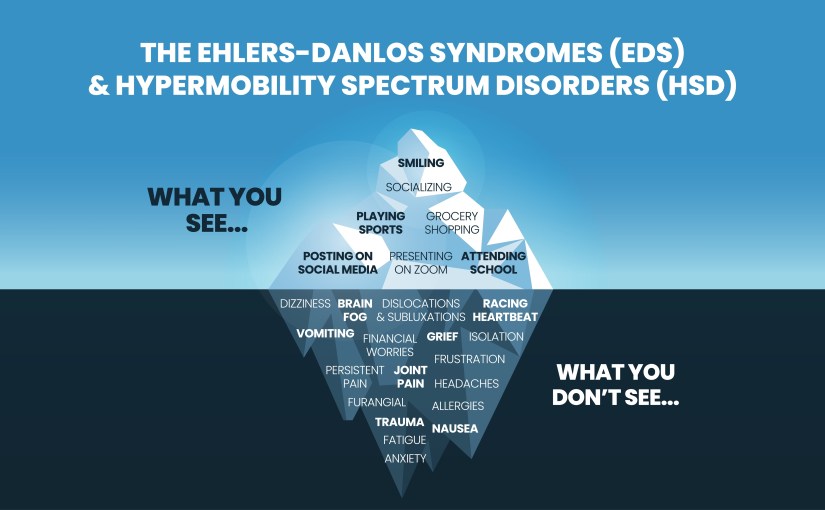
Hypermobility is a disorder of connective tissues. Some would consider connective tissues to be ligaments and tendons; they are that, and so much more.
Connective tissue is cartilage, bones, fibres such as collagen and elastin, adipose tissue (yes, fat), blood and fibroblasts, the cells that activate for tissue healing and wound repair.
So hypermobility is not just a disorder of ligaments and tendons. It has the potential to affect the whole body.
I know a lady with Ehlers-Danlos Syndrome (hEDS). For her, it caused devastation, with nine miscarriages for two live births.
People with hEDS generally have the super flexy, bendy bodies. An ignorant massage therapist can inadvertantly dislocate a shoulder during a massage. For my friend, it meant the disorder of the connective tissues presented in her uterus, with devastating consequences.
So it makes me wonder, just how much the undisguised hypermobility has impacted my life. It makes me wonder what the links are between hypermobility and hormones, postural orthostatic tachycardia syndrome (POTS), adrenal fatigue, and mast cell activation syndrome (MCAS)? Is there a link to estrogen dominance and fibroids? And is there really a difference between Hypermobility Spectrum Disorder and Ehlers Danos Syndrome?
There is so much more to be discovered. Stay tuned.
I started this blog from a simple Facebook post, expressing my frustration.
“Knowing I’m autistic and hypermobile, I started a program of daily exercises designed for an autistic, hypermobile body. I recently bought some resistance bands to add, to strengthen muscles around my hypermobile joints to help stabilise the joints. I bought a product marketed at women. Smaller diameter and thickness on the bands, girly pinks and purples as opposed to the men’s bigger, thicker and generally black bands. That’s ok. I’m starting out. I’m happy with a lighter, graduated set. So imagine my feminist outrage when I open the box of this product, marketed at females, to find a male model in the photos on the instruction sheet. WTF?”
Femvertising
Femvertising is the use of feminism in advertising. Slogans like “You go, girl” and “Girl, you’ve got this” are rampant, yet the companies behind these campaigns often fail to live up to their marketing. Recent lawsuits and scandals involving companies such as Dove, KPMG, and the Australian High Court illustrate this hypocrisy.
Interestingly, the company behind my resistance bands isn’t guilty of femvertising. There’s nothing on their website claiming feminist values or corporate social governance (CSG) statements to suggest they uphold such values. They do sponsor women’s sports teams like the Matildas (soccer) and the Opals (basketball), but there’s no explicit feminist branding. CSG is generally required for companies listed on the Australian Stock Exchange, as part of their Annual Reports.
For a deeper dive into the concept of femvertising and its impact on consumer perceptions, you can refer to Negm’s (2023) study on femvertising social marketing and Sterbenk et al.’s (2022) exploration of corporate commitment to gender equality and Katie Martell’s post on Chief Marketer (2019).
The Issue, Unboxed
Despite this, a novice like me might assume that a product with a woman on the box is specifically for women. This was my perception.
Discovering my autistic identity and acknowledging my hypermobility has been a game-changer. At 52, I realized it’s never too late to start focusing on mobility, agility, strength, and fitness. My autistic need for routines led me to design a daily exercise routine tailored to my body, focusing on strengthening muscles around my hypermobile joints to enhance stability and reduce injury risk. Recently, I decided to up my game by incorporating resistance bands into my workouts. Little did I know, this simple addition would spark a wave of feminist outrage.
These resistance bands, in lighter, graduated weights, and adorned in rainbows, seemed like the perfect fit for someone like me who is just starting out. The smaller diameter and thickness of the bands were exactly what I needed to ease into this new aspect of my fitness journey. As an autistic, hypermobile woman, the gentler progression promised by these bands was what I wanted.
Imagine my surprise and disappointment when I opened the box to find a male model featured in the photos on the instruction sheet. Here I was, having purchased a product clearly targeted at women, yet the first visual guidance I received was of a man demonstrating the exercises.
It felt like a slap in the face. In a market where women’s specific needs are frequently overlooked or downplayed, the decision to use a male model in a product designed for women seemed not just careless but insulting.
This incident might seem minor to some, but it underscores a broader issue. Why, in 2024, are women still being subjected to such thoughtless marketing strategies? The fitness industry is rife with gender-specific products, yet it continues to perpetuate outdated and exclusionary practices.
Women, especially those like me who are navigating unique physical challenges, deserve products that not only cater to their needs but also respect and acknowledge their identity. Seeing a male model in the instructional material for a women-targeted product reinforces the notion that women are an afterthought in the fitness industry.
Curwen and Park’s (2014) research on female consumers’ negative emotions can provide further insights into how such marketing missteps affect women’s experiences and perceptions .
We Deserve Better
My feminist outrage isn’t just about a model on an instruction sheet; it’s about the pervasive issue of women’s representation and respect in all areas of life, including fitness. It’s about demanding better, not just for myself but for all women.
This experience serves as a reminder that as consumers, we have the power to demand change and to support brands that genuinely understand and cater to our needs.
The journey of understanding and embracing my autistic, hypermobile body has been empowering and enlightening. Integrating resistance bands into my routine was a step towards greater strength and stability. Yet, this small act of purchasing a fitness product unveiled a glaring issue in the way women’s products are marketed.
As I continue my fitness journey, I am reminded of the importance of not only physical strength but also the strength to stand up against gender biases and demand better representation. Here’s to all the women who refuse to be sidelined and continue to push for a world that sees and respects us.
References and Bibliography
Cunningham, J., & Roberts, P. (2006). Inside her pretty little head a new theory of female motivation and what it means for marketing / Jane Cunningham and Philippa Roberts. Cyan.
G. Curwen, L., & Park, J. (2014). When the shoe doesn’t fit: female consumers’ negative emotions. Journal of Fashion Marketing and Management, 18(3), 338–356. https://doi.org/10.1108/JFMM-12-2012-0078
Negm, E. M. (2023). Femvertising social marketing: a focus on perceived authenticity and perceived congruence of the advertising and consumers’ attitudes toward female portrayal. Journal of Humanities and Applied Social Science, 5(5), 435–449. https://doi.org/10.1108/JHASS-05-2023-0053
Sterbenk, Y., Champlin, S., Windels, K., & Shelton, S. (2022). Is Femvertising the New Greenwashing? Examining Corporate Commitment to Gender Equality. Journal of Business Ethics, 177(3), 491–505. https://doi.org/10.1007/s10551-021-04755-x
Creating a new identity, a sense of self, happens at times in our lives, usually after a significant life event. For me, becoming a widow was one such event.
No longer was I a wife or carer. I was a widow, determined to forge a new sense of self as a “merry widow”.
I settled on the “merry travelling widow”. Let me tell you, I got moving on that. What I had planned:
May 2020, multi-modal trip to Melbourne and back on trains, plains, and ships.
November 2020, camp and cruise from Cairns to Bamaga and back.
April 2021, New Zealand by rail and ferry, flying in, cruising back.
September 2021, a Queensland cruise.
May 2022, a half world cruise, Brisbane to Southhampton, train to France, 8 weeks there, then the Orient Express from Paris to Venice, overland to Rome, then flying home. It was to be a glorious three month indulgence.
But, we all know what happened in February, 2020. Covid-19. All those travel plans got cancelled.
Who was I?
If I couldn’t be the “merry travelling widow”, then who was I? That’s when I settled on the “merry student widow”, as going to university had been a lifelong dream.
Prerequisites. I met the prerequisites from life experience, but I was apprehensive about writing, and, let’s face it, I left school in 1988.
I found UQ College and their Tertiary Preparation Program. Back then, in 2020, it was free. It was a crazy but wonderful program that crammed Year 11 into 13 weeks, and then crammed Year 12 into another 13 weeks.
It was wonderful. All mature age students, small class sizes, because of Covid-19, on campus at the University of Queensland’s magnificent St Lucia campus. I did Academic English, Maths, Chemistry, Biology, and Business Management.
I loved it. I thrived. It was amazing. It was life-changing. I was happy.
Regrettably, university turned out to be a major disappointment. Yes, my undiagnosed autism, and the trials and tribulations of being a grey-haired mature-age student played into it, as well. Imposter syndrome occupied every thought.
Back to UQ College
This is an essay I wrote for Chemistry. From the list of topics, I chose:
Topic Number and Name: 6. The quality of air in towns and cities is greatly affected by automobile emissions. What causes this pollution and what can be done to control it? How does the “catalytic converter” help to cut down on the pollutants released from car exhausts? Discuss the chemistry of automobile emissions and why they are pollutants and the chemistry behind the catalytic converter.
This was a no-brainer for me. With my background in occupational health and safety and environmental management, 11 years of that in downstream petroleum, along with a lifetime of “leaning left and bleeding green”, I knew this like the back of my hand.
So enjoy a technical look into vehicle emissions public health and air quality. Or, as I put it:
A story about cars, lunatics, acid rain, white bread, suicide prevention, and it’s as serious as a heart attack
(Apologies about the academic language. These assignments were supposed to get us ready for university. Oh, and I got 100% for this. )
The quality of air in towns and cities is greatly affected by automobile emissions. Vehicle emissions, and industrial emissions, have been linked to acid rain and other pollution events, and the presence of lead in petroleum (gasoline) has been linked to neuropsychiatric illnesses and lead toxicity in the general population (World Health Organisation 2002). Concerns over the air quality around the world saw international efforts to reduce exhaust emissions. In 1975, the USA implemented legislation requiring a 75% reduction in exhaust emissions, which saw the removal of lead from gasoline and gave impetus to the introduction of catalytic converters. In Australia, unleaded gasoline was introduced nationally in 1985, although it had a slow take-up (Kristensen 2015).
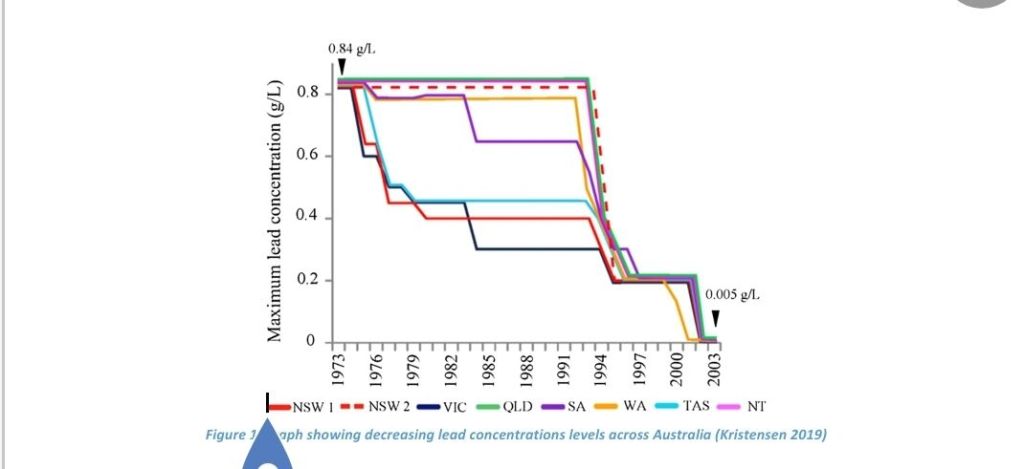
Removing lead from gasoline was a major advance in improving air quality in towns and cities (see figure 1 below), and the introduction of catalytic converters for gasoline vehicles also saw significant reduction in air pollution. In more recent times, the introduction of selective catalytic reduction (SCR) for diesel vehicles aimed to reduce greenhouse gas emissions. Internationally, vehicle emissions standards have grown increasingly stringent, such as the current Euro 6 standards and proposed Euro 7 standards. This paper will investigate, firstly, the removal of lead from gasoline; secondly, chemical reactions in a catalytic converter; thirdly, it will investigate the potential loss of functionality in catalytic converters, and lastly, it will explore selective catalytic reduction in diesel vehicles. This investigation of changes resulting in improved air quality begins with the removal of lead from gasoline.
Figure 1, graph showing decreasing lead concentrations levels across Australia (Kristensen 2019)
Leaded petrol
Lead was added to gasoline in the 1920s as an anti-knock agent and octane booster, reducing pre-ignition in engines (Compound Interest 2016). Following on from the UN’s 1972 Conference on Human Health and the Environment and the introduction of US EPA standards, lead was removed from gasoline around the world from the mid-1970s (Encyclopaedia Britannica 2019). The release of harmful lead oxides into the atmosphere was as a result of this reaction, in the combustion of leaded gasoline in internal combustion engines.
(CH3CH2)4Pb + 13O2+ heat → 8CO2 + 10H2O + Pb
Lead could then oxidise further to yield as lead(II) oxide:
2Pb + 2O2 → 2PbO2
Removing lead removed lead oxide from vehicle exhaust gases; with the move to unleaded gasoline, the combustion reaction changed to:
C8H18 + 25/2 O2 → 8CO2 + 9H20
Unleadedpetroland catalytic converters
The removal of lead also allowed for the introduction of catalytic converters, to further modify the profile of vehicle exhaust gases (Chemistry LibreTexts 2021). While the reactions above state oxygen as a reactant, the actual fuel/air mixture for the internal combustion engine cycle is drawn from air; air generally consists of 21% oxygen, 78% nitrogen, and the remaining 1% is a mixture of carbon dioxide and other gases. As a result, the reaction that produces nitrogen oxides in vehicle exhaust gases is incidental to the internal combustion engine process. These harmful nitrogen oxides, along with carbon monoxide, are dealt with by the catalytic converter. The catalysts, platinum, palladium and rhodium, trigger a two-stage reaction. The first stage in a catalytic converter deals with the nitrogen oxides, in a reduction reaction, using rhodium as the catalyst.
2NOx → xN2 + xO2
The second stage in a catalytic converter is an oxidation reaction, with platinum and palladium as the catalysts, combining carbon monoxide and oxygen to create carbon dioxide, and combustion of gasoline to produce carbon dioxide and water in vehicle exhaust gases.
2CO + O2 → 2CO2
2C8H18 + 25O2 → 16CO2 + 18H2O
The question remains, though, for how long does a catalytic converter remain effective?
Precious metals found where?
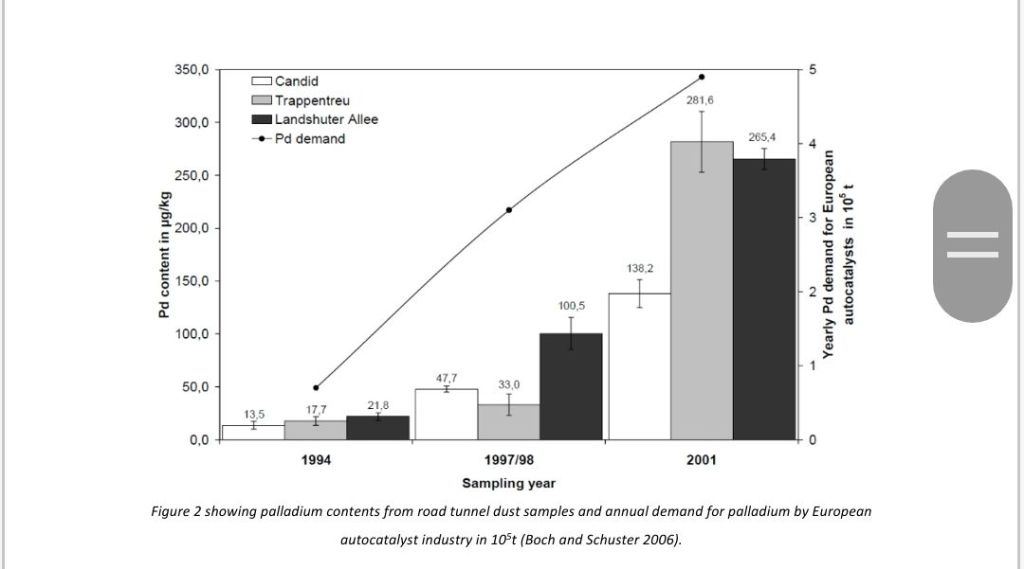
Since the introduction of catalytic converters, researchers have explored the presence of platinum, palladium and rhodium in the environment. Researchers have discovered these precious metals in road sludge and sewage systems. In Germany, a longitudinal study of samples of road tunnel dust, over seven years from 1994 to 2001, showed the presence of palladium in dust samples increasing over time; in 2001, samples yielded a combined total palladium content from the three tunnels involved in the study, of 685.2 palladium μg/kg (Boch and Schuster 2006). See figure 2 below.
Figure 2 showing palladium contents from road tunnel dust samples and annual demand for palladium by European autocatalyst industry in 105t (Boch and Schuster 2006).
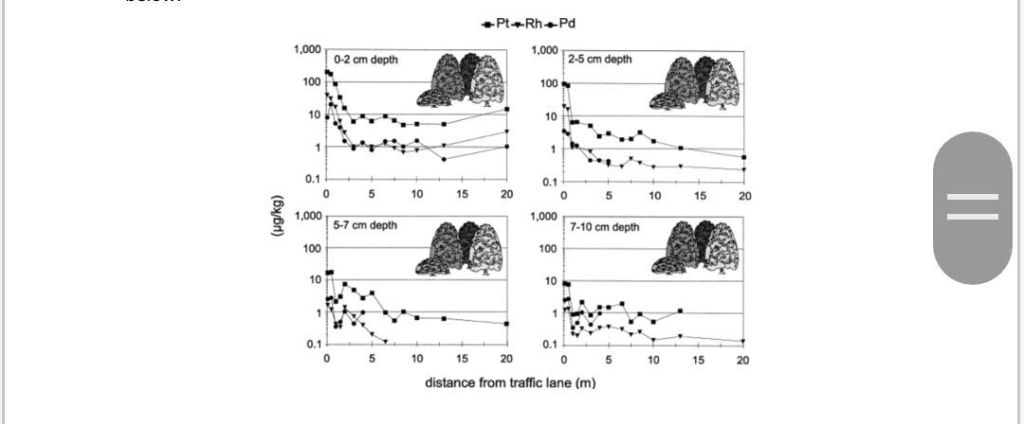
In 1998, further research found platinum, palladium and rhodium at locations along German roads, yielding concentrations above background levels at varying depths, with the highest concentrations found within 10 metres of the road (Schäfer and Puchelt). See figure 3 below.
Figure 3 showing concentrations of platinum, palladium and rhodium found along German highways (Schäfer and Puchelt 1998).
In 2016, Chinese researchers found platinum, palladium and rhodium above background levels, with a median measurement of 68.25ng/kg, 93.15ng/kg and 23.85ng/kg, respectively (Zhong et al).
The conclusion is that these metals are on the road after having become detached from the catalytic converter (Boch and Schuster 2020; Schäfer et al 1996). In 2019, Goodman et al reported that while car manufacturers, in the expectation that metal atoms would move to form larger particles, usually apply more platinum, palladium and rhodium to catalytic converters than would normally be considered necessary. It was expected that this sintering, forming larger particles would decrease the effectiveness of catalytic converters over time. Goodman et al discovered that the opposite also happens, with the elements becoming ineffective as catalysts, as they decompose into single atoms. This then calls into question the long-term effectiveness of catalytic converters, in the absence of mandatory exhaust emission testing. However, Brisbane City Council offers exhaust emission testing for diesel vehicles as part of the City’s environmental management program (Brisbane City Council 2020).
Diesel fuel
Diesel vehicles have a different profile for exhaust gases, including sulphur dioxide and nitrogen oxides. Sulphur dioxide emissions have been reduced through fuel quality standards in Australia, which restrict sulphur content in diesel to no more than 10mg/kg (Fuel Quality Standards (Automotive Diesel) Determination 2019 (Cwth)). Nitrogen oxides in diesel exhaust gases have been reduced through the introduction of SCR. SCR, aqueous urea, is marketed in Australia as AdBlue, and most modern diesel trucks, and some diesel passenger vehicles, will not operate without an adequate volume of AdBlue in the tank. The SCR is injected into the exhaust of diesel vehicles. See figure 4 below.
Figure 4, still from video illustrating the SCR reaction in diesel vehicle exhaust (AdBlue Dispensing n.d.)
The aqueous urea (32.5% in solution) decomposes in the hot exhaust gas to form ammonia and isocyanic acid.
(NH2)2CO → NH3+ HNCO
The isocyanic acid hydrolyses to produce carbon dioxide and ammonia.
SCR technology has progressively been rolled out to trucks and passenger vehicles, under the Euro Diesel 6 standard (Association for Emission Control by Catalyst 2021). The ongoing focus on particulate matter in diesel exhausts and the impact on human health, though, has seen a trend to ban diesel vehicles from roads entirely (European Federation for Transport and Environment 2018).
Vehicle exhaust gases, from both gasoline and diesel vehicles, have contributed to air pollution. The switch from leaded gasoline to unleaded gasoline was a major first step; the introduction of catalytic converters for gasoline-powered vehicles saw further improvement. The presence of the catalysts, platinum, palladium and rhodium, in roadside environs, raises questions about the ongoing effectiveness of catalytic converters, in the absence of mandatory testing of vehicle exhaust gases. Exhaust gases from diesel vehicles have also been cleaned up, with aqueous urea as the catalyst to remove greenhouse gases from diesel vehicle exhaust gases.
As the world considers the transition to electric vehicles, and hydrogen powered vehicles, gasoline and diesel-powered vehicles are likely to remain on our roads for several years to come. In the interim, mandatory testing of exhaust emissions in gasoline vehicles could quantify the issue of non-functional catalytic converters, complemented by further research to follow on from the work of Goodman et al.
Diesel vehicle exhaust emissions could also be tested regularly, for particulate matter. Shifting the transport of freight from road to rail, such as is proposed for the inland rail corridor, could see a reduction in the number of trucks on the roads, and there are already many electric buses on the roads. Lessons can be learned from the introduction of tetraethyllead into gasoline, given the public health epidemic that ensued. Such advancements in improving air quality may yield better health outcomes not just for humans, but also our planet.
Boch K, Schuster M, 2006, ‘Determination of palladium in road dust and sewage sludge ashes’, in F Zereini, F Alt (eds), Palladium Emissions in the Environment, Springer, Berlin, Heidelberg, pp. 191-201, https://doi-org.ezproxy.library.uq.edu.au/10.1007/3-540-29220-9_14.
Goodman, ED, Johnston-Peck, AC, Dietze, EM, Wrasman, CJ, Hoffman, AS, Abild-Pedersen, F, Bare, SR, Plessow, PN & Cargnello, M 2019, ‘Catalyst deactivation via decomposition into single atoms and the role of metal loading’, Nature Catalysis, vol. 2, no. 9, pp. 748-755, https://www-nature-com.ezproxy.library.uq.edu.au/articles/s41929-019-0328-1.
Schäfer, J & Puchelt, H, ‘Platinum-Group-Metals (PGM) Emitted from Automobile Catalytic Converters and Their Distribution in Roadside Soils’, Journal of Geochemical Exploration, vol. 4, no. 1, pp. 307–14, https://doi.org/10.1016/S0375-6742(98)00040-5.
Schäfer, J, Eckhardt, J, Detlef, B, Zsolt, A & Stüben, D 1999, ‘Time-dependent increase of traffic-emitted platinum-group elements (PGE) in different environmental compartments’, Environmental Science & Technology, vol. 33, no. 18, pp. 3166–3170, https://pubs-acs-org.ezproxy.library.uq.edu.au/doi/abs/10.1021/es990033i.
Zhong, L, Li, J, Yan, W, Tu, X, Huang, W & Zhang, X, ‘Platinum-group and other traffic-related heavy metal contamination in road sediment’, Journal of soils and sediments, vol. 12, no. 6, pp.942–951, https://doi-org.ezproxy.library.uq.edu.au/10.1007/s11368-012-0527-8.







 The Auld Skald's Fudgel