So long, farewell, auf wiedersehen, goodbye
Back in late September 2021, the world was still a bit crazy with Covid-19. In that craziness, I jumped from passenger to driver. And what a ride it’s been.
Nearly four years later, more than 7,000 rides, and more than $210,000 in revenue, I’m hanging up my Shebah hat.
In that four years, I’ve worn the widow hat a little easier, and I found a new hat—the autistic hat. And it’s that autistic hat that now means hanging up the Shebah hat.
—
When strengths overstay their welcome
There’s a 20th-century business principle that essentially says: a strength, over-used, becomes a weakness.
That’s exactly what happened to me.
My care, dedication, compassion, reliability—everything that made my weeks so reliable and structured with regular passengers—was the same strength that became my weakness. In theory, yes, my time was mine to decide, my schedule mine to decide. But in the face of passenger needs, and the scarcity mindset that runs through the gig economy, my time was no longer mine at all. It was dictated on passenger terms.
Scarcity is a tricky thing. The gig economy runs on it. If I say no today, will I be asked tomorrow? If I don’t take this booking, will someone else slide in and take the work? Add in an autistic brain—one that craves rhythm, predictability, structure—and you get the perfect trap. The schedule looks like regulation, but the regulation isn’t yours anymore. It belongs to everyone else.
—
The shape of exhaustion
Here’s what that looked like in practice: a booking at 7.10am, then 8.30am, 9.20am, 12pm, 3.15pm, 5pm, 6.55pm, 8pm, and 8.30pm. Fourteen hours away from home. Packed breakfast, lunch, and dinner. Water, coffee, snacks. And when I finally got my autistic self home? Exhaustion in a way only other neurodivergent people really understand.
I love my passengers—don’t get me wrong. Seeing the same people every day, every week, every fortnight, every holiday trip to and from the airport. The interstate regulars who sometimes even planned their flights around my availability. It was a special rhythm. And for me, getting to know my autistic self, that rhythm was part of my regulation.
But when I had trouble finding messages from friends in amongst all the messages from passengers? The flags were hard to ignore.
—
The straw that broke the back
And then came the new driver and passenger app. Not the cause of my leaving, but the straw that broke the camel’s back. A shift in systems that tipped an already precarious balance.
—
Mon répit
So here I am, reclaiming my time.
The dream now? A 4–5 hour window in the middle of the day, in the style of the French “pause.” Mon répit.
Because yes, I was making my revenue targets—but not in a productive way. I want productivity with dignity, not exhaustion.
—
The close
What it all means is that I’ll still be driving—just not in Shebah colours. Two other services now carry me, and with them, the space to shape my days differently.
Goodbye, Shebah hat. You taught me a lot, you carried me through grief, and you gave me thousands of rides and stories. But it’s time.
So long, farewell, auf wiedersehen, goodbye.
Category: Uncategorized

The Price of Quiet
In 1984, at the kitchen table after breakfast, Lottie was still hesitating about selling the house. I was thirteen, resisting the idea with the kind of immovable emotional gravity that only children can manage. Roy was at the sink, washing up the breakfast dishes. She raised the subject again, gently, nervously, that maybe they shouldn’t sell, and stay here in Maryborough.
He didn’t turn around.
“Oh, it’ll be sold all right. You’ll get your bloody half and I’ll get mine.”
That was the end of a marriage that had lasted forty-seven years. A marriage that started in World War Two, was blessed with a son, survived the loss of a son, continued through the medical crisis and grief, celebrated an adopted daughter; 47 years, ended with 15 words.
The divorce and property settlement would unfold slowly, bureaucratically, over the following years. But in that moment, the damage was done. The foundations cracked, the promise dissolved, and whatever love or duty had once held them together slipped into silence.
What followed was not rebuilding. Not reflection. What followed was Serepax.
Doctor’s Little Helper
Before Serepax, there was Vincent’s APC powder. Aspirin. Phenacetin. Caffeine.
Tipped into tea, taken at the sink, sold over the counter, handed from woman to woman like advice. For nerves. For cramps. For pressure. For life.
Phenacetin was toxic to the kidneys. It caused silent renal failure. It was eventually banned—but not before decades of women had used it daily. Lottie was one of them.
By the 1980s, phenacetin was gone, but the logic behind it remained. Women weren’t offered support. They were offered sedation.
Enter Serepax. Oxazepam. The little white tablet that didn’t raise eyebrows. Not scandalised like Valium. Not brutal like Mandrax. Serepax was positioned as gentle. Appropriate. Feminine.
“Serepax is gentle,” they’d say. “And sometimes, that’s all you need.”
But Lottie didn’t need gentleness. She needed thyroxine.
What Serepax Did, and What It Didn’t
Serepax binds to GABA receptors. It slows the central nervous system. It calms—but it also dulls. It sedates without healing. It mutes without solving.
What it doesn’t do is more important than what it does.
It doesn’t regulate metabolism.
It doesn’t support cardiovascular health.
It doesn’t restore thyroid hormone.
It doesn’t correct the biochemical collapse of post-surgical hypothyroidism.
Lottie didn’t need to be sedated. She needed her endocrine system supported. She needed a blood test. A plan. A dose.
But instead, she was handed quiet.
Eighteen Years of Slow Poison
Lottie had her partial thyroidectomy in 1969. No thyroxine was prescribed. No endocrinologist consulted. No one followed up.
And for eighteen years, her body deteriorated.
She had previously used Vincent’s powders, damaging her kidneys. She smoked two packets of cigarettes a day—forty cigarettes daily—constricting her blood vessels and starving her tissues of oxygen. She was eventually prescribed Serepax, which dulled the symptoms but never touched the cause.
This wasn’t benign neglect. It was accumulative harm. It was a system that kept handing her silence and calling it medicine.
Her body was in contradiction. One foot on the brake, hypothyroidism slowing her down. One foot on the accelerator, nicotine and anxiety pushing her to keep up.
No one was watching the dashboard.
Her weight crept up, from twelve stone to fourteen. Her energy declined. Her skin changed. Her cognition slipped. Her emotional regulation shattered.
They said she was hormonal.
They said she was difficult.
They said she was just getting old.
They said everything except the one thing that mattered.
“We failed you.”
The Silence of Renewals
Every few months, she would visit the GP. Not for evaluation. Not for curiosity or care. Just for authority scripts.
Her Serepax was renewed, over and over again, without reassessment, without bloodwork, without anyone asking whether it was still helping—or if it ever had.
There was no hormone panel. No psychiatric review. No second opinion. Just a refill.
The treatment she needed was simple. The question she needed someone to ask was obvious.
“Do you think this might be your thyroid?”
But no one asked. Not in 1971. Not in 1977. Not in 1985.
Symptoms Reframed as Personality
Lottie wasn’t treated. She was blamed.
Her emotional outbursts weren’t seen as neurological symptoms. They were called tantrums.
Her swelling wasn’t myxedema. It was weight gain.
Her exhaustion wasn’t hormonal. It was laziness.
Her paranoia wasn’t biochemical. It was madness.
She wasn’t seen as a woman whose body had been mismanaged. She was seen as a woman who was hard to love.
And when a woman becomes too loud, too fragile, too unrecognisable, people stop coming. Friends drifted. Family pulled away.
Eventually, even the mirror avoided her.
This Was Not a Personal Failure
This was not a woman who failed to take care of herself.
This was a woman no one took care of.
What happened to Lottie between 1969 and her death in 2005 was not the result of poor lifestyle choices. It was the result of systemic disinterest, gendered medicine, and a clinical culture that mistook sedation for support. Iatrogenic hypothyroidism. Doctor-caused harm
She was not sad. She was hypothyroid.
She was not mad. She was mismanaged.
She was not a lost cause. She was abandoned.
Mama’s Holding Things That You Can’t Buy
From The Chiaroscuro Anthology to The Infernal Dames
Yesterday, The Chiaroscuro Anthology closed with a poem depicting intergenerational trauma, starting with rage against parents, ending with a promise to a child.
So hush, little baby, don’t you cry,
Mama’s here to help you fly.
And if flying feels too much to do,
Mama’s gonna stay right here with you.
A soft ending to The Chiaroscuro Anthology—nineteen poems about my autistic experience.
Yet, I’m not just autistic. I’m a woman, 53 years on this earth, and furious.
Not Joking – Global Gender Parity in 2158
The World Economic Forum estimated, late last year, that it would take another 134 years to reach global gender parity.
134 years
This day, this year, this decade, this century—we have granddaughters still fighting the battles their grandmothers thought they had won. Intergenerational inequity. Injustice, passed down like recipes and silverware. From the Greats to the Silents, the Boomers, Gen X, Millennials, Gen Z, Gen Alpha, and the unborn Gen Bravo.
The First Wave. The Second Wave. The Third Wave of feminism.
How many more waves must we ride when we’re already facing a tsunami?
A tsunami of dead women.
A tsunami of gender pay gaps.
A tsunami of stolen autonomy—of everything, even down to kitchen bench heights and seatbelts in cars.
Why not build a fire so big that not even this tsunami can extinguish it?
From this idea came The Infernal Dames.
While I have no children, I make this promise to the grandchildren of the next generation.
I do not want you to inherit the intergenerational trauma of centuries, the ache of millennia. I don’t want you to have to sing this lullaby and know it’s real:
Hush, little baby, don’t you cry
Mama’s holding things that you can’t buy
And if those things do make you cry
You’ll understand why, bye and bye.
The Infernal Dames
A forensic reckoning, a class action, a ledger of women burned by silence, by medicine, by the system.
We gave more care to punch cards than to living women. “Do not fold, spindle or mutilate.”
We built hospitals where no one listened. “It’s anxiety. Lose weight.”
We prescribed silence. “Take this, it will help.”
We institutionalised grief. “You’re too much. Take this, it will help.”
We pathologised hormones. “You’re hysterical. Too much.”
We erased. “Your file could not be found.”
It is my intention that The Infernal Dames will roar.
Tomorrow, we begin.

Autistic Humor & The Unexpected Joys of Neurodivergence
Authored by ChatGPT, at my request
“Protecting vampires since 2008.”
I drive past the sign on the auto window tinting business and laugh out loud. Alone. The road is quiet, the car’s a bubble of music and thought, and that one sentence lights up my brain like a pinball machine. It’s clever. It’s absurd. It’s perfect.
Except, I wasn’t alone that day. Riding beside me was a lovely woman—autistic, mid-support-needs, on her way to her supported workplace. She hadn’t seen the sign, but she heard my laugh and asked why. I told her what it said.
And she laughed too.
Not politely. Not performatively. She got it. And we laughed together, our brains delighting in the same absurd leap. That laugh was a moment of mutual recognition. Two autistic women, different support needs, same wiring for joy-in-inference.
That laugh? That involuntary burst of recognition and joy? It turns out, it’s a kind of unofficial diagnostic tool. Not just for autism, but for how your brain is wired to process humour.
The Inference Engine
Let’s break it down. The vampire joke has no punchline. No setup. Just a sign:
Protecting vampires since 2008.
No explanation. No context. No visual cue. Just a sentence. To laugh, your brain has to do some lightning-fast conceptual acrobatics:
- Window tinting reduces UV light.
- Vampires are fictional creatures that burn in sunlight.
- Therefore, tinted windows would help a vampire avoid sun damage.
- That means the tinting business is jokingly marketing itself to vampires.
You laugh because it’s absurd, but it tracks. It’s coherent. It’s a leap that lands. And if your brain is wired for lateral, pattern-based inference, it’s delicious. It’s play.
But if your processing style relies more on literal, linear, or socially mediated cues, the joke might fall flat. It might seem nonsensical or confusing. That sign becomes noise, not signal.
For many autistic people, this kind of inferred humour—the kind that leaves gaps to be mentally filled in—is our bread and butter. We love absurdity, incongruity, layers. We love jokes that reward close reading, or that subvert the obvious. Not because we’re trying to be clever. But because it feels good to solve the puzzle.
It’s not that NTs can’t get it. It’s that many don’t default to humour as inference. They default to humour as social bonding or tone. And that’s a very different joke structure.
A Brief Map of Humour (and How It Lands)
Let’s zoom out. What are the main types of humour—and how might they hit differently depending on your neurotype?
Slapstick – Physical comedy, pratfalls, exaggerated gestures. Often lands better when visual and immediate. Popular across audiences. (Think: Mr Bean, Buster Keaton.)
Parody – A mimic of a known form or genre, often with a twist. Autistics often love this especially when it involves rule-breaking or subverting clichés. (Think: Weird Al.)
Satire – Critical, layered, often political. Requires cultural context but rewards pattern recognition. (More on Jon Stewart and George Carlin below.)
Deadpan/Dry Humour – Delivered without affect. Can be gold for autistic folks who dislike forced tone or expressive exaggeration. (Think: Steven Wright, Tig Notaro.)
Wordplay/Puns – Linguistic gymnastics. Often polarising. Loved by those who delight in language precision and soundplay.
Dark Humour – Morbid, taboo, or gallows humour. Strangely therapeutic for many ND folks—it creates distance from trauma.
Surreal/Absurdist – Dreamlike, irrational, sometimes nonsensical—but not random. When patterns are just under the surface, ND brains light up. (Think: Monty Python.)
Observational – Everyday situations reframed. If rooted in relatable sensory or social experience, this can be gold for both ND and NT folks.
Sarcasm/Irony – Tone-based, socially coded. Often alienating for autistic people—unless the sarcasm is clearly marked, or structurally logical.
Comedians as Case Studies
Jon Stewart: The Satirical Architect
Jon Stewart’s legacy on The Daily Show wasn’t just about jokes. It was about layering facts, framing hypocrisy, and constructing absurd juxtapositions that revealed the cracks in public discourse. This was humour that rewarded inference. You had to track the logic behind the joke. Autistic viewers—especially those wired for systems thinking—often felt right at home.
Stewart’s timing was surgical. But his power lay in mapping truth onto absurdity and watching the audience blink awake. It wasn’t just funny. It was intellectually satisfying.
George Carlin: The Linguistic Prophet
Carlin was a brutalist in word form. He ripped through cultural norms with a sledgehammer made of syllables. He cared about precision. Language was his scalpel. His infamous “seven dirty words” routine? Not just provocation—it was a thesis on arbitrariness, censorship, and semiotics.
For autistic listeners who have a deep relationship with language, Carlin’s rants feel like sermons. He didn’t just joke. He argued. His comedy had structure, rhythm, ethos. It lit up the logic-loving parts of the brain.
Dave Allen: The Subversive Storyteller
Allen, the Irish comedian with the missing finger, was master of the slow burn. He sat in a chair with a glass of whiskey and told stories. Stories that bent into absurdity. Catholic guilt, childhood fear, death, silence—all fair game. He was dry, sly, and layered.
He didn’t hammer home punchlines. He let the absurdity sit. Which gave autistic viewers time to inhabit the joke, not just hear it. Allen’s humour was subversive but gentle. He told truths sideways.
When Your Laughter Is a Clue
The lonely laugh is a very specific autistic experience. You find something hysterical, but the room doesn’t. They stare. They frown. They ask, confused: “Why is that funny?”
You start doubting your reaction. You feel the weight of social dissonance. But here’s the thing: you weren’t wrong. You just mapped a meaning they didn’t see.
And when you finally meet someone who does laugh with you? It’s electric. It’s recognition. It’s relief.
Because humour is not just about fun. It’s about how we process reality. It’s how we name absurdity, process grief, and resist the tyranny of the literal.
The Social Rules of Laughing
In neurotypical culture, humour is often about timing, tone, facial expression, and shared context. It’s less about conceptual elegance and more about bonding. Laughing at the “right” jokes builds social capital. Not laughing when you’re “supposed to” marks you as odd.
For autistic folks, humour is often more private. It’s not always expressed in facial or vocal cues. It’s dry, lateral, layered. It’s often missed by NT peers—not because it’s not funny, but because it’s not marked the way they expect.
We weren’t humourless. We were just running a different codebase.
Final Thoughts: Laughing in the Wild
So yes. That vampire sign? It was more than a roadside chuckle. It was a litmus test. It asked:
Do you think in metaphor?
Do you delight in absurd inference?
Does your brain fill in gaps faster than conversation can catch up?
If you laughed—maybe you’re one of us.
And if you didn’t? That’s okay too. Just don’t be surprised when we laugh first. We’re not confused. We’re just already three steps down the metaphor.
The Chiaroscuro Anthology, 14/19
Too late and right on time
By Lee-Anne Ford
In a time and place both near and far,
A girl grew up in her own bright way.
They called her smart, well-read, terrific—
Charmed by the cute things she would say.
Unknowingly autistic.
In second grade, she had a friend,
Dear Sylvie, always near.
A year behind, repeating class,
Then suddenly—she disappeared.
Unknowingly autistic.
“Subnormal,” they said. “Special school.”
So Sylvie went away.
Two girls who laughed at hidden things—
But only one got to stay.
Unknowingly autistic.
Imagine, then, if they had known,
If supports had lit the way—
Two girls giggling at the world,
In their own autistic play.
Knowingly autistic.
Two friends for life, side by side,
Safe, understood, together.
Instead, the years just faded her,
A friendship lost forever.
Unknowingly autistic.
But in some world, some place beyond,
Where time bends, twists, and sways,
Maybe they’re still swimming, laughing—
In their own autistic way.
Knowingly autistic.
Singing, biking, learning, growing,
Side by side, each day.
Instead, they split—one “subnormal,” one “smart”—
The 1970s way.
Unknowingly autistic.
And now I stand, reborn at last,
Autistic since ‘72.
It took fifty years to know myself—
To see the truth in view.
Knowingly autistic.
But grief, too, for what was lost—
For the path that might have been.
Two girls who should have had forever,
But lived in different skins.
Knowingly autistic.
Want the whole Anthology? It’s here.

The Chiaroscuro Anthology, 11/19
Chronos’ paradox
By Lee-Anne Ford
You look young for your age
I feel old
Your appointment’s at 1pm
Work backwards to waking
He’s 29, so what?
He makes sense that boys my age don’t
What time is it?
What day is it?
Oh no, what did I forget?
Bulk order of sticky notes
Ten hours later
Am I hungry?
Let me sleep.
Want the whole Anthology? It’s here.

A life without consent
Imagine a world where you have never had a choice, never had autonomy.
This is the world of my birth mother, Coralie. Born of rape, adopted out, and happy until her adopted mother died. Unhappiness began with the arrival of a stepmother, culminating in a pre-teen being committed to the psychiatric hospital. Her first relocation without consent.
She stayed in the psych hospital until late 1972, falling in love and birthing a daughter along the way. But both her lover and daughter were sent away. A dislocation without consent.
When she left the hospital—a 24-year-old mother with no child, handicapped by 14 years in a psychiatric ward, those important teenage years when you find yourself—she entered a boarding house with little to no life skills, and stayed with the family of that boarding house for 30 years, even when they moved from Toowoomba to Tallebudgera. A relocation without consent.
Meeting, once again, her lover from the hospital, marriage ensued, a departure from the boarding house. A relocation with their dissent and her consent.
Marriage, happy until his dementia brought violence. A police-assisted exit and placement in a nursing home. A relocation without consent.
Three years later, the nursing home is scheduled for demolition, no longer fit for use. Relocation to another nursing home. A relocation without consent.
And all while undiagnosed autistic, bearing the shame of growing from child to adult in an asylum.
So how could I, that daughter she gave life to in 1972, knowing my own autism at last, leave her on her own? When her childhood diagnosis of childhood schizophrenia with borderline mental retardation really meant that she was autistic, too—the source code of mine—how could I not support her, mother her, in this latest unconsented relocation?
Think of all the autistic things. Change in routine, outraged sense of justice, RSD. And so much more.
So while draining, it was my privilege every step of the way, from old to new. To stay with her, for hours, as she processed; to listen to her and to let her know that yes, I am autistic, and you are, too. Just like our hair, our jawline, our noses; our autism.
And to prove her autism? Her first thought was for her half-sister: was she autistic, too? Hyperempathy and pattern recognition.
So I told her I loved my autism and the things it gave me. And I thanked her.
That was Thursday. Friday, she was better. I gave her the zebra card; we are not defective horses, we are zebras. And we cried together. For that, and for the birthday of her lost husband, my birth father. Turning 81, alone in his world of dementia.
Mothering my adopted mother was done from love and obligation, and turned to alienation and hatred.
Mothering my birth mother through yet another unconsented relocation and her grief for the husband not yet dead, was a privilege.

The Chiaroscuro Anthology, 7/19
A childhood in deficit and afficit
By Lee-Anne Ford
She’s not gifted, just smart.
She’s not talented, just smart.
She’s a girl, she can’t do that.
She’s a girl, she can’t be that.
Brutal put-down, not my shutdown
Let me throw down, take you down
Do I shine too bright? Wear sunglasses.
Do I fall too low? That’s your shame.
Do I dig too deep? That’s your shallow.
Do I see too much? That’s your blindness.
Brutal shut-down, fallen crown
Let me lie down, adjust my gown
You judge too much. Not my fault.
You’re blind to see. Not my fault.
You cannot touch. Not my fault.
You cannot hear. Not my fault.
Allistic let-down, don’t dare frown
Autistic touchdown, go to town.
We are, we have, we do.
We just don’t do you.
Want the whole Anthology? It’s here.
New recipe – cashew salad dressing
Cashews, you say? It’s amazing how many good things can start with 200g of cashews in hot water and soaked for 4 hours, or even overnight.
Coleslaw with Cashew Dressing
I wanted to make easy coleslaw so I grabbed a pre-made ranch salad mix from the supermarket. It had croutons and a little dressing packet—both got the boot. I needed something creamy but calm, rich without being sharp. I’d just made an experimental batch of my cashew salad dressing… and it was perfect.
Why It Works:
The creaminess of the dressing balances the crunch of raw veg, without the tang or sharpness of traditional slaw dressings. It’s rich, grounding, and full of nutrients. The miso and nutritional yeast add umami that gently replaces vinegar’s sharp lift.
How to Make It (The Real-Life Way):
One packet of supermarket coleslaw mix (skip any croutons or dressing)
A few generous spoonfuls of Cashew Salad Dressing (adjust to taste and texture)
Toss until everything is gently coated. Eat straight away or chill for an hour to let the flavors settle. It keeps well in the fridge for a couple days.
Sensory Notes:
Texture: Crunch meets cream—satisfying without sharpness
Flavor: Subtle, savory, no sour tang
Aroma: Mild and comforting
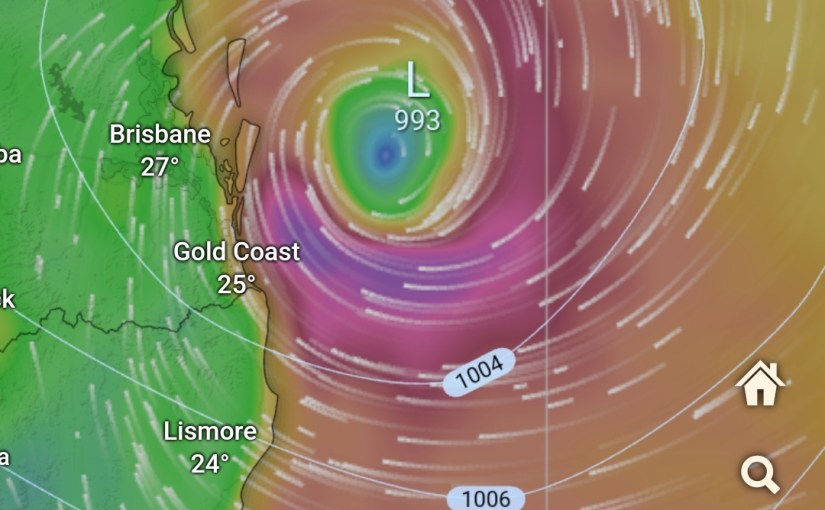
Tropical Cyclone Alfred
Veni, Vidi… Defici” (It came, it saw… it faltered)
Tropical cyclones. If you’ve been through one, the next one will still surprise you.
One of the good things that mother did was not to pass on her fear of storms to me. I am grateful for that, because I do love a good storm. But tropical cyclones? Yes, I even have nostalgia about them.
How, you say. How could anyone have misty-eyed nostalgia about tropical cyclones?
Like this. In the 1970s, we didn’t have a TV. We had radio. And radio is where I heard the crisp-toned voices of emergency broadcasts on the ABC, and that emergency cyclone warning I saw as a loaded spring, like a slinky. (I didn’t know I was autistic then, but, hello, synaesthesia.)
I was fascinated by the places that were always mentioned. Home Hill, Clairview, Double Island Point, St Lawrence. Mother, or father, as I can’t recall who started it, would pull out the big fold-up map of Queensland and we would trace the cyclones on the nap by the radio calls.
That’s how I learned Queensland’s shape, coastline, towns and inland regions. Tracing a child’s finger over those place names and imagining, wondering.
My “close calls” with cyclones, a little too close to home, was TC Cliff in 1981 (when I was 8 years old) and TC Nancy in 1990, when I was 18 years old.
Cliff went for Bundaberg, but its effects were felt in Maryborough and much further south than that, all the way to the Gold Coast, with beach erosion. I remember my parents, taping windows, and talking about the protection that K’gari (the Fraser Island) offered, a big buffer against storms. But, they said, what if one comes down the middle, between Fraser and the mainland. “Down the guts” is how I remember father saying it.
As an adult, I still know the names of those places, heard on old radio sets in the 1970s. And I’ve made a point of visiting them. A curious thing, but it meant something to me. Seeing the places that had only existed for me, before, on maps and in cyclone warnings.
So, yes, I have some nostalgia about cyclones, but also a healthy respect.
So when Alfred came along, I was not at all blasé. Most track maps had it crossing the coast some 8kms north of me as a Cat 2. Just like Cliff. Just like Nancy. So I filled water bottles, brought everything inside, prepped my important documents and, with my housemate taped 100m² of glass.
Alfred, Alfred, Alfred. You came too far south and Moreton Island broke you.
But what if, one day, due to global warming, our ocean waters off south-east Queensland get to 28°C? Warm enough to sustain a Cat 2, a Cat 3, or God forbid, a Cat 5? I’ll joke now about the Toowoomba Surf Life Saving Club, and hope it remains a joke.
So, enough of my maudlin meanderings. Here is ChatGPT’s interpretation of my other ramblings about ex-TC Alfred.
Understanding Cyclone Alfred: A Near Miss and the Role of Outer Pressure Bands
Cyclone Alfred may not have made landfall, but that doesn’t mean it wasn’t a legitimate cyclone. In fact, Alfred’s path and effects highlight an important but often misunderstood aspect of tropical cyclones: the significance of outer pressure bands. With many people trying to grasp the event, it’s crucial to clarify the nature of Alfred’s journey, why it was a fully developed storm, and the role these outer bands play in its reach and impact.
Cyclones don’t need to make landfall to be powerful or to have significant effects. Alfred was a case in point. While it didn’t directly strike Southeast Queensland, it was still a force to be reckoned with, and its outer bands caused considerable disruption in coastal regions. But what exactly do we mean when we talk about the outer pressure bands, and how do they differ from the eye of a cyclone?
—
A Legitimate Cyclone: The Journey of Alfred
Alfred wasn’t a ‘wannabe’ cyclone. It started its life in the Coral Sea and, at its peak, strengthened to a powerful Category 4 system, driven by the warm ocean waters that act as a nursery for tropical cyclones. These waters provide the energy a cyclone needs, following fundamental principles of thermodynamics—where heat from the ocean fuels rising air currents, lowering surface pressure and creating a self-sustaining system of spiraling winds.
As it tracked southward, high-pressure systems to the east and south forced it westward, a classic example of how weather is a continuous process of high-pressure areas moving toward low-pressure areas in an attempt to reach equilibrium. This constant balancing act of atmospheric forces shapes global weather patterns, and tropical cyclones are one of the most dramatic examples of this principle in action.
As Alfred neared Southeast Queensland, it slowed significantly to just 7 km/h, which isn’t typical for a tropical cyclone but may be more characteristic of a system transitioning into temperate waters. However, due to climate change, these waters were warmer than historical averages, which may have influenced its unusual slowing. Cyclones in temperate zones often move more slowly due to weaker steering currents, but Alfred’s behaviour may indicate a shifting pattern as ocean temperatures continue to rise.
—
Outer Pressure Bands: The Real Impact of Alfred
While the eye of a cyclone is often the most dramatic and dangerous part of a storm, it’s not the only area that affects land. In fact, the outer pressure bands—sometimes stretching hundreds of kilometers from the cyclone’s center—often have the most widespread impact, even when a cyclone doesn’t make direct landfall.
These outer bands are large swathes of rain and wind that spiral outward from the cyclone’s core, extending far beyond the calm eye. As the system moves, the rotation of these bands can bring heavy rain, strong winds, and even tornado-like conditions to areas far from the storm’s center.
In Alfred’s case, these outer bands were responsible for most of the disruption across Southeast Queensland and Northern NSW:
Lismore and the Northern Rivers, the Gold Coast, and Redland Bay all felt the impact of Alfred’s outer bands as the storm ran parallel to the coast.
On the eastern part of the rotation, these same bands later brought horizontal rain to northern Brisbane—two days after Alfred had weakened.
People often assume that if a cyclone doesn’t make landfall, it isn’t a real threat. But Alfred’s impact came from its outer bands, not its eye. This is typical cyclone behaviour—many cyclones run alongside the coast rather than striking directly, and their effects are felt across a much wider area than just their central path.
—
The Cyclone Eye vs. Outer Bands: What’s the Difference?
The eye of a cyclone, with its eerie calm, is the most recognizable feature of a storm. This is where winds are light, skies clear, and atmospheric pressure is at its lowest. But surrounding the eye is the eyewall, where the storm’s most intense winds and rainfall occur.
Beyond the eyewall lie the outer bands—vast spirals of convective clouds, wind, and rain that extend far beyond the storm’s center. These bands are responsible for:
Heavy rainfall over large areas, sometimes leading to severe flooding.
Strong, gusty winds that can cause damage even far from the cyclone’s core.
Isolated storm cells, which can spin up tornado-like conditions.
The most destructive effects of a cyclone don’t always come from the eye itself. In many cases—Alfred included—it’s the outer bands that do the most damage, especially when they interact with pre-existing weather systems or local geography.
—
Why Cyclones Behave the Way They Do
At their core, cyclones are thermodynamic engines powered by heat and moisture. They need:
Warm ocean water (above 26.5°C) to fuel convection and sustain a low-pressure core.
Moisture-rich air to continue feeding the system.
A lack of wind shear (which would otherwise tear the storm apart).
Alfred followed this pattern perfectly. It strengthened over warm waters in the Coral Sea but weakened when it moved over land—in this case, Moreton Island rather than the mainland. Land disrupts a cyclone’s energy source by cutting off its supply of warm, moisture-laden air, causing it to lose strength.
Alfred’s slowing to 7 km/h was unusual for a tropical cyclone, but given its movement into temperate waters, it may reflect broader shifts in cyclone behaviour. With rising ocean temperatures, cyclones may retain strength further south and move more erratically as they encounter weakened steering forces.
—
Conclusion: Alfred Wasn’t Defective, Just a Near Miss
In conclusion, Cyclone Alfred was a fully developed and legitimate cyclone—not a defective system or a storm that “failed” to make landfall. It was a Category 4 storm at peak strength, shifted westward by high-pressure systems, and slowed dramatically in temperate waters that were warmer than historical averages due to climate change.
The real story of Alfred wasn’t about a direct impact, but about the outer pressure bands, which:
Drenched Southeast Queensland and Northern NSW with heavy rain and winds.
Brought horizontal rain to Brisbane days later as the outer bands swung around.
Followed a common cyclone path—running parallel to the coast before losing strength.
Alfred’s near miss serves as a reminder that cyclones don’t have to make landfall to leave a lasting impact. Their power comes not just from their eye, but from the outer bands that stretch far and wide, influencing weather systems across entire regions.
By understanding the thermodynamics, pressure dynamics, and behaviour of outer bands, we gain a deeper appreciation for how storms like Alfred operate—and why no cyclone should ever be underestimated.
As always, here is a link to the full chat I had with ChatGPT about this blog post.
And what did BoM have to say about TC Alfred? This is an extract from the Tropical Climate Update, 11/03/2025.
Severe Tropical Cyclone (TC) Alfred impacts Queensland and north-eastern New South Wales
Severe Tropical Cyclone (TC) Alfred (22U) formed in the Coral Sea off the Queensland coast on 20 February. Tropical Low 22U reached TC status on 23 February and its intensity peaked at Category 4 (a Severe Tropical Cyclone) on 27 February as it tracked southwards. On 4 March, TC Alfred turned westward, and over the days that followed, tracked slowly as a Category 2 system towards Queensland’s south-eastern coast. TC Alfred stalled in its movement just off the coast from Bribie Island early on the 8th then weakened to a tropical low and crossed the Australian mainland coast, north of Brisbane, at 9 pm local time.
Very heavy rain and flooding has impacted south-eastern Queensland and the Northern Rivers region of New South Wales as TC Alfred approached the coast (from 6 March). Seven-day totals to 9 am on 10 March of more than 200 mm were recorded across much of south-eastern Queensland and north-eastern New South Wales, with some regions south of Brisbane recording totals of over 400 mm. Three sites in the Gold Coast Hinterland exceeded 7-day totals of 1,000 mm to 9 am on 10 March. Some sites across New South Wales’ Northern Rivers and bordering south-eastern Queensland recorded 4 consecutive days of rainfall above 100 mm.
Daily annual and March rainfall records were set at a number of sites across south-eastern Queensland and north-eastern New South Wales, including Brisbane, which recorded 275.2 mm to 9 am on 10 March, both an annual record for the site (26 years of data) and its highest daily rainfall total since January 1974. K’gari Eurong (43 years of data) recorded 427.3 mm to 9 am on 9 March, breaking the previous annual record of 301.0 mm on 22 February 1976. Hervey Bay Airport, with 27 years of data, set a March and annual record of 261.4 mm to 9 am on 9 March, close to triple its previous March record of 94.8 mm.
Sustained, strong winds impacted coastal areas as TC Alfred moved towards Queensland’s south-eastern coast. Many locations recorded wind gusts of more than 100 km/h, with sustained winds causing damage across parts of south-eastern Queensland and north-east New South Wales. Byron Bay (Cape Byron AWS), which has 22 years of data, set a highest wind gust record of 120 km/h on 7 March.
Many rivers across south-eastern Queensland and north-eastern New South Wales peaked at major flood levels during the passage of TC Alfred. As of 11 March, most river levels are dropping. Flooding is forecast to gradually ease in these river basins as rainfall associated with ex-TC Alfred eases. For more information, visit the Bureau’s National Warnings Summary.
As of 11 March, there have been 8 tropical cyclones in the Australian region during the 2024–25 season. Recent post-event analysis has shown that 09U sustained Category 1 intensity for long enough on 10 January 2025 to be re-classified as a tropical cyclone. 6 of the 8 tropical cyclones have reached Severe intensity (Category 3 or higher).
 The Auld Skald's Fudgel