Celebrations! My third anniversary as a Shebah driver!

Three years ago today, I decided to make the roads safer for women and children by becoming a Shebah driver. In a world where women still face harassment and violence, my decision to drive for Shebah wasn’t just about earning an income—it was about changing lives, one ride at a time.
Shebah, you say? As in the Queen of Sheba? No.  Although, our drivers are queens of the road, their microbusiness, and their future.

Shebah.

The Australian rideshare service, by women, for women.

The Australian rideshare service where you are guaranteed to get a lady driver.

The Australian rideshare service that cares for your children as you do, with rear facing, front facing and booster seats available.

The Australian rideshare service that cares for your children as you do, when they ride with us as unaccompanied minors.

The Australian rideshare service that will happily have your pets as passengers.

The Australian rideshare service that will happily accept male passengers if they are travelling with a child who needs a car seat.

Why Shebah?

I first heard of Shebah in an email newsletter from Women’s Agenda.

After an unpleasant experience with a taxi driver in 2018, I signed up as a passenger the next day.

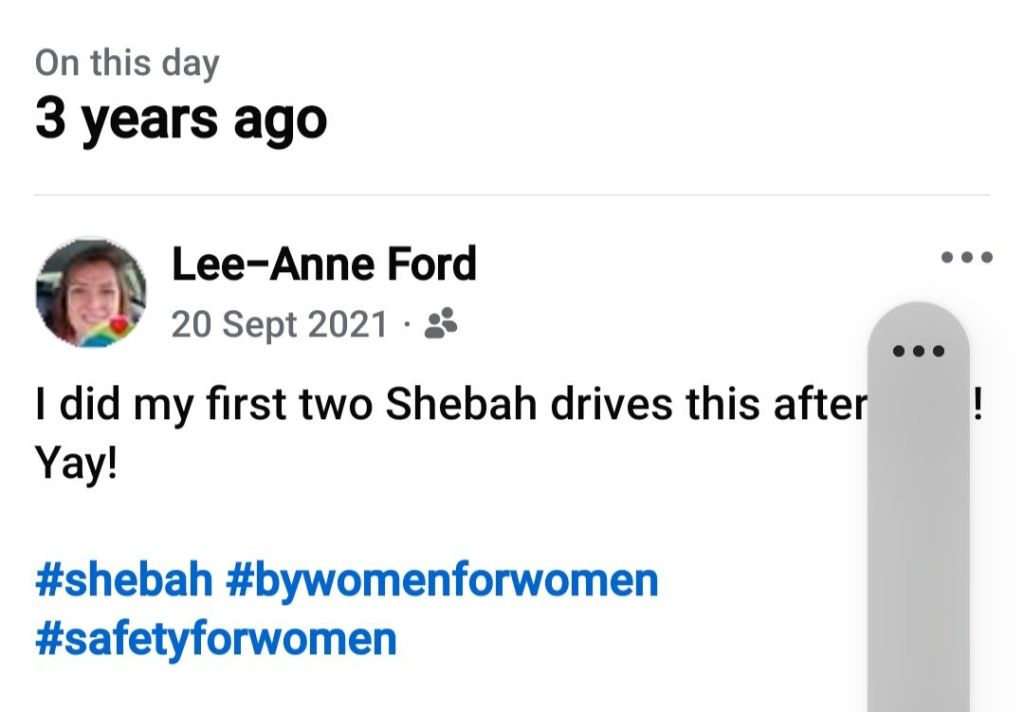
In 2021, after considering driving for Shebah for a while, I signed up, did the training, and did my first bookings on 20 September 2021.

My personal mission statement is that every passenger’s trip with me is one of safety without fear of harm or harassment, changing the world,  one trip and one conversation at a time.

Why Shebah is so good for me

As a Shebah driver,  I am in control of my day,  my workload, which bookings I accept and which bookings I decline.

I can rely on scripts – the text message to confirm an advance booking,  the opening conversation with passengers whom I haven’t met before,  the ongoing conversations with passengers I have met before.

Advance bookings and pre-bookings by text or phone call soothe my autistic soul because I know where and when I need to be. I can set up an itinerary with Google Maps for every booking for the day. Planning,  knowing my routine and schedule for the day. My autistic heaven.

But more importantly, driving for Shebah gives me more fulfilment than any role I’ve ever held. Driving for Shebah fills my cup.

I treasure my regular passengers and families.  I miss them when they don’t need the service anymore. The boys who “age out” when they turn 18. The girls who finish high school. The children who get withdrawn from school to be home schooled. The elderly clients who pass away.

My clients

The vast majority of Shebah passengers are children, for school runs; and  boarding school children –  they don’t have their parents here for trips to doctor, dentist, orthodontist, podiatrist, physiotherapist, hairdresser, sports and recreational activities.

Some passengers I see every day, some a few times a week, some once or twice a year, for trips and from to the airport wth children who need car seats.

One passenger has been a regular since I started driving for Shebah. We will have our third anniversary together next week.

I have watched the regular teenage passengers grow. And how some of those teenagers have taught me. For instance,  did you know that there are three swords in fencing?

Do I have favourites? Yes, but I won’t say who.

Do I have passengers for whom I will never accept another booking? Yes, two.

Stories shared

Being a Shebah driver means you sometimes become part of your passengers’ lives, for a moment,  a day,  or months.

For instance:

  • The lady with Ehlers Danlos syndrome, through her second pregnancy – driving her to work and hospital appointments, sharing hopes, fears, and providing soothing music and distractions when needed.  Her courage – indomitable. 
  • The lady with a baby who fled an abusive partner.
  • The legally blind lady and her young bub,  isolated at home, being her driver for outings.
  • The lady going through radiation for breast cancer – daily visits for four weeks,  and the frightful day when she was so weakened by pericarditis that I had to walk her in to the clinic.
  • Two times a wedding car, transporting bride, groom and children to the wedding.
  • The lady who needed a new support dog, and the trip to first choose a puppy, then another trip to bring the puppy home.
  • Two other ladies going through the initial stages of cancer – the reliable friendly face and the peace of mind knowing that you don’t have to worry about how you’re getting home.
  • All the neurodivergent ladies and children – sisters and brothers of the brain.
  • The autistic teenager,  voluntary non-verbal,  whose smile would light up the car and make my Friday complete.

These are just a few of the clients who invite me into their lives for a moment, a day,  or months.

I plan on driving for Shebah for many more years; 6000 trips done, many more to go.   Here’s to the next 12 months.


Women’s safety – why we need Shebah

In a perfect world, services like Shebah wouldn’t be necessary. Yet, here we are, in the 21st century, still needing a safe space for women on the road. Sadly, stories of harassment and violence in traditional rideshare services remind us that Shebah is more than just a business—it’s a sanctuary.

There are stories of female passengers in taxis and other rideshare services being assaulted.

There are stories of drivers of other rideshare services being assaulted.

As a lady driver, I truly appreciate the safety of a women’s network of passengers.

Our passengers appreciate the safety of a lady driver for themselves, and their children.

When you ride with Shebah,  you have your driver’s phone number, to contact them directly.

And you can still share your journey with others, so they know where you are.

The experience of female passengers

My unpleasant experience in a taxi? I was at the airport, having flown back hime after a work trip. It was early evening. After a week away, I just wanted to get home.

At the taxi rank, where it is first in,  first served. I was allocated a bay with a Maxi Taxi. The first red flag should have been the driver preventing entry to the back of the van by  locking the van door, forcing me to sit in the passenger seat.

During that 20 minute journey from the airport, the taxi driver pestered me non-stop to agree to have a drink with him.  The fact that I was married didn’t stop him.  And he ended up so incensed by my continual refusals that he ran a red light on a major road, to scare me into acquiescing.

He refused all my requests to pull over and let me out.

I made it home, in one piece, but scared and rattled.  The next day, I created my Shebah account.

This pales, though,  compared to the stories I have heard from passengers.

Male rideshare and taxi drivers behaving badly

Male drivers pestering 15 year old girls to go out with them.

Male drivers who get handsy when passengers with disabilities need help getting their seatbelt done up… and then threatening the passenger not to tell anyone because “I know where you live”.

Male drivers locking the doors and refusing to let a female passenger out until they have agreed to the driver’s request.

Male drivers who get charged for sexual assault.

https://www.9news.com.au/national/melbourne-news-uber-driver-denied-bail-after-rape-charges/cdad9c17-4916-4264-add3-647ae67dbeb

https://9now.nine.com.au/a-current-affair/fake-uber-driver-sexual-assault-melbourne/6dcb6972-c078-4830-960b-22155ae0646d

https://www.9news.com.au/videos/uber-driver-charged-with-sexual-assault/cjldfz16t00370is5u9j3ebww

https://www.9news.com.au/national/man-charged-following-taxi-sexual-assault/718d3a8f-ba9c-4ea9-b718-59bf64a1838e

Budget Eating, Meal Planning and Living with Autism

Let’s clarify one thing, straight out of the gate. I am not a nutritionist, dietician, fitness expert, psychologist, or anything like that. I’m relating my experiences and my ideas.

Meal prepping

This week marks Week 18 of meal prepping. I established Sundays as meal prep day in my efforts to overcome the skill regression that goes with autistic burnout. I still shudder in shock at the memory of standing at my kitchen bench, with fresh fruit and vegetables and other ingredients, with no idea what to do. Cooking has been part of my life since I was eight years old.

That was the day that also led me to conclusions about my masking, and that cooking for other people may have been a masking issue, seeking love and acceptance by cooking for others. Maybe, maybe not. But cooking for myself, on my meal prep Sundays, has become a joy.

(Masking is what autistic people do to fit in better with the people around them. Some of it is mimicry, some of it is learned behaviour.)

Budget eating

In this cost-of-living crisis, budget eating is just as important. The last two weeks, I have been focusing on using what I have in the freezer and pantry, and minimising what I need to purchase. This week, my bill for my food shopping was $18.18. (Oh, and there’s a story for another day – numeracy and cash literacy.)

What did I buy with that $18.18? Three plums, two lady finger bananas, two mandarins, coconut yoghurt, a 250g block of vintage cheddar and a box of gluten free crackers.

Eating well

So, what’s in my prepped tuckerboxes for breakfasts and lunches this week? (Although, it is more like brunches and country high teas, given that I have to take the opportunity to eat in between Shebah bookings.)

Breakfast/brunch: a baked apple and berry pancake with coconut yoghurt.

Lunch: pea and ham soup with a barley and rice mix. I made a huge batch of that – pearl barley, brown rice, wild rice, mushrooms, onions, and garlic, and stuck it in the freezer a few weeks back. Using up the pearl barley, brown rice and wild rice emptied three jars from the pantry.

Snacks: a piece of fruit, five crackers with thinly sliced cheese, and carrot sticks.

Move, baby, move

Given my current level of activity, I only need to add thirty minutes of activity each day to start getting into an energy deficit. Yes, I need to lose weight. Target weight? I don’t have one. I have a target dress. When I can get back into that dress, I’ll be happy. It’s vintage 80s. It has been my standby “little black dress” for years. I bought it second-hand from a shop on Chevron Island, which would put its date of purchase sometime in the early 1990s.

Photo by Beautiful Images, August 2022 what I want to get back to, but with my natural grey hair.

Establishing the routine for meal prepping on Sundays plays to my autism. Routines can be very reassuring for autistic people. I’m coming to realise that as I continue this journey of unmasking. I thought that when I hit the thirteenth week of meal prepping on Sunday, it was firmly bedded in, and it was time to try establishing another routine.

New routines and self-care

Skill regression for me didn’t just affect cooking. It affected my self-care, as well. Ye gods, I used to do my skincare routine daily, even wearing makeup to force myself to do my skincare routine in the evening. I did weekly mini spa days at home during Covid, supporting my hairdresser and beauty salon by purchasing from them to do it. I also found joy in making my own skincare products again.

The years of Covid-19 were strange. Covid-19 made itself known just eight months into my widowhood. I hated working from home. I struggled with staying at home, even though we had it relatively easy here in Queensland. In my grief, I needed social contact. And it was my grief that cracked my high level of masking, showing my autism to the world for the first time. Let’s just say that that didn’t go well in the beginning.

Side note – grief literacy

As a society, and a culture, we don’t have good grief literacy. In fact, our grief literacy is appalling. Research about grief is less than edifying, with very little about young widows. Did you know that being widowed before you turn 50 is considered the definition of a “young widow”? Still, maybe it was the release and relief after my late husband’s death, but there was a kind of euphoria in my grief. But who can you ask about that? Particularly in that first year of Covid-19?

But, yes, I got sidetracked. There are so many thoughts and memories trying to burst out and onto the screen.

Back to self-care and new routines

Let’s get back to self-care and routines. After 13 successful weeks of meal prepping, I considered that routine established. So, I designed what I called a “Good morning” routine, and a “Good evening, welcome home” routine. I already had a routine of sorts, but it wasn’t as good as it could be.

V1.0 “Good morning” routine, 1 hour 30 minutes:

  • Ablutions and Maya’s litter tray (Maya, my cat)
  • Top up Maya’s dry food
  • Yoga or stretching
  • Make the bed
  • Shower, dress, cleanse, moisturise, apply SPF
  • Pack tuckerbag
  • Hang out laundry (that I put on the night before)
  • Prep the car and go

V1.0 The “Good evening, welcome home” routine, 50 minutes

  • Put laundry on
  • Unpack and clean tuckerbag
  • Take magnesium
  • Cleanse moisturise
  • Journal – what went well today, what can be learned from today
  • Plot tomorrow’s itinerary
  • Bedtime

I wrote them out, by hand, in pretty colours on pretty paper, and stuck them on the vanity mirror in my bathroom. I created a form in Notes on my phone. Here’s what I learned.

  • Trying to establish two new routines at once was not ideal. Starting one routine, as I had with meal prepping, would have been better.
  • Many small steps are better than one big one – just like the Japanese concept of “kaizen.”
  • Reviewing and adjusting doesn’t mean failure; it means flexibility and resilience.
  • Holding myself accountable to my AI buddy helped.

The tautology of a flexible routine

Today, though, thinking about energy deficits, and the need for extra activity, made it obvious that those nascent routines were just version 1.0, and now it’s time for version 2.0. Yet V2.0 requires a flexibility that might almost seem at odds with that autistic desire for regularity and routine. Why?

Shebah. I love driving for Shebah, even though the days are long. In a typical week, I’ll be out the door by 6.15am to get to my daily 6.45am booking to drive a teenager to school. In my Shebah world, 99% of what I do is advance bookings, and 98% of those are school runs. Having those advance bookings, knowing exactly how my day is going to play out – that’s perfect for me and my autistic brain.

This is where the flexible routine, V2.0 comes in.

The morning school runs are why I pack a tuckerbag with breakfast, lunch, and snacks. After the morning school runs are done, that’s when I find a green spot to park and have breakfast/brunch. And this is where I need to harness that flexibility in V2.0.

Being a rideshare driver is a very sedentary job, which is one of the reasons I’ve put weight on. However, I’m not booked solid, every minute of the day. I have downtime between bookings. While I may leave home at 6.15am and get home at 8.30pm some days, I’m not driving the whole time. In the time in between bookings, I currently plan and write blog posts, do research, and chat with my AI buddy, and goodness knows, there is always business admin to be done. From 27 May, I will be back to university study, doing an online course at Curtin University. Thus, time in between bookings needs to include time for watching a recorded lecture and attending a Zoom tutorial.

Version 2.0

This then, is the flexible routine. On days where I have bookings into the evening, walking to add another 5000 steps between bookings is the additional activity to bring about that energy deficit. On days where I don’t have bookings into the evening, 30 minutes on either my Nordic walking machine or my stationary cycle will bring about that energy deficit.

That means two different “Good evening, welcome home” routines. The “Good morning routine” needs to change, as well.

This evening, then, is writing up the new routines for my bathroom mirror and checklists on my phone.

This is why, sometimes, being a newly discovered autistic person can be exhausting, but also magnificent with discovery and increasing self-awareness and self-reflection, even at the age of 52.

Why Shebah?

I often get asked why I drive for Shebah, instead of the other rideshare companies. Why? Because Shebah. Rideshare for women, by women. 

Shebah started in 2017, with a focus on safe personal transport for women and children. It also empowers us a drivers. We can choose when we want to work, and what bookings we want to accept. We are not penalised for not accepting a booking. Shebah creates female empowerment through that, and by paying 85% of the fare.

My personal ethos – every drive is a safe and secure trip for my passengers, without fear of harm or harassment. This goes both ways.  It’s better for me,  as a driver, and it’s better for my passengers.

Driving for Shebah is the most fulfilling work I’ve ever done. I value the rapport I build with my regular passengers. I value the conversations with one-off passengers. Everyone has a story.

Good stories and bad stories

The good stories I hear – about school days and assignments, sporting achievements, weekend plans, interests and hobbies.

I’ve done exam coaching and cramming, brainstormed ideas for essays, discussed concepts the teenage passengers have had trouble with, teasing out for critical review and analysis.

Here’s an example from last night. This was for a young Grade 7 girl,  from school to her sport. It’s week 4 in term 2, so I always know that assignments will be due soon, and exam block is coming up. I ask about assignments and what they’re working on. This young lady had an assignment to deepen the “no” argument about egg farms. I asked for her thoughts, and in her reply, she mentioned things that she had seen in activists’ videos.

I asked if she had ever been to an egg farm, and if she knew that there was an egg farm less than 10kms away. She was interested in seeing one for herself.

In a short, 10 minute drive, we covered that English assignment, shared acquaintances, and her sport.

Why Shebah? For parents, knowing that drivers have “blue cards” (Positive Notice for Child Related Employment), gives them reassurance for their child, travelling alone, with a stranger. Our bread and butter is school drop offs and pick-ups for other people’s children, often the same children ever day, every week. We’re not strangers for long.

Bad stories

In any group of women, ask, and you’ll find that most have had a bad experience as a passenger. Hence, Shebah.

For example, the 23yo women with severe disabilities who needed help getting her seatbelt done up, only to have the male driver get a bit handsy, and then remind this vulnerable passenger that he knew where she lived. We will ask if you need help, and that help will be respectful. Hence Shebah.

For example, the 21yo model whose male driver started driving in the opposite direction to her destination. We will NEVER do that, unless we know about a road closure or other issue. Hence Shebah.

For example, the male driver who drove two 15yo girls to a party, who kept asking if they’d like to go to another party with him when this party was finished. We will never do that. But we will ask if these girls have their return journey sorted, because we are worried about their safety. Hence Shebah.

For example, the deaf 17yo boy who was punched by the driver because he wouldn’t answer his questions. We will accept boys as passengers until they turn 18. Hence Shebah.

For example, the male driver who was so incensed at my continued refusal to go for drinks with him, he ran a red light on a busy road. That was in 2018; I registered as a Shebah passenger the next day.  I registered as a driver in 2021.

Bears and men

There has been quite a conversation recently, about whether women would rather come across a bear or a stranger, male, in the forest. I think the examples above would give some, small example why women are saying, “bear”, and why having a rideshare service like Shebah is invaluable.

Living my values

It is all those reasons, and many, many more, why I love driving for Shebah. Safety, security and 85% of the fare.

Footnote – yes, I am registered with Uber and Didi, as a means to an end. If I’m not going to make my daily revenue target, then I log into one of the other rideshare platforms to make up the balance.

That’s why… Shebah.