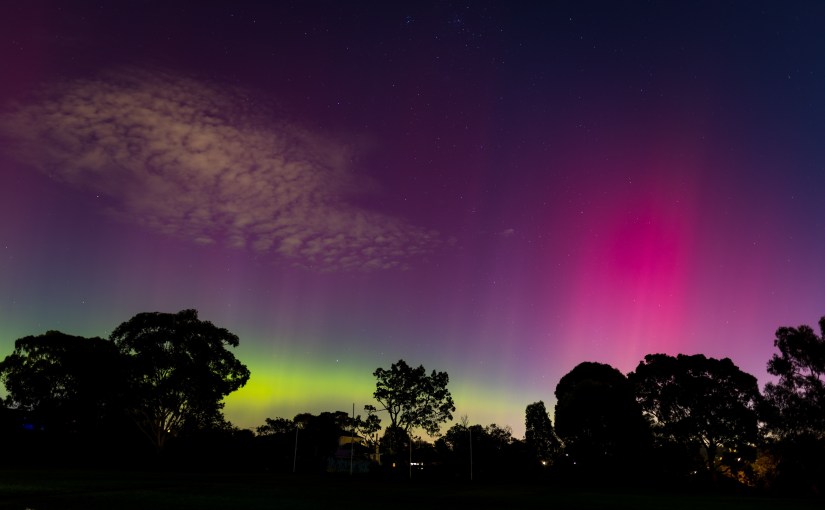
Awe is a complex emotional response to a thing or experience that is vast, beyond your current understanding, or connected to something greater than yourself, such as natural wonders, artistic masterpieces, profound ideas, or extraordinary human achievements. For example, look at the amazing auroras seen during the recent electromagnetic storm. Awesome.
Way back in March 2012, I wrote this as a Facebook note. What made me recall this? A podcast, “Searching for awe” from the ABC program “All in the Mind”. It’s a 30- minute listen.
Back to March 2012
In 2012, I was seven years into my late husband’s journey with Huntington’s Disease. Over the previous 20 years, I had become deeply spiritual, but my faith was destroyed because of my late husband’s condition. I was wandering in a spiritual wasteland, a state of hiraeth. That state continues today.
This is what I posted on Facebook
Those of you know who know me quite well will have heard me say that ‘I want to go home’, meaning I’m tired of this life and want to go home to the Divine. I heard an interview with Jane Rutter, the fabulous flautist, the other day, and she described it is ‘divine homesickness’. At the time, I thought, “Wow, that is so right. It is divine homesickness.” She named my longing perfectly.
You have to recognise something to learn from it. You don’t know what you don’t know… all those phrases. They’re right, every single one of them. If I hadn’t heard that term, ‘Divine homesickness’, I wouldn’t have rocognised it for what it is. Recognising the attitude of the self is the first step to growing, healing, learning.
Driving to work one morning, listening to ABC Classic FM, and hearing, by chance, a Kyrie, gave me a golden, precious moment. A moment when the tree-lined street, the angle of the morning sunlight, yes, even the other cars on the road, melded into one moment of pure, untramelled experience.
In a heartbeat, I learnt the next lesson on from divine homesickness. How can you be homesick for something that is right there with you, every day, all around you? I don’t have to ‘go home’ to be with (your choice of deity); their blessing is right here in every waking and sleeping moment, if only I can open my eyes, open my heart, and experience it. It was a powerful, humbling and moving moment.
Hiraeth no more.
Back to today
What does awe feel like? It might look and feel like some of this:
- Widened eyes
- Dropped jaw
- Goosebumps or shivers
- Slower movements or stillness
- Changes in vocal tone
- Altered perception of time
The physiological effects of experiencing awe can include:
- Reduced Inflammation: Research suggests that awe can lead to lower levels of pro-inflammatory cytokines, indicating a reduction in bodily inflammation.
- Lowered Stress Levels: Awe can decrease cortisol levels, helping to reduce stress.
- Enhanced Well-being: Regular experiences of awe are associated with greater overall well-being and life satisfaction.
- Improved Social Connections: Awe can promote feelings of connectedness with others, fostering social bonds and pro-social behaviors.
- Altered Perception of Time: People often feel as though time has slowed down, which can lead to a greater appreciation of the present moment.
Is it harder for us to experience awe?
In the past, awe was often tied to religious meaning, providing structured opportunities to encounter the divine – the weekly church service, which also gave the “rules of life”.
In today’s secular world, we might need to access nature, scientific discoveries, art, and technology, broadening potential sources of awe. This, though, tends to be a singular, not communal experience
Importance of Social Cohesion
Strong community bonds create shared experiences that foster awe. Deteriorating social cohesion reduces these opportunities, leading to increased isolation and individualism.
Cultivating Awe Through Mindfulness and Gratitude.
Much has been written about mindfulness; being present and focussing on what’s in front of your nose. Maybe, too, mindfulness increases our sensitivity and openness to moments and experiences of awe.
Similarly, gratitude, can amplify our emotional responses, and could also increase our openness to moments and experiences of awe.
So, here’s my awed response to the auroras of the last week.
In the grand scheme of things, we exist on an amazing rock in a small solar system in a small galaxy. The magnetic field that gives us gravity and the layers of our atmosphere that protect us from the hazards of space, just like coronal mass elections. How? By deflecting the plasma and electromagnetic energy to our poles, hence the usual Aurora Australis and Aurora Borealis.
And in the event of a series of “sun burps” (coronal mass elections) that blast us with a super-sized dose of electromagnetic energy, it still works. That magnificent magnetic field and atmosphere protects us in ways we don’t know and can’t imagine, until we get G5.0 electromagnetic storm. That protective magnetic field and atmosphere still protected us and gave us, in Australia, auroras that could be seen as far north as Mackay, in Central Queensland.
Wow, just wow. The physics of it, and the auroras. Wow. I’ve got goosebumps and near tears just thinking about it. (Thanks to my autistic hyperempathy.)
When did you last experience awe?
Want more info?
A closer look at the time course of bodily responses to awe experiences. Sci Rep 13, 22506 (2023).
Eight reasons why awe makes your life better
 The Auld Skald's Fudgel