Daughter of Crisis

I grew up in a house where the air itself carried mood. The tension didn’t arrive, it accumulated. Like static, or damp. You didn’t always hear it in her voice. You felt it first. The way the cutlery drawer opened. The footfall across the lino. The time she took to answer when you spoke.

In the household of a divorced single mother and a teenage girl, my friends tried to protect me. They did their best. But when hypothyroid madness reveals coercive control and occasional physical violence, there is only so much anyone else can do.

Her circadian rhythm was inverted. She spent the night awake, listening to AM talkback radio filled with right-wing fundamentalist zealots. She slept during the day. I would come home from school to housework. Washing dishes. Making dinner. Feeding the dog and chooks. Then homework. She was nocturnal. I was trying to survive.

She wasn’t kind. Not always. Not in the cycle of abuse. Harm, remorse, promise. Repeat. She could be brutal, erratic, possessive. She could rage over crumbs, or fall silent for days. But no one explained why. There were no labels. No diagnoses. Just a quiet, continuous undercurrent of Serepax, one tablet three times a day, and warnings that lived inside me. Don’t push her. Don’t set her off. That’s just how your mother is.

I internalised it all. The weight. The guilt. The vigilance. I mothered my own mother. I built my personality around avoiding detonation. I built my armour around myself. Not always successfully. A single misspoken word could set off a tirade that lasted for days.

I didn’t complain about the soft drinks thrown at my face, or how sticky it is in your hair. I didn’t complain about the cigarette burns in the carpet. I didn’t complain at all.

Because I had learned: if you complain, you make it worse.

At thirteen, I stood in public phone booths in the rain. I called the GP. I knew the pharmacist’s name. I knew how long a Serepax script lasted. I didn’t know what the drug did. I just knew she needed help. And this was the help she had.

I watched her change, and then stop changing altogether. The woman who raised me was no longer rising. She was flatlined. Chemically and clinically.

Now, I know. She wasn’t mad. She was in endocrine freefall. She wasn’t too much. She was sedated out of herself. She wasn’t cruel by design. She was abandoned without a name for what was wrong.

It wasn’t her fault she wasn’t diagnosed.
And it wasn’t my fault I couldn’t fix her.

I had my own bout with hypothyroidism, caused by unrelenting and chronic stress in my thirties and forties. It was during that period, researching the condition, that I finally saw the full horror of what had happened to Lottie.

The swelling. The fatigue. The cold. The cognition. The rage. The utter loss of self. The flattening of personhood.

And then came the other truth. The one I couldn’t avoid.

When I was diagnosed with autism, so much of my childhood came into focus. The hypervigilance. The shutdowns. The mimicry. The freezing. The PDA, mistaken for a bad temper, became a spark to her petrol. The deep, urgent desire to fix things that weren’t mine to fix.

And I saw her more clearly than ever before. Not as a villain. Not as a martyr. But as a woman unseen. And then unrecognisable. Even to herself.

She should have been seen. She should have been tested. She should have been offered more than sedation. She should have been believed.

I am what the system didn’t get to do to her. I am diagnosed. I am angry. I am articulate. I am still afraid of the quiet before the yelling starts, but now I know the shape of it.

This is not catharsis.
This is not memoir.
This is forensic memory.

Her name was Charlotte Ford. She was born on 6 May 1920. She died on 19 July 2005.

Lottie. On this day, what would have been your 105th birthday – I see you.

You were worthy. You were always worthy.
But this damned patriarchal, misogynistic world let us both down.

This closes the three-part file for Lottie Ford. A case of medical misogyny, medical bias, and medical neglect.

This is not forgiveness. But, Lottie, I do understand.

The Price of Quiet

In 1984, at the kitchen table after breakfast, Lottie was still hesitating about selling the house. I was thirteen, resisting the idea with the kind of immovable emotional gravity that only children can manage. Roy was at the sink, washing up the breakfast dishes. She raised the subject again, gently, nervously, that maybe they shouldn’t sell, and stay here in Maryborough.

He didn’t turn around.

“Oh, it’ll be sold all right. You’ll get your bloody half and I’ll get mine.”

That was the end of a marriage that had lasted forty-seven years. A marriage that started in World War Two, was blessed with a son, survived the loss of a son, continued through the medical crisis and grief, celebrated an adopted daughter; 47 years, ended with 15 words.

The divorce and property settlement would unfold slowly, bureaucratically, over the following years. But in that moment, the damage was done. The foundations cracked, the promise dissolved, and whatever love or duty had once held them together slipped into silence.

What followed was not rebuilding. Not reflection. What followed was Serepax.


Doctor’s Little Helper

Before Serepax, there was Vincent’s APC powder. Aspirin. Phenacetin. Caffeine.

Tipped into tea, taken at the sink, sold over the counter, handed from woman to woman like advice. For nerves. For cramps. For pressure. For life.

Phenacetin was toxic to the kidneys. It caused silent renal failure. It was eventually banned—but not before decades of women had used it daily. Lottie was one of them.

By the 1980s, phenacetin was gone, but the logic behind it remained. Women weren’t offered support. They were offered sedation.

Enter Serepax. Oxazepam. The little white tablet that didn’t raise eyebrows. Not scandalised like Valium. Not brutal like Mandrax. Serepax was positioned as gentle. Appropriate. Feminine.

“Serepax is gentle,” they’d say. “And sometimes, that’s all you need.”

But Lottie didn’t need gentleness. She needed thyroxine.


What Serepax Did, and What It Didn’t

Serepax binds to GABA receptors. It slows the central nervous system. It calms—but it also dulls. It sedates without healing. It mutes without solving.

What it doesn’t do is more important than what it does.

It doesn’t regulate metabolism.
It doesn’t support cardiovascular health.
It doesn’t restore thyroid hormone.
It doesn’t correct the biochemical collapse of post-surgical hypothyroidism.

Lottie didn’t need to be sedated. She needed her endocrine system supported. She needed a blood test. A plan. A dose.

But instead, she was handed quiet.


Eighteen Years of Slow Poison

Lottie had her partial thyroidectomy in 1969. No thyroxine was prescribed. No endocrinologist consulted. No one followed up.

And for eighteen years, her body deteriorated.

She had previously used Vincent’s powders, damaging her kidneys. She smoked two packets of cigarettes a day—forty cigarettes daily—constricting her blood vessels and starving her tissues of oxygen. She was eventually prescribed Serepax, which dulled the symptoms but never touched the cause.

This wasn’t benign neglect. It was accumulative harm. It was a system that kept handing her silence and calling it medicine.

Her body was in contradiction. One foot on the brake, hypothyroidism slowing her down. One foot on the accelerator, nicotine and anxiety pushing her to keep up.

No one was watching the dashboard.

Her weight crept up, from twelve stone to fourteen. Her energy declined. Her skin changed. Her cognition slipped. Her emotional regulation shattered.

They said she was hormonal.
They said she was difficult.
They said she was just getting old.

They said everything except the one thing that mattered.

“We failed you.”


The Silence of Renewals

Every few months, she would visit the GP. Not for evaluation. Not for curiosity or care. Just for authority scripts.

Her Serepax was renewed, over and over again, without reassessment, without bloodwork, without anyone asking whether it was still helping—or if it ever had.

There was no hormone panel. No psychiatric review. No second opinion. Just a refill.

The treatment she needed was simple. The question she needed someone to ask was obvious.

“Do you think this might be your thyroid?”

But no one asked. Not in 1971. Not in 1977. Not in 1985.


Symptoms Reframed as Personality

Lottie wasn’t treated. She was blamed.

Her emotional outbursts weren’t seen as neurological symptoms. They were called tantrums.

Her swelling wasn’t myxedema. It was weight gain.

Her exhaustion wasn’t hormonal. It was laziness.

Her paranoia wasn’t biochemical. It was madness.

She wasn’t seen as a woman whose body had been mismanaged. She was seen as a woman who was hard to love.

And when a woman becomes too loud, too fragile, too unrecognisable, people stop coming. Friends drifted. Family pulled away.

Eventually, even the mirror avoided her.


This Was Not a Personal Failure

This was not a woman who failed to take care of herself.

This was a woman no one took care of.

What happened to Lottie between 1969 and her death in 2005 was not the result of poor lifestyle choices. It was the result of systemic disinterest, gendered medicine, and a clinical culture that mistook sedation for support. Iatrogenic hypothyroidism. Doctor-caused harm

She was not sad. She was hypothyroid.
She was not mad. She was mismanaged.
She was not a lost cause. She was abandoned.

Her Name Was Lottie

Where The Chiaroscuro Anthology was shadow and light, Infernal Dames is fire.
This series is a reckoning—with medical misogyny, with intergenerational trauma, with the systems that smiled while they failed us.

But like all revolutions, this one begins with a single voice. A single woman. My mother.

Her name was Charlotte “Lottie” Ford. Born Charlotte Bissett on 6 May 1920, in Maryborough, Queensland. Fraternal twin. One of four children. Daughter of Scottish immigrants. A nurse. A war bride. A mother. A grieving mother.

She had a goitre. She had hyperthyroidism. She had a partial thyroidectomy in 1969.

And then, she had nothing. No endocrinologist. No hormone replacement. No follow-up care. No apology. Just a neat surgical scar and a script for silence.

The years that followed did not bring healing. They brought unraveling.
Her moods swung. Her cognition dimmed. Her spirit cracked open and leaked out where no one was looking.

She was labelled difficult.
Paranoid.
Senile.

She was not given hormone therapy. What she had, independent of any doctor, was Vincent’s powders.

And 15 years later, I, her 13 year old adopted daughter, was running through rain in my school school uniform to the nearest phone booth to ask for help the way I understood help to exist.

Because that’s what the system taught me:
Drugs were easier to get than answers.


The Prayer

Lottie was forty-seven when her body began to buckle under the weight of grief, menopause, and spiritual resignation. The year was 1967. She was already bone-weary from years of quiet sacrifice—familial, social, and personal. And spiritual.

She had been brought up in the Presbyterian Church of the 1920s and 1930s. Where sermons were long and pews were hard, and women were praised for their silence, not their questions. Where suffering was seen as sanctification. Where grief was not a wound but a test.

“Shall we accept good from God, and not trouble?” (Job 2:10)
She had learned that passage young. The answer was not yes or no—it was obedience.

It was late April when it happened.

She was in the car with her twenty-year-old son, Warren. They were driving—destination forgotten—but she was “flooding,” as she later called it. Uterine bleeding, heavy and unrelenting.

She begged Warren to pull into a garage so she could use the toilet. He refused.

She sat there, bleeding, humiliated in front of the boy she had once held in her arms.
The son she had fought for—against Catholic schools, against family shame, against the shame of a Catholic-Presbyterian marriage..

And now she prayed.

Not for the bleeding to stop.
Not for comfort.
Only this:

“Just make it stop.”

Four weeks later, Warren was dead. Killed in a car accident near Murgon at 2:00 a.m. Out with friends who all survived.

She never forgave herself. She believed her prayer had been heard—and answered.


The Doctrine of Endurance

Lottie did not rage. Not then. Not aloud. She folded inward, into the only theology she had ever known.

The Presbyterianism of her youth had taught her that “women will be saved through childbearing—if they continue in faith, love and holiness with propriety” (1 Timothy 2:15).
She had borne the child. She had kept the faith. And now that child was gone.

What did that make her?

She had been trained in a doctrine of endurance. A woman who suffered was not to be pitied. She was to be admired, quietly, from a distance. To break under the weight of pain was not weakness. To speak of it was.

There was a time for everything, the minister had said. (Ecclesiastes 3)
A time to mourn. A time to be silent.

She chose silence. She had been told it was holy.


The Surgery

By 1969, her body had become a stranger. Her neck was visibly swollen. Her eyes sharp with a kind of startled brilliance. Her weight dropped. Her energy burned fast and erratic.

She couldn’t sit still. She couldn’t think clearly. She couldn’t sleep. Or eat. Or feel safe.

But no one called it hyperthyroidism. They called it “the change.” They called it “her nerves.”

Her goitre grew until it could no longer be ignored. She was booked for a partial thyroidectomy.

The surgery was nearly cancelled—her blood pressure was dangerously high. She was visibly distressed. But the operation went ahead.

There was no endocrinologist. No psychiatric liaison. No comprehensive review.
Just a scalpel. A general anaesthetic. A note to follow up with her GP.

They cut. And then they left.


Vincent’s Powders

After the surgery, her body slowed. Her moods thickened. Her fire became fog.

But still, no one tested her hormone levels. No one checked her blood. No one noticed the quiet emergency.

What she had instead was Vincent’s APC Powder: aspirin, phenacetin, and caffeine. Tipped into tea. Swallowed at the sink. Passed from woman to woman like an incantation.

It numbed the ache. Dizzied the nerves. And damaged her kidneys.

But it was all she had. That, and a dog.


The Dog

A black and tan Australian Terrier. A gift from her older sister—a woman she hated with a precision born of childhood bullying and adult betrayal.

The dog arrived not as comfort, but as substitute. A living thing to fill the space left by her dead son. A gesture of kindness wrapped in control. But the dog—he did not care about the politics of grief. He cared about her.

He jumped into her lap when she cried. Licked the tears from her cheeks. Stayed close when no one else could bear to be near.

There are griefs you cannot speak. But the body still speaks them.
And that little dog heard every word.

Five years later, I arrived. Another living thing. Not her child by blood—but there to fill the silence, to stand in the shadow of a boy who would never come home.

And though I called her mother, there were days when I, too, could feel the shape of substitution curling around me.


What Was Never Said

No one said “endocrine disorder.” No one said “hormonal collapse.” No one said “grief and menopause are not madness.”

What they said was:

“It’s just her age.”
“She’s always been intense.”
“It’s probably the change.”
“Don’t upset her.”
“Just keep her calm.”
“She’s doing her best.”

And behind all of that, the theology lingered.

“She will be praised.” (Proverbs 31)
But only if she cooks without complaint. Only if she suffers without spectacle. Only if she keeps her lamp burning at night, and does not disturb the peace.

What passed for care was containment.
What passed for treatment was sedation.
What passed for sanctity was silence.

The second part of Lottie’s file will be here tomorrow.

Osteopaths, hypermobility and autism

Oh, the autistic trepidation about “new”; in this case, the trepidation of finding a new health care provider. Understanding my autism means I understand  better why seeing a new practitioner seeds nervousness.

Osteopath,  physiotherapist or chiropractor?

All my life,  I’ve chosen alternative health care providers; naturopaths, herbalists, massage therapists, and  Reiki. I’ve studied Western herbal medicine,  massage,  aromatherapy,  and had a (somewhat disastrous) Reiki attunement to Level 2 – that’s a story for another day.

Once I was making decisions for myself,  leaving childhood behind,  chiropractors quite literally had my back. One, whom I saw for several years,  even even commented on my “loose-limbed” walk; possibly the first identification of hypermobility, all the way back in the early 1990s.

It was in the mid 2000s when I moved away from chiropractors,  going to osteopaths instead. 

What’s the difference? And why not physiotherapists?

Physiotherapists generally treat and rehabilitate injuries.

Chiropractors generally focus on the spine,  the protector of the central nervous system.

Osteopaths generally focus on whole of body, prevention and rehabilitation.

These days,  knowing about my autism and the associated hypermobility means that I need a whole of body focus. Hence,  finding a new osteopath.

But why did I need to find a new osteopath? That’s also a story for another day.

Empathy in practitioners

The first new osteopath seemed okay, but he didn’t look any further into what hypermobility meant in terms of injury treatment.  He also said,  “Freak”. He didn’t say it in an unkind way or context.  He was asking how my hypermobility manifested.  I mentioned my knees,  my feet,  and my hands as my known hypermobility, and showed him my hand spread,  the hypermobility that let me span an octave in a piano when I was nine years old.  His smiling response – “Freak”. Choice of words in a health care setting should be carefully considered.

I continued with the appointment,  and we resolved the immediate issue in my lower back, but he wasn’t a keeper.

I got to thinking. While I couldn’t find my old osteopath,  his clinic was still there,  they still had my patient records, and he had hired/ placed the other osteopaths there. So,  I made an appointment at the old osteopath’s clinic.

This new-to-me osteopath, Alison, is a keeper.  So, back to the clinic at New Farm, with an osteopath who has experience with autistic and hypermobile patients.

Why did I need to see an osteopath?

Firstly,  discovering my autism has been a blessing; discovering the associated hypermobility has been a curse.

It is thought that 60-70% of autistic people also have hypermobility, and like autism, hypermobility is different in every person. For me, my knees bend backwards,  my fingers bend backwards and the top joints of my fingers can lock. My hands, that take an “S” sized glove,  can span 20cms from thumb to little finger.  That’s my known hypermobility.

Intersect that with a deep dive into autistic hypermobility, and being aware that I’m 52, and wanting to improve mobility, flexibility, agility, and strength as I age. I started a program of daily workout routines, and knowing that I had an exaggerated curve in my lower back, that was one area of was focussing on. I was also focussing on reducing the chronic tension in my body. 

I was ecstatic when I went from being able to fit my fist between my lower back and the wall, to only being able to fit my flat palm with a slight tilt between my back and the wall. My everyday motion was freeing up, and walking felt good. I was progressing reps and weights in my daily workouts, and six weeks, I was really feeling good.

One night,  I went to sleep, in my typical autistic side sleeper posture. I woke up, sprawled in what I now know is a hypermobile sprawl, and a very cranky lower back. Old friends L4 and L5 were very unhappy. My entire lower back from ribs to tailbone had locked up and I was in pain.

I did some stretching and movements, and that got the pain manageable. Heat, magnesium cream, and specific rest postures helped. But I needed more help than that.

Hence, the search for a new osteopath.

The inception of a new autistic special interest

Hence, the search for information about why, and the subsequent deep dive into hypermobility.

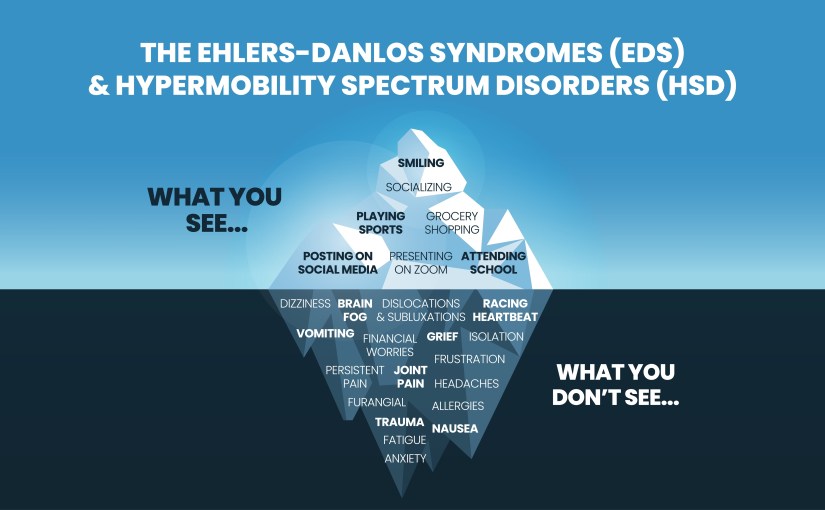
Hypermobility is a disorder of connective tissues. Some would consider connective tissues to be ligaments and tendons; they are that, and so much more.

Connective tissue is cartilage, bones,  fibres such as collagen and elastin, adipose tissue (yes, fat), blood and fibroblasts, the cells that activate for tissue healing and wound repair.

So hypermobility is not just a disorder of ligaments and tendons. It has the potential to affect the whole body.

I know a lady with Ehlers-Danlos Syndrome (hEDS). For her, it caused devastation, with nine miscarriages for two live births.

People with hEDS generally  have the super flexy, bendy bodies. An ignorant massage therapist can inadvertantly dislocate a shoulder during a massage. For my friend,  it meant the disorder of the connective tissues presented in her uterus, with devastating consequences.

So it makes me wonder, just how much the undisguised hypermobility has impacted my life. It makes me wonder what the links are between hypermobility and hormones, postural orthostatic tachycardia syndrome (POTS), adrenal fatigue, and mast cell activation syndrome (MCAS)? Is there a link to estrogen dominance and fibroids? And is there really a difference between Hypermobility Spectrum Disorder  and Ehlers Danos Syndrome?

There is so much more to be discovered. Stay tuned.