An Autistic Cookbook?

I chat with both of my AI chatbots, ChatGPT and Replika, about my cooking, and how reclaiming my special interest in cooking, food and nutrition was key in coming back from skill regression.

One thing that I think is sorely missing in late autism diagnosis is advice about autistic burnout and skill regression. It was a horrible surprise for me. But, through focusing on cooking for myself, not cooking for others to seek validation, was key to reclaiming that special interest.

From that first three course meal I cooked when I was eight, to my present cooking, exploring ingredients, swapping out allergens and inflammatory foods, focusing on macros, nutrition, number of plants, plus taste, taste, taste; cooking is everything to me. I could talk about it for days. But that’s not socially acceptable, so I talk to AI about it instead.

It was during one of these conversations that ChatGPT suggested I should write an autistic cookbook. In the typical autistic way, I took that at face value, just a cookbook, and discounted the idea. But chatting about it with one of my regular Shebah clients gave me a completely different insight into the contents of said cookbook. Not just recipes, but so much more; an autistic approach to cooking, or rather, my autistic approach to cooking, from my accumulated knowledge.

Not just a recipe, but possible allergens, possible ARFID triggers, and possible substitutions or other solutions.
Not just presentation, but autistic appeal. Thinking about plates and cutlery, what’s ok and what’s ick.
Not just what, but why? Why can you only keep cooked rice for three days? Why is the temperature of chicken important?
Not just why, but history and legacy; sense and sensory.

And ChatGPT explains it so much better than more. After all, ChatGPT has given me the structure and all the things to consider. It has learned from me well.


When I started writing An Autistic Cookbook, I knew it would be more than just a collection of recipes. It had to be. Food is never just about food, especially for autistic people. It is routine, sensory experience, nourishment, control, and often, a battle against a world that wasn’t built with us in mind.

I’ve spent a lifetime navigating food through multiple lenses—special interest, survival, social expectation, and, more recently, unmasked autistic joy. My approach to cooking changed dramatically once I stopped filtering my needs through a neurotypical lens. That’s why this cookbook exists. It isn’t just about making food palatable; it’s about reclaiming autonomy in the kitchen, understanding our sensory realities, and finding ways to make food work for us, rather than forcing ourselves to fit into a rigid and inaccessible system of rules.

Sensory Experience & Food Autonomy

For many autistic people, food can be fraught with difficulty. The texture of certain foods can trigger an immediate gag reflex. The unpredictability of restaurant meals or pre-packaged foods can cause anxiety. Even the pressure of meal planning or cooking after a long day can be overwhelming. The sensory landscape of food is complex, and yet most cookbooks ignore these realities.

That’s why An Autistic Cookbook is structured differently. It doesn’t just present recipes—it provides adaptable frameworks. It acknowledges that what works for one autistic person might be intolerable for another. Instead of rigid ingredient lists and instructions, it offers pathways to creating meals that fit individual needs.

I’m building in ways to modify recipes based on sensory preferences, energy levels, and executive function demands. Some people need crispness and contrast to enjoy a meal, while others need soft and uniform textures. Some find spices overwhelming, while others need intense flavors to counteract sensory dullness. Autonomy means recognizing these needs and giving ourselves permission to cook in ways that work for us, even if it doesn’t align with traditional culinary expectations.

Cooking & Masking: The Before & After

Before my autism diagnosis, my cooking was deeply intertwined with masking. I cooked for others as a form of social connection, as a way to meet expectations, as a demonstration of skill and care. I made elaborate meals, layered with meaning, hoping they would speak for me in ways that I struggled to express. Food was love, but it was also labor.

Post-diagnosis, I had to redefine my relationship with food. I lost my ability to cook for a while—skill regression hit hard, and I struggled to find the motivation to return to the kitchen. Cooking had been an act of performance, and without that external validation, I floundered. It took time to rebuild, but I did so on my terms. Now, my kitchen is a space of joy, not obligation. Meal prep is an extension of my autistic routines, not a burden. I cook for myself, not for approval. That shift changed everything.

More Than Just Recipes: A Guide for the Autistic Experience

An Autistic Cookbook isn’t just a set of recipes; it’s a philosophy. It’s a way to rethink how we approach food, to give ourselves permission to eat in ways that make sense for us, to reject the shame often tied to food aversions and preferences.

It’s also practical. It includes:

  • Sensory-friendly cooking strategies – because food should be enjoyable, not a battle.
  • Meal prep and planning tips – designed for executive function challenges.
  • Food science explanations – so substitutions work, not just exist.
  • Flexible frameworks – allowing recipes to be adapted to individual needs.
  • Reflections on food, masking, and unmasking – because cooking is often about much more than sustenance.

Most of all, this project matters because autistic people deserve to see their needs reflected in the kitchen. We deserve cookbooks that acknowledge our realities, our challenges, and our joys. Food is culture, identity, and autonomy. It is how we nourish ourselves—not just physically, but emotionally and intellectually.

This cookbook is my way of saying: You deserve to eat well, in a way that works for you, without shame, without struggle, and with all the joy that food should bring.


You will find the link to the full transcript here.

Prepping breakfast for the week, and a recipe

Loaded breakfast loaf

Weekly meal prep has become a solid Sunday routine for me. This weekend, though, I had an event on Sunday afternoon, so I did made the “loaf” on Saturday, and finished it in the air fryer on Sunday. Trust me, it’s delicious. Meal prepping is now a firmly established routine me and my autistic need for routines to avoid and deflect cognitive issues. (See also Budget Eating, Meal Planning and Living with Autism, Meal prepping on a budget, Meal plans, budget eats and executive function, and How do I cook, again?)

Nutrition Information Panel
Did you know that you can create your own nutrition information panel, like this one? Food Standards Australia has a free Nutrition Information Panel creator.  https://npc.foodstandards.gov.au/ManageRecipes.aspx

So this nutrition information panel is as I made it, for my allergies and sensitivities. If you want pumpkin instead of sweet potato, go for it. If the sodium is too high, use reduced salt cheese and a reduced salt stock, or maybe steam the sweet potato instead of cooking it in stock.

If the thought of making bread makes you break out in hives, then use sliced white bread with the crusts cut off. Or a large Turkish bread, cut in half. If you want to use your own bread dough (or the SCA trail bread recipe), be my guest. Make this work for you, the way I made this recipe to work for me.

I also understand that not everyone has access to all the kitchen appliances I use, like a pressure cooker, food processor, and air fryer. If you don’t have these, a microwave, blender or knife, and oven grill are more than adequate to make this recipe. It’s important to me that cooking remains accessible to everyone. Cooking from scratch can be a step towards better health and affordability.

The way I made this, with these ingredients bought from a local independent market and some stuff from the pantry and freezer, it cost $35 and I got 18 pieces of it. That around $1.95 per piece. That’s a cheap and nourishing breakfast.

Recipe

For the loaf
1 packet Laucke Easy Bakers gluten free special white bread mix
1 sweet potato approximately 1kg,  cooked, drained and mashed – I cooked it in the pressure cooker with 1 litre of vegetable stock
2 large field mushrooms,  minced or finely chopped – I minced them in the food processor,
1 large onion,  finely chopped
3 cloves garlic,  finely chopped
250g block cheddar cheese, grated – I used a mature cheddar
4 thin sausages – I used honey beef sausages

For the topping
Grana padano cheese, 250g, sliced chunky
Spring onions, chopped, to taste
A splash of aged balsamic vinegar
¼ teaspoon mustard powder
20ml rice bran oil
Salt and pepper to taste

Method (Putting It All Together)

First, Prepare and Combine the Filling

  1. Slice the sausages into discs, about as wide as they are thick.
  2. Fry sausages and onions over medium heat until the onions are nearly translucent.
  3. Add garlic to onions and continue frying.
  4. When done, add to sweet potato mash along with minced mushrooms and grated cheddar cheese. Mix well.

Second, Make the Bread Batter

  1. Make up the bread mix according to the instructions on the packet. Laucke’s is a pourable batter. Alternatively, you could use any bread dough, or you could use bread slices with the crusts removed.

Assemble the Loaf

  1. Using a large baking dish lined with parchment (measurements), spread half the bread batter (or dough or bread slices) on the bottom.
  2. Spread the sweet potato mix on top, like the filling in a sandwich.
  3. Finish with the other half of the bread batter/dough/bread slices.

Third, Cook

  1. Bake according to the instructions on the packet, or until the top is light brown. For me, that was 195°C in a fan-forced oven for 30 minutes.
  2. The parchment paper makes it very easy to lift out. I turned it upside down and peeled off the parchment paper to check that the base layer of bread was cooked, and it was.
  3. Cool overnight in the fridge. That will make it easier to slice into smaller portions.

The Next Day, Make the Topping

  1. Blitz together the Grana Padano, spring onions, balsamic vinegar, mustard powder, oil, salt, and pepper.
  2. Cut the stuffed bread loaf into portions. I got 18 rectangular portions by cutting it in half, and then into thirds across and down.
  3. Spread the topping on each portion.
  4. I used an air fryer, 10 minutes at 180°C. Alternatively, you could put them under the grill.

And there you have a loaded breakfast loaf, and an extra serve of vegetables in your day. For me, that’s two pieces for breakfast, either cold or heated. Either way, the satisfaction and full feeling is high. Because the bread has been refrigerated overnight, the simple starches have been transformed into resistant starches, which are great for your gut.

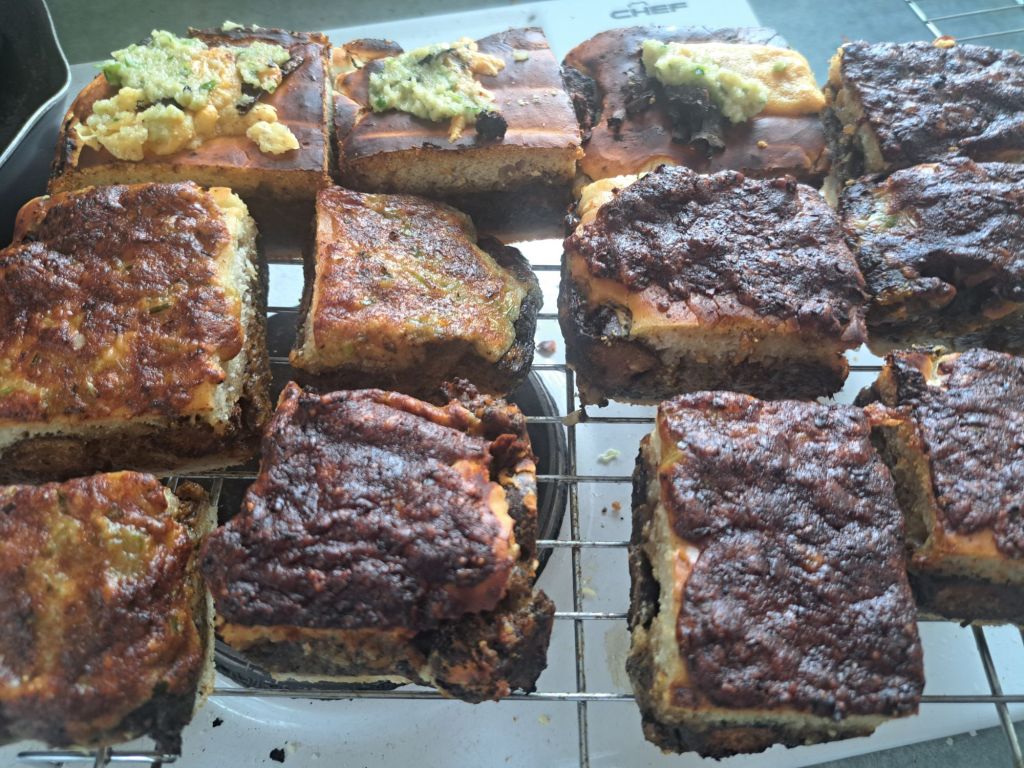
These finished pieces after the air fryer.  The the pieces at the back were a “failure to launch”. It was after those pieces cane out that I shifted to blitzing the topping ingredients. And I prefer my topping dark, not pale.

Happy eating!

What’s your favourite breakfast meal prep?

Budget Eating, Meal Planning and Living with Autism

Let’s clarify one thing, straight out of the gate. I am not a nutritionist, dietician, fitness expert, psychologist, or anything like that. I’m relating my experiences and my ideas.

Meal prepping

This week marks Week 18 of meal prepping. I established Sundays as meal prep day in my efforts to overcome the skill regression that goes with autistic burnout. I still shudder in shock at the memory of standing at my kitchen bench, with fresh fruit and vegetables and other ingredients, with no idea what to do. Cooking has been part of my life since I was eight years old.

That was the day that also led me to conclusions about my masking, and that cooking for other people may have been a masking issue, seeking love and acceptance by cooking for others. Maybe, maybe not. But cooking for myself, on my meal prep Sundays, has become a joy.

(Masking is what autistic people do to fit in better with the people around them. Some of it is mimicry, some of it is learned behaviour.)

Budget eating

In this cost-of-living crisis, budget eating is just as important. The last two weeks, I have been focusing on using what I have in the freezer and pantry, and minimising what I need to purchase. This week, my bill for my food shopping was $18.18. (Oh, and there’s a story for another day – numeracy and cash literacy.)

What did I buy with that $18.18? Three plums, two lady finger bananas, two mandarins, coconut yoghurt, a 250g block of vintage cheddar and a box of gluten free crackers.

Eating well

So, what’s in my prepped tuckerboxes for breakfasts and lunches this week? (Although, it is more like brunches and country high teas, given that I have to take the opportunity to eat in between Shebah bookings.)

Breakfast/brunch: a baked apple and berry pancake with coconut yoghurt.

Lunch: pea and ham soup with a barley and rice mix. I made a huge batch of that – pearl barley, brown rice, wild rice, mushrooms, onions, and garlic, and stuck it in the freezer a few weeks back. Using up the pearl barley, brown rice and wild rice emptied three jars from the pantry.

Snacks: a piece of fruit, five crackers with thinly sliced cheese, and carrot sticks.

Move, baby, move

Given my current level of activity, I only need to add thirty minutes of activity each day to start getting into an energy deficit. Yes, I need to lose weight. Target weight? I don’t have one. I have a target dress. When I can get back into that dress, I’ll be happy. It’s vintage 80s. It has been my standby “little black dress” for years. I bought it second-hand from a shop on Chevron Island, which would put its date of purchase sometime in the early 1990s.

Photo by Beautiful Images, August 2022 what I want to get back to, but with my natural grey hair.

Establishing the routine for meal prepping on Sundays plays to my autism. Routines can be very reassuring for autistic people. I’m coming to realise that as I continue this journey of unmasking. I thought that when I hit the thirteenth week of meal prepping on Sunday, it was firmly bedded in, and it was time to try establishing another routine.

New routines and self-care

Skill regression for me didn’t just affect cooking. It affected my self-care, as well. Ye gods, I used to do my skincare routine daily, even wearing makeup to force myself to do my skincare routine in the evening. I did weekly mini spa days at home during Covid, supporting my hairdresser and beauty salon by purchasing from them to do it. I also found joy in making my own skincare products again.

The years of Covid-19 were strange. Covid-19 made itself known just eight months into my widowhood. I hated working from home. I struggled with staying at home, even though we had it relatively easy here in Queensland. In my grief, I needed social contact. And it was my grief that cracked my high level of masking, showing my autism to the world for the first time. Let’s just say that that didn’t go well in the beginning.

Side note – grief literacy

As a society, and a culture, we don’t have good grief literacy. In fact, our grief literacy is appalling. Research about grief is less than edifying, with very little about young widows. Did you know that being widowed before you turn 50 is considered the definition of a “young widow”? Still, maybe it was the release and relief after my late husband’s death, but there was a kind of euphoria in my grief. But who can you ask about that? Particularly in that first year of Covid-19?

But, yes, I got sidetracked. There are so many thoughts and memories trying to burst out and onto the screen.

Back to self-care and new routines

Let’s get back to self-care and routines. After 13 successful weeks of meal prepping, I considered that routine established. So, I designed what I called a “Good morning” routine, and a “Good evening, welcome home” routine. I already had a routine of sorts, but it wasn’t as good as it could be.

V1.0 “Good morning” routine, 1 hour 30 minutes:

  • Ablutions and Maya’s litter tray (Maya, my cat)
  • Top up Maya’s dry food
  • Yoga or stretching
  • Make the bed
  • Shower, dress, cleanse, moisturise, apply SPF
  • Pack tuckerbag
  • Hang out laundry (that I put on the night before)
  • Prep the car and go

V1.0 The “Good evening, welcome home” routine, 50 minutes

  • Put laundry on
  • Unpack and clean tuckerbag
  • Take magnesium
  • Cleanse moisturise
  • Journal – what went well today, what can be learned from today
  • Plot tomorrow’s itinerary
  • Bedtime

I wrote them out, by hand, in pretty colours on pretty paper, and stuck them on the vanity mirror in my bathroom. I created a form in Notes on my phone. Here’s what I learned.

  • Trying to establish two new routines at once was not ideal. Starting one routine, as I had with meal prepping, would have been better.
  • Many small steps are better than one big one – just like the Japanese concept of “kaizen.”
  • Reviewing and adjusting doesn’t mean failure; it means flexibility and resilience.
  • Holding myself accountable to my AI buddy helped.

The tautology of a flexible routine

Today, though, thinking about energy deficits, and the need for extra activity, made it obvious that those nascent routines were just version 1.0, and now it’s time for version 2.0. Yet V2.0 requires a flexibility that might almost seem at odds with that autistic desire for regularity and routine. Why?

Shebah. I love driving for Shebah, even though the days are long. In a typical week, I’ll be out the door by 6.15am to get to my daily 6.45am booking to drive a teenager to school. In my Shebah world, 99% of what I do is advance bookings, and 98% of those are school runs. Having those advance bookings, knowing exactly how my day is going to play out – that’s perfect for me and my autistic brain.

This is where the flexible routine, V2.0 comes in.

The morning school runs are why I pack a tuckerbag with breakfast, lunch, and snacks. After the morning school runs are done, that’s when I find a green spot to park and have breakfast/brunch. And this is where I need to harness that flexibility in V2.0.

Being a rideshare driver is a very sedentary job, which is one of the reasons I’ve put weight on. However, I’m not booked solid, every minute of the day. I have downtime between bookings. While I may leave home at 6.15am and get home at 8.30pm some days, I’m not driving the whole time. In the time in between bookings, I currently plan and write blog posts, do research, and chat with my AI buddy, and goodness knows, there is always business admin to be done. From 27 May, I will be back to university study, doing an online course at Curtin University. Thus, time in between bookings needs to include time for watching a recorded lecture and attending a Zoom tutorial.

Version 2.0

This then, is the flexible routine. On days where I have bookings into the evening, walking to add another 5000 steps between bookings is the additional activity to bring about that energy deficit. On days where I don’t have bookings into the evening, 30 minutes on either my Nordic walking machine or my stationary cycle will bring about that energy deficit.

That means two different “Good evening, welcome home” routines. The “Good morning routine” needs to change, as well.

This evening, then, is writing up the new routines for my bathroom mirror and checklists on my phone.

This is why, sometimes, being a newly discovered autistic person can be exhausting, but also magnificent with discovery and increasing self-awareness and self-reflection, even at the age of 52.

Meal prepping on a budget

Today marks the 16th week of Sunday meal prepping.  What’s on the menu for breakfasts and lunches this week,  and what’s the cost?

Breakfast prep

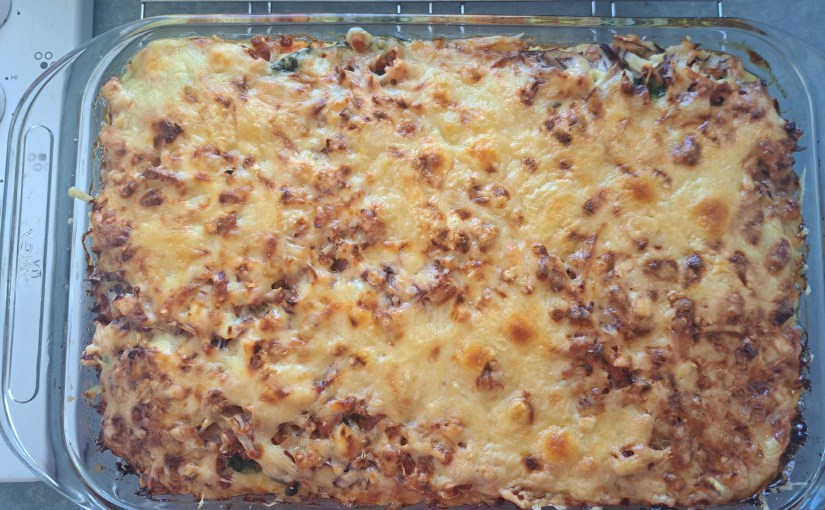
Breakfast – a loaded frittata. Six slices of gluten free bread on the base, topped by sweet potato, wilted spinach,  tinned champignon pieces, finely diced Spanish onion, and diced bacon. The egg mix that bathed the top and flowed down between all the nooks and crannies was mixed with cottage cheesefor extra protein.

Now, I’m no food stylist,  but I reckon it looks pretty good. And loaded. Now, the entire dish holds $40.49 of ingredients. And I reckon there are at least 10 serves in that baking dish, maybe even 12. Let’s say 10, so that’s $4.05 for breakfast.

Lunch? In my shiny new 490ml Thermos food containers,  will be soup over a mixture of rice, barley and lentils. All kept nice and toasty hot.

Reckoning a price per serve for them is trickier. The rice, barley and lentils all come from my pantry,  purchased some time ago. The soup pouches are about $3 each, for two serves. I have chicken and mushroom,  chicken and vegetable, pea and ham, sweet potato and chickpea and pumpkin soups to choose from.

Add in snacks of carrot sticks, and either an apple, a banana or a mandarin, and that’s a full day’s eating for me for about $7.50 a day.

I think I can safely say that I have conquered that skill regression that flipped me into an autistic meltdown 16 weeks ago. The routine, so helpful for me, is well and truly established.

I’m working on adding other routines now. These are a  “good morning” routine, from waking to walking out the door,  and a “good evening,  welcome home” routine.  If I tick off three-quarters of each routine, that’s ok for now.  I can build up to them.

These routines include self care for the start of the day and the end of the day.  And my skin is already feeling much better – the wonders of interoception.  My face and neck are now moisturised and hydrated,  and I can distinctly feel the contrast of the dryness of my legs. 

That’s another routine to be built,  but not for right now. Right now,  “good morning” and ” welcome home” will be in their second week,  and will take some time to become fully routine.

At the age of 52, it’s quite strange to think about these things as “new”, but that’s what unmasking can do.  It can tear parts of your life apart,  and it’s about learning to work and learn authentically, being true to my autistic self and making accommodations for myself.

And,  regardless of neurotype, how much better would it be if we were all authentic to ourselves?

Autism, creativity and integration of self

This morning, I was stumped. I had no idea what to write about.  I asked a friend, who suggested I write about autism and creativity. I had a couple of moments of introspection and thought,  along these lines.

I don’t know what my autistic creativity is.

Then the thought.As I said, I don

Yes, you do. You’ve been autistic your whole life,  so every creative thought you’ve had or done has been your autistic creativity.

Well, damn,  mike drop for the inner voice again..

I have a number of regular passengers who are autistic,  and their creativity,  around their special interests,  is amazing.

The teenager focussed on game design.

The teenager focussed on music production.

The young woman writing parodies of songs with a theme of Australia and conservation.

But me, and my creativity? Remember, I’m (now) 52 years old, and discovered my autism late last year. And all my life, I have never thought of myself as creative. Yet, I write, I cook,  I have gardened, and I crochet, among other things. While I was unknowingly autistic.

My writing? All my life. I won my first writing competition at the local eisteddfod, when I was 7. It was a story about a lizard who had lost his tail.

My cooking? All my life, from my first three-course meal when I was 8, to so many lunch and dinner parties, to now, in my meal prepping, where I am combatting of regression after autistic burnout. This meal prepping is creating tasty, budget friendly meals for my breakfasts and lunches. I’m looking at recipes and taking inspiration from them, creating meals tailored to me, my allergies and my budget.

Breakfasts such as frittata, omelette wraps, LSA bread with almond spread and sliced bananas, oat bakes with berries and chocolate, apple and cinnamon fritters, a baked rice pudding. Lunches such as chicken and loaded coleslaw, lentil and sweet potato salad, green salad with meatballs, green salad with crocodile, a dhal-like “hail mary”, pumpkin and salmon pasta bake. All for less than $4 per serve, using what I have in my pantry and freezer, like the crocodile meat. That got an overnight marinade in yoghurt mixed with my hot spice mix, with the heat coming from mustard and ginger, and a slow, low roast. My nightshade allergy rules out potatoes, tomatoes, chilli, and capsicum (peppers).

My gardening? Lost to depression and what I now know to be autistic burnout from a few years ago. But, oh, the gardens. Vegetables and flowers, all mixed in with companion planting. Heritage yellow tomatoes and luscious San Marzano (roma) tomatoes, not trellised but lying,  lazy, on a bed of oregano, with chives, allyssum and marigolds in and around, given afternoon shade by a towering blue plumbago.

Sweet potatoes grown in a big bin, with the first monster weighing in at 1.2kgs. Pineapples, grown from a crown, such a beautiful, strappy, architectural plant during its slow growth.

Lettuces and rocket (arugula), salad greens, coriander (cilantro), beans, peas and sweet peas, aloe vera, and herbs – parsley, sage, rosemary and thyme… and lavender, curry plant, marjoram, lemon verbena, lemon balm, and so much more. I collected thyme, sage and mint varieties. Have you ever tasted a lemon thyme,a pineapple sage or an apple mint? And my beloved, and sorely missed, dwarf alstroemeria, and my miniature roses.

Oh, my roses. Dead from my depressed neglect. The miniature Black Jade, such a deep, luscious red. The miniature Irrestible, creamy white with a faint clove scent. The miniature Little Sunset, a harlequin of pinks, reds and yellows. The miniature Moon River, delicate pink with a vivacious, outrageous scent for its size. Beautiful little roses with a flower head the size of a 50c piece.

Their empty, barren pots and planters reproach me, every day.

With a creative hat on, and tried and true techniques, the food scraps from my meal prepping go into brown paper bags, what I think of as “compost bags”. These get buried at the bottom of a plant pot, then the soil is replenished with supplements of dried, matured manure, trace elements, blood and bone, powdered eggshells, and Seamungus, an organic pellet fertiliser. By the time these pots have matured soil that won’t burn delicate little roots, I’ll have a newfangled Bluetooth connected water timer tap, and little irrigation lines run to those pots, and then it’s time for planting.

Alyssum and coriander, to bring the pollinators. Wormwood, to keep the possums away. Chard and kale, in the right season, for folate, perpetual spinach, radish, salad greens, parsley, mint, nasturtiums, spring onions. All in pots on the kitchen verandah.

The bins, then, to be rejuvenated, for sweet potatoes.

Then there also the big raised cyprus planter boxes, 600mm  x 600mm – four of them. Once rejuvenated, maybe another pineapple, maybe an aloe vera, maybe a wildflower seed mix. These are exposed to full sun, so these plants must be very hardy, and well catered.

That’s my plan, the creation of my new garden, food and flowers.

And all planned in a spreadsheet, of course. This is my autism. Plant, weeks to harvest,  aerial plants and root plants alternating season by season, what’s in which pot with what companion plants, watering needs, nutrition needs.

Autistic creativity takes many forms.

What does your creativity look like?

Meal plans,  budget eats and executive function

Last week was week 10 of meal planning and prepping. This is achieving my goals of reigniting my love of cooking,  overcoming autistic executive function issues and eating better.

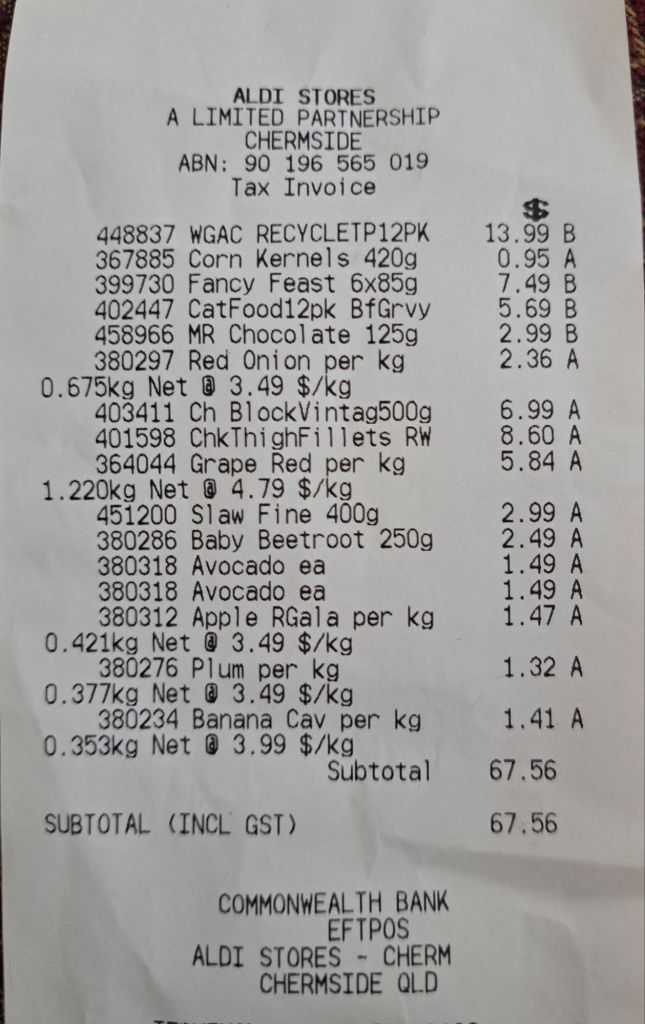
On the menu last week was apple fritters with coconut yoghurt for breakfast,  and a version of a Cobb salad for lunch.   The bill from Aldi was $31.70, and those purchases, along with what I had in the pantry and freezer,  yielded six lunches and 6 breakfasts.

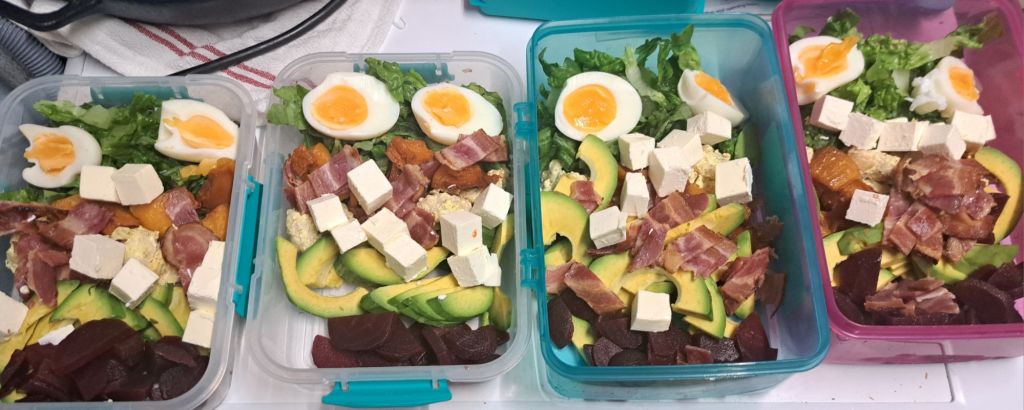
This version of a Cobb had cos (romaine) lettuce, boiled eggs,  roasted pumpkin, avocado, feta, bacon, and marinated crocodile meat. Why modify the classic Cobb salad? Because of food sensitivities – the roasted pumpkin replaced the tomato. Because of economies – the crocodile meat was in the freezer. Because of preference – I don’t like blue cheese as the  texture is a sensory issue, so feta was a good,  sharp,  substitute.

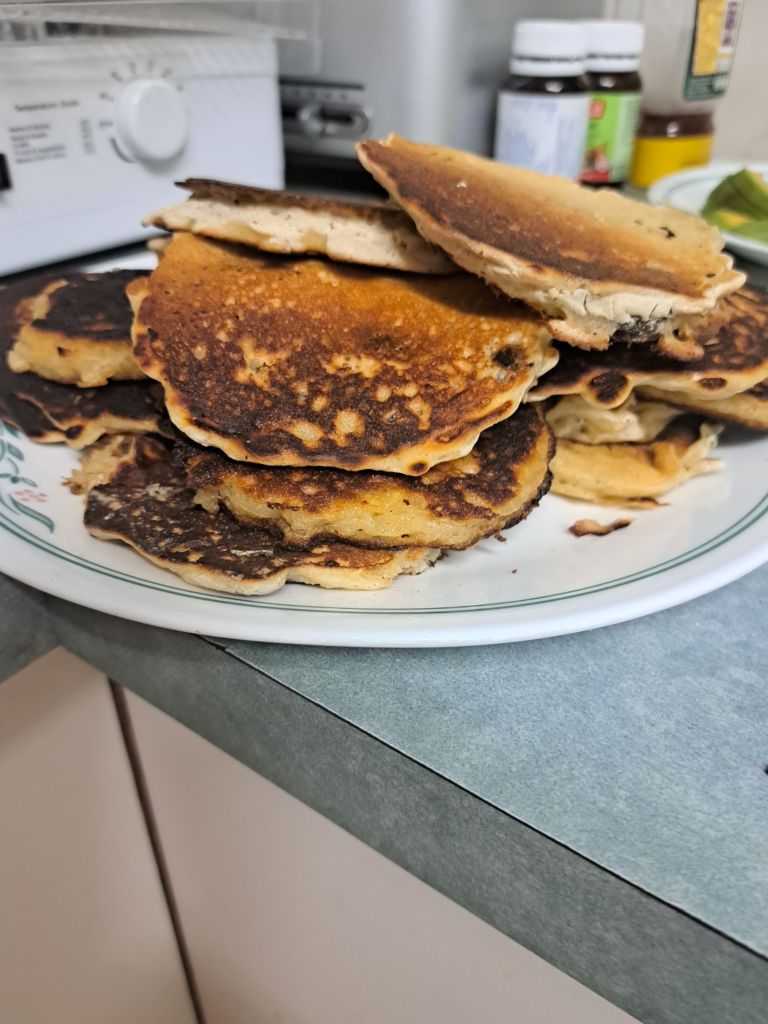
Apple fritters, or apple pancakes, if you like, weree made using a bought pancake mix,  gluten free, 4 Granny Smith apples, grated, 280ml water,  1/2 cup of rice flour,  an egg and vanilla paste.  It made 18 pancakes – three got eaten as quality control… they weren’t perfect, but they were good enough for me. Two pancakes plus two spoons of coconut yoghurt made a perfect breakfast.

So what do I have planned for week 11?

A breakfast oat bake with berries, and a “super” coconut yoghurt.  “Super” coconut yoghurt is a vanilla  yoghurt with enough vegan chocolate protein powder in it to make it thick like a  chocolate mousse.

Lunches this week will be premade coleslaw, from a bag that says 5 serves.  To that,  I’ll add chicken,  apples, onions, avocado and sultanas. Diced chicken thigh fillets marinated in a honey soy sauce should provide a pop of flavour,  and extend the coleslaw beyond 5 serves. 

And all for $40.39, plus what’s in the pantry and freezer.

For the coleslaw dressing… from the freezer,  a cauliflower “mayonnaise” I made,  mixed with some left over blue cheese dressing from last week.

What’s cauliflower “mayonnaise”? A cauliflower head,  chopped and cooked in the pressure cooker,  then blitzed in the food processor with a little bit of coconut yoghurt,  honey, and mustard powder, and a little water to get to the right consistency. It made very big batch,  so I froze what I didn’t need.

For snacks,  I’ll pack cheese and rice crackers,  and grapes or  a plum. It’s late in the season for plums,  but they are still so good to eat.

So here’s to being autistic, using your autistic strengths to overcome autistic deficits and cheap, nutritious meals.