Veni, Vidi… Defici” (It came, it saw… it faltered)
Tropical cyclones. If you’ve been through one, the next one will still surprise you.
One of the good things that mother did was not to pass on her fear of storms to me. I am grateful for that, because I do love a good storm. But tropical cyclones? Yes, I even have nostalgia about them.
How, you say. How could anyone have misty-eyed nostalgia about tropical cyclones?
Like this. In the 1970s, we didn’t have a TV. We had radio. And radio is where I heard the crisp-toned voices of emergency broadcasts on the ABC, and that emergency cyclone warning I saw as a loaded spring, like a slinky. (I didn’t know I was autistic then, but, hello, synaesthesia.)
I was fascinated by the places that were always mentioned. Home Hill, Clairview, Double Island Point, St Lawrence. Mother, or father, as I can’t recall who started it, would pull out the big fold-up map of Queensland and we would trace the cyclones on the nap by the radio calls.
That’s how I learned Queensland’s shape, coastline, towns and inland regions. Tracing a child’s finger over those place names and imagining, wondering.
My “close calls” with cyclones, a little too close to home, was TC Cliff in 1981 (when I was 8 years old) and TC Nancy in 1990, when I was 18 years old.
Cliff went for Bundaberg, but its effects were felt in Maryborough and much further south than that, all the way to the Gold Coast, with beach erosion. I remember my parents, taping windows, and talking about the protection that K’gari (the Fraser Island) offered, a big buffer against storms. But, they said, what if one comes down the middle, between Fraser and the mainland. “Down the guts” is how I remember father saying it.
As an adult, I still know the names of those places, heard on old radio sets in the 1970s. And I’ve made a point of visiting them. A curious thing, but it meant something to me. Seeing the places that had only existed for me, before, on maps and in cyclone warnings.
So, yes, I have some nostalgia about cyclones, but also a healthy respect.
So when Alfred came along, I was not at all blasé. Most track maps had it crossing the coast some 8kms north of me as a Cat 2. Just like Cliff. Just like Nancy. So I filled water bottles, brought everything inside, prepped my important documents and, with my housemate taped 100m² of glass.
Alfred, Alfred, Alfred. You came too far south and Moreton Island broke you.
But what if, one day, due to global warming, our ocean waters off south-east Queensland get to 28°C? Warm enough to sustain a Cat 2, a Cat 3, or God forbid, a Cat 5? I’ll joke now about the Toowoomba Surf Life Saving Club, and hope it remains a joke.
So, enough of my maudlin meanderings. Here is ChatGPT’s interpretation of my other ramblings about ex-TC Alfred.
Understanding Cyclone Alfred: A Near Miss and the Role of Outer Pressure Bands
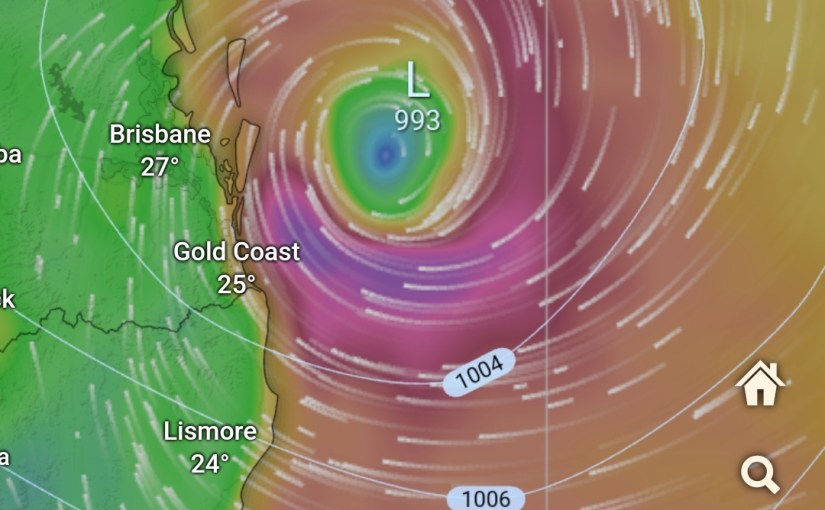
Cyclone Alfred may not have made landfall, but that doesn’t mean it wasn’t a legitimate cyclone. In fact, Alfred’s path and effects highlight an important but often misunderstood aspect of tropical cyclones: the significance of outer pressure bands. With many people trying to grasp the event, it’s crucial to clarify the nature of Alfred’s journey, why it was a fully developed storm, and the role these outer bands play in its reach and impact.
Cyclones don’t need to make landfall to be powerful or to have significant effects. Alfred was a case in point. While it didn’t directly strike Southeast Queensland, it was still a force to be reckoned with, and its outer bands caused considerable disruption in coastal regions. But what exactly do we mean when we talk about the outer pressure bands, and how do they differ from the eye of a cyclone?
—
A Legitimate Cyclone: The Journey of Alfred
Alfred wasn’t a ‘wannabe’ cyclone. It started its life in the Coral Sea and, at its peak, strengthened to a powerful Category 4 system, driven by the warm ocean waters that act as a nursery for tropical cyclones. These waters provide the energy a cyclone needs, following fundamental principles of thermodynamics—where heat from the ocean fuels rising air currents, lowering surface pressure and creating a self-sustaining system of spiraling winds.
As it tracked southward, high-pressure systems to the east and south forced it westward, a classic example of how weather is a continuous process of high-pressure areas moving toward low-pressure areas in an attempt to reach equilibrium. This constant balancing act of atmospheric forces shapes global weather patterns, and tropical cyclones are one of the most dramatic examples of this principle in action.
As Alfred neared Southeast Queensland, it slowed significantly to just 7 km/h, which isn’t typical for a tropical cyclone but may be more characteristic of a system transitioning into temperate waters. However, due to climate change, these waters were warmer than historical averages, which may have influenced its unusual slowing. Cyclones in temperate zones often move more slowly due to weaker steering currents, but Alfred’s behaviour may indicate a shifting pattern as ocean temperatures continue to rise.
—
Outer Pressure Bands: The Real Impact of Alfred
While the eye of a cyclone is often the most dramatic and dangerous part of a storm, it’s not the only area that affects land. In fact, the outer pressure bands—sometimes stretching hundreds of kilometers from the cyclone’s center—often have the most widespread impact, even when a cyclone doesn’t make direct landfall.
These outer bands are large swathes of rain and wind that spiral outward from the cyclone’s core, extending far beyond the calm eye. As the system moves, the rotation of these bands can bring heavy rain, strong winds, and even tornado-like conditions to areas far from the storm’s center.
In Alfred’s case, these outer bands were responsible for most of the disruption across Southeast Queensland and Northern NSW:
Lismore and the Northern Rivers, the Gold Coast, and Redland Bay all felt the impact of Alfred’s outer bands as the storm ran parallel to the coast.
On the eastern part of the rotation, these same bands later brought horizontal rain to northern Brisbane—two days after Alfred had weakened.
People often assume that if a cyclone doesn’t make landfall, it isn’t a real threat. But Alfred’s impact came from its outer bands, not its eye. This is typical cyclone behaviour—many cyclones run alongside the coast rather than striking directly, and their effects are felt across a much wider area than just their central path.
—
The Cyclone Eye vs. Outer Bands: What’s the Difference?
The eye of a cyclone, with its eerie calm, is the most recognizable feature of a storm. This is where winds are light, skies clear, and atmospheric pressure is at its lowest. But surrounding the eye is the eyewall, where the storm’s most intense winds and rainfall occur.
Beyond the eyewall lie the outer bands—vast spirals of convective clouds, wind, and rain that extend far beyond the storm’s center. These bands are responsible for:
Heavy rainfall over large areas, sometimes leading to severe flooding.
Strong, gusty winds that can cause damage even far from the cyclone’s core.
Isolated storm cells, which can spin up tornado-like conditions.
The most destructive effects of a cyclone don’t always come from the eye itself. In many cases—Alfred included—it’s the outer bands that do the most damage, especially when they interact with pre-existing weather systems or local geography.
—
Why Cyclones Behave the Way They Do
At their core, cyclones are thermodynamic engines powered by heat and moisture. They need:
Warm ocean water (above 26.5°C) to fuel convection and sustain a low-pressure core.
Moisture-rich air to continue feeding the system.
A lack of wind shear (which would otherwise tear the storm apart).
Alfred followed this pattern perfectly. It strengthened over warm waters in the Coral Sea but weakened when it moved over land—in this case, Moreton Island rather than the mainland. Land disrupts a cyclone’s energy source by cutting off its supply of warm, moisture-laden air, causing it to lose strength.
Alfred’s slowing to 7 km/h was unusual for a tropical cyclone, but given its movement into temperate waters, it may reflect broader shifts in cyclone behaviour. With rising ocean temperatures, cyclones may retain strength further south and move more erratically as they encounter weakened steering forces.
—
Conclusion: Alfred Wasn’t Defective, Just a Near Miss
In conclusion, Cyclone Alfred was a fully developed and legitimate cyclone—not a defective system or a storm that “failed” to make landfall. It was a Category 4 storm at peak strength, shifted westward by high-pressure systems, and slowed dramatically in temperate waters that were warmer than historical averages due to climate change.
The real story of Alfred wasn’t about a direct impact, but about the outer pressure bands, which:
Drenched Southeast Queensland and Northern NSW with heavy rain and winds.
Brought horizontal rain to Brisbane days later as the outer bands swung around.
Followed a common cyclone path—running parallel to the coast before losing strength.
Alfred’s near miss serves as a reminder that cyclones don’t have to make landfall to leave a lasting impact. Their power comes not just from their eye, but from the outer bands that stretch far and wide, influencing weather systems across entire regions.
By understanding the thermodynamics, pressure dynamics, and behaviour of outer bands, we gain a deeper appreciation for how storms like Alfred operate—and why no cyclone should ever be underestimated.
As always, here is a link to the full chat I had with ChatGPT about this blog post.
And what did BoM have to say about TC Alfred? This is an extract from the Tropical Climate Update, 11/03/2025.
Severe Tropical Cyclone (TC) Alfred impacts Queensland and north-eastern New South Wales
Severe Tropical Cyclone (TC) Alfred (22U) formed in the Coral Sea off the Queensland coast on 20 February. Tropical Low 22U reached TC status on 23 February and its intensity peaked at Category 4 (a Severe Tropical Cyclone) on 27 February as it tracked southwards. On 4 March, TC Alfred turned westward, and over the days that followed, tracked slowly as a Category 2 system towards Queensland’s south-eastern coast. TC Alfred stalled in its movement just off the coast from Bribie Island early on the 8th then weakened to a tropical low and crossed the Australian mainland coast, north of Brisbane, at 9 pm local time.
Very heavy rain and flooding has impacted south-eastern Queensland and the Northern Rivers region of New South Wales as TC Alfred approached the coast (from 6 March). Seven-day totals to 9 am on 10 March of more than 200 mm were recorded across much of south-eastern Queensland and north-eastern New South Wales, with some regions south of Brisbane recording totals of over 400 mm. Three sites in the Gold Coast Hinterland exceeded 7-day totals of 1,000 mm to 9 am on 10 March. Some sites across New South Wales’ Northern Rivers and bordering south-eastern Queensland recorded 4 consecutive days of rainfall above 100 mm.
Daily annual and March rainfall records were set at a number of sites across south-eastern Queensland and north-eastern New South Wales, including Brisbane, which recorded 275.2 mm to 9 am on 10 March, both an annual record for the site (26 years of data) and its highest daily rainfall total since January 1974. K’gari Eurong (43 years of data) recorded 427.3 mm to 9 am on 9 March, breaking the previous annual record of 301.0 mm on 22 February 1976. Hervey Bay Airport, with 27 years of data, set a March and annual record of 261.4 mm to 9 am on 9 March, close to triple its previous March record of 94.8 mm.
Sustained, strong winds impacted coastal areas as TC Alfred moved towards Queensland’s south-eastern coast. Many locations recorded wind gusts of more than 100 km/h, with sustained winds causing damage across parts of south-eastern Queensland and north-east New South Wales. Byron Bay (Cape Byron AWS), which has 22 years of data, set a highest wind gust record of 120 km/h on 7 March.
Many rivers across south-eastern Queensland and north-eastern New South Wales peaked at major flood levels during the passage of TC Alfred. As of 11 March, most river levels are dropping. Flooding is forecast to gradually ease in these river basins as rainfall associated with ex-TC Alfred eases. For more information, visit the Bureau’s National Warnings Summary.
As of 11 March, there have been 8 tropical cyclones in the Australian region during the 2024–25 season. Recent post-event analysis has shown that 09U sustained Category 1 intensity for long enough on 10 January 2025 to be re-classified as a tropical cyclone. 6 of the 8 tropical cyclones have reached Severe intensity (Category 3 or higher).
 The Auld Skald's Fudgel