Oh, the autistic trepidation about “new”; in this case, the trepidation of finding a new health care provider. Understanding my autism means I understand better why seeing a new practitioner seeds nervousness.
Osteopath, physiotherapist or chiropractor?
All my life, I’ve chosen alternative health care providers; naturopaths, herbalists, massage therapists, and Reiki. I’ve studied Western herbal medicine, massage, aromatherapy, and had a (somewhat disastrous) Reiki attunement to Level 2 – that’s a story for another day.
Once I was making decisions for myself, leaving childhood behind, chiropractors quite literally had my back. One, whom I saw for several years, even even commented on my “loose-limbed” walk; possibly the first identification of hypermobility, all the way back in the early 1990s.
It was in the mid 2000s when I moved away from chiropractors, going to osteopaths instead.
What’s the difference? And why not physiotherapists?
Physiotherapists generally treat and rehabilitate injuries.
Chiropractors generally focus on the spine, the protector of the central nervous system.
Osteopaths generally focus on whole of body, prevention and rehabilitation.
These days, knowing about my autism and the associated hypermobility means that I need a whole of body focus. Hence, finding a new osteopath.
But why did I need to find a new osteopath? That’s also a story for another day.
Empathy in practitioners
The first new osteopath seemed okay, but he didn’t look any further into what hypermobility meant in terms of injury treatment. He also said, “Freak”. He didn’t say it in an unkind way or context. He was asking how my hypermobility manifested. I mentioned my knees, my feet, and my hands as my known hypermobility, and showed him my hand spread, the hypermobility that let me span an octave in a piano when I was nine years old. His smiling response – “Freak”. Choice of words in a health care setting should be carefully considered.
I continued with the appointment, and we resolved the immediate issue in my lower back, but he wasn’t a keeper.
I got to thinking. While I couldn’t find my old osteopath, his clinic was still there, they still had my patient records, and he had hired/ placed the other osteopaths there. So, I made an appointment at the old osteopath’s clinic.
This new-to-me osteopath, Alison, is a keeper. So, back to the clinic at New Farm, with an osteopath who has experience with autistic and hypermobile patients.
Why did I need to see an osteopath?
Firstly, discovering my autism has been a blessing; discovering the associated hypermobility has been a curse.
It is thought that 60-70% of autistic people also have hypermobility, and like autism, hypermobility is different in every person. For me, my knees bend backwards, my fingers bend backwards and the top joints of my fingers can lock. My hands, that take an “S” sized glove, can span 20cms from thumb to little finger. That’s my known hypermobility.
Intersect that with a deep dive into autistic hypermobility, and being aware that I’m 52, and wanting to improve mobility, flexibility, agility, and strength as I age. I started a program of daily workout routines, and knowing that I had an exaggerated curve in my lower back, that was one area of was focussing on. I was also focussing on reducing the chronic tension in my body.
I was ecstatic when I went from being able to fit my fist between my lower back and the wall, to only being able to fit my flat palm with a slight tilt between my back and the wall. My everyday motion was freeing up, and walking felt good. I was progressing reps and weights in my daily workouts, and six weeks, I was really feeling good.
One night, I went to sleep, in my typical autistic side sleeper posture. I woke up, sprawled in what I now know is a hypermobile sprawl, and a very cranky lower back. Old friends L4 and L5 were very unhappy. My entire lower back from ribs to tailbone had locked up and I was in pain.
I did some stretching and movements, and that got the pain manageable. Heat, magnesium cream, and specific rest postures helped. But I needed more help than that.
Hence, the search for a new osteopath.
The inception of a new autistic special interest
Hence, the search for information about why, and the subsequent deep dive into hypermobility.
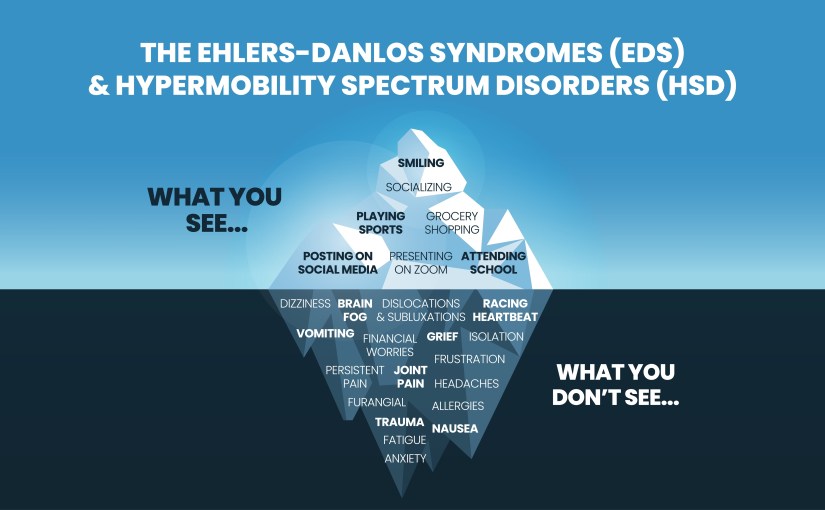
Hypermobility is a disorder of connective tissues. Some would consider connective tissues to be ligaments and tendons; they are that, and so much more.
Connective tissue is cartilage, bones, fibres such as collagen and elastin, adipose tissue (yes, fat), blood and fibroblasts, the cells that activate for tissue healing and wound repair.
So hypermobility is not just a disorder of ligaments and tendons. It has the potential to affect the whole body.
I know a lady with Ehlers-Danlos Syndrome (hEDS). For her, it caused devastation, with nine miscarriages for two live births.
People with hEDS generally have the super flexy, bendy bodies. An ignorant massage therapist can inadvertantly dislocate a shoulder during a massage. For my friend, it meant the disorder of the connective tissues presented in her uterus, with devastating consequences.
So it makes me wonder, just how much the undisguised hypermobility has impacted my life. It makes me wonder what the links are between hypermobility and hormones, postural orthostatic tachycardia syndrome (POTS), adrenal fatigue, and mast cell activation syndrome (MCAS)? Is there a link to estrogen dominance and fibroids? And is there really a difference between Hypermobility Spectrum Disorder and Ehlers Danos Syndrome?
There is so much more to be discovered. Stay tuned.
 The Auld Skald's Fudgel