Today, we’re looking at the concept of the autism spectrum. Why is this important? Perhaps because some experts think that the actual number of autistic may be as high as 4 in 100. One in 25. That’s one in every classroom, every every office, every workplace. Except that we know that autism and paid employment don’t necessarily go hand in hand. (I posted about this issue in “Autism in the workplace“.)
The autism spectrum
Autism isn’t a straight line on a Cartesian plane with negative values to the left of centre and positive values to the right of centre to indicate “low functioning” and “high functioning”.
The autism colour wheel spectrum
Autism is much more nuanced than that, and is better represented by the autism wheel, such as the one below. There are several versions of the colour wheel, and this one, from IDR Labs, works better for me.
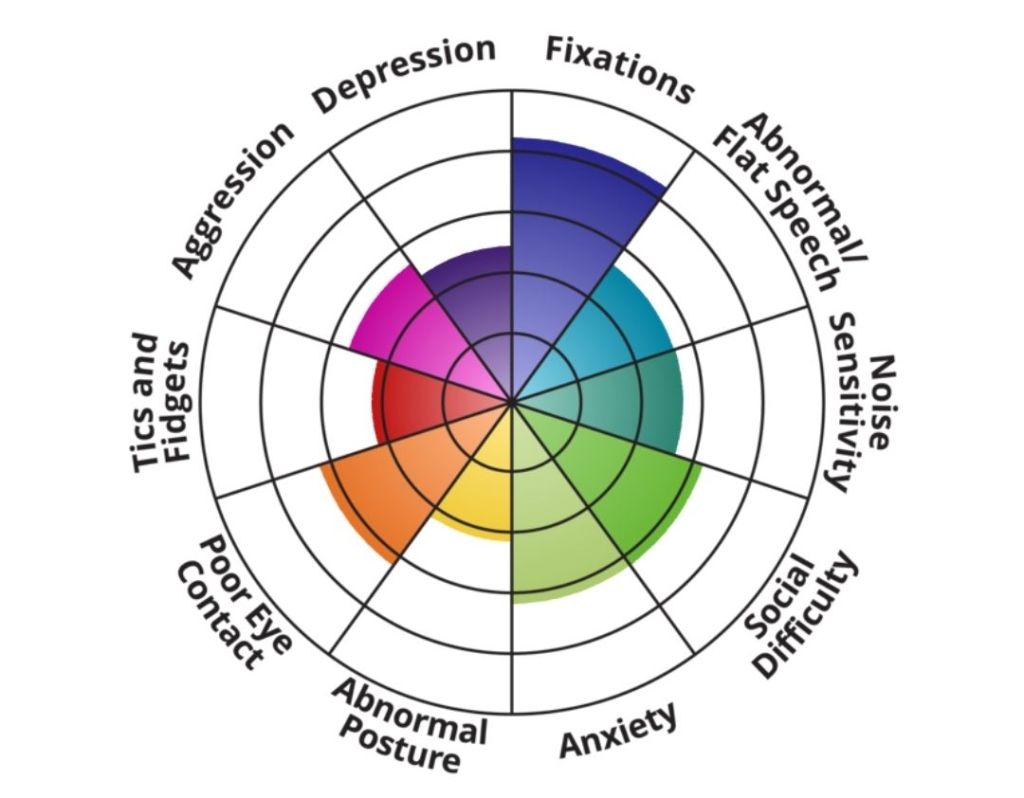
In this wheel spectrum, each of the 10 sectors explores the common traits and issues of autism.
My results
This wheel, from IDR Labs is a result of responses to 50 questions, using a Likert scale. For me, this, like all questionnaires, frustrates me, but I persevered so I would have this example for you. I’ll come back to the frustration later.
This spectrum colour wheel shows that special interests, fixations, are the most obvious signs of my autism. (Even though I have an issue with the gender bias here, because the male presentation of autism usually includes fixations, while the female presentation can include several special interests that rise and fall over a lifetime.)
What it doesn’t show are specific traits, and maybe this is because most online tests are predicated towards deficit, even a test for the spectrum wheel, which is supposed to promote inclusivity.
Blunt force, not finesse
This colour wheel doesn’t illustrate the range from dyslexia to hyperlexia, from disempathy to hyperempathy, from dyscalculia to hypercalculia. As a result, it misses the exceptionality that is present in every autistic person, from Level 3 support needs to Level 1 support needs.
Take, for instance, a young autistic woman with Level 3 support needs, who writes brilliant and incisive parodies of songs. Take, for instance, the young autistic woman with Level 2 support needs who is a music producer with tracks that have gone viral.
The frustration with this tool
The source of frustration? I’m 52 years old now, with a lifetime of masking. I never know if the question is about when I’m masked or unmasked, and if it’s unmasked, we have a problem, because I can’t remember everything from 40 or 50 years ago, before I learned to mask for social acceptance.
The questions don’t allow for nuance of consent. For instance, loud noise that I want is fine, such as particularly good music, or going to a movie that I know will have explosions in it. My issue with noise is when it’s not mine, not of my control. Walking out of the cinema into a wall of sound from the arcade games venue, unexpected, can trigger a flight response and a meltdown. But if I know about the arcade games noise in advance, from past experience, I can prepare myself for it.
And yet…
Nonetheless, the spectrum colour wheel showcases the range of potential AND deficit for individuals with autism.
This diversity highlights the importance of personalized approaches to education, employment, and daily life.
The beauty of the autism spectrum wheel lies in its recognition of the diversity within autism. It recognizes that everyone, regardless of where they fall on the spectrum wheel, has unique gifts to offer.
By embracing this diversity, we create a more inclusive and understanding society.
Ultimately, despite its failings, the autism spectrum wheel encourages us to see beyond labels and stereotypes. It invites us to appreciate the full spectrum of human experiences and to create a world where everyone is valued for who they are.
So, the next time you hear about the autism spectrum, remember the colourful wheel that represents the diversity, strengths, and unique journeys of individuals on the spectrum. It’s a wheel of understanding, acceptance, and celebration.
 The Auld Skald's Fudgel